


How the Gyroscope project was hacked: a detailed breakdown of the attack and fund flows
Attackers seized $807,000 in assets and refused to return the funds despite being offered a 33% bounty.

06.02.2026
331
4 min
0
On January 30, 2026, the Gyroscope team announced on X that it had temporarily suspended its liquidity pools due to an issue in its cross-chain contract—a mechanism used to transfer assets between different blockchains. As a result of this vulnerability, 6 million Gyro Dollar (GYD) tokens were affected, with the attacker managing to extract liquidity worth approximately $807,000. GetBlock AML Research provides a detailed breakdown of the attack and the movement of the stolen funds.
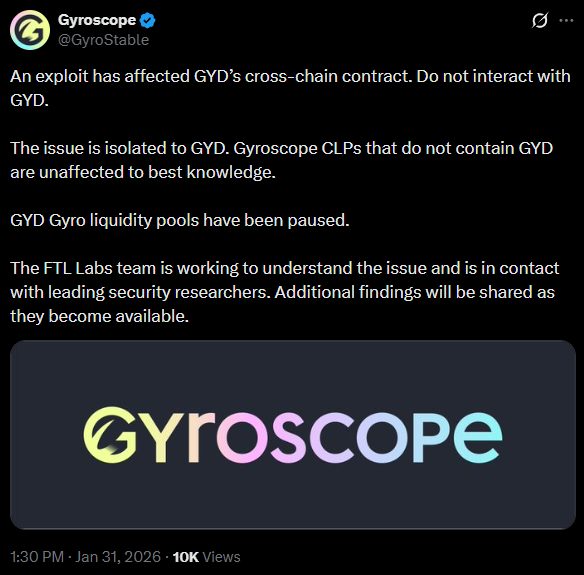
The root cause of the incident was an error related to improper input validation in Gyroscope’s bridge contract. This flaw allowed the attacker to grant themselves so-called “unlimited approval” to spend GYD tokens on Ethereum. With this approval in place, the attacker used a standard function that allows transfers on behalf of another contract and drained 6 million GYD tokens.
Following the incident, the Gyroscope team offered the attacker a bounty equal to 33% of the stolen funds in exchange for their voluntary return. This offer was more than three times higher than the industry norm, which typically sits around 10%.
Attack Timeline
| Attacker address: |
| 0x7DD4075A6eAe9f18309F112364f0394C2DfA8102 |
Step-by-step sequence of events
| Transaction from January 30, 2026, 20:07:51 |
| 0x51c22898a9b9f519a10b0a0be89b9d51c0248adb80cc0f89e57437e15e6c60c7 |
The attacker bridged the minimum possible amount—1 wei of GYD (an extremely small fraction of a token)—from the Arbitrum network to Ethereum. As the recipient, they specified not a regular user address, but the GYD token contract itself, while simultaneously passing specially crafted data to be executed.
| Transaction from January 30, 2026, 20:27:59 |
| 0x45739a92c2d99f172a74d8028736a2fd1b507ac6fc134680cd1dccd3c572c600 |
The 1 wei of GYD was successfully received on Ethereum. At the same time, the attacker obtained unlimited approval to spend GYD tokens. This approval was never revoked.
| Transaction from January 30, 2026, 20:40:59 |
| 0xe03ac744df1910a71fedab58bc6a32ab5afe1cb4fcad94a0e5c8d7edf0d7405c |
Using the granted approval, the attacker withdrew 6,099,337.37 GYD tokens.
Vulnerability Explanation
The core issue stemmed from the bridge contract accepting arbitrary input data when calling the BridgeToken() function from contract 0xCA5. This function accepted four parameters: the destination network, the recipient address, the transfer amount, and additional data to be executed after the cross-chain transfer.
The attacker sent 1 wei of Gyro Dollar not to a user address, but directly to the Gyro Dollar token contract—an essential condition for executing the attack. They also included extra data that would be executed after the cross-chain transfer was completed.
On the receiving side, the transfer finalized as expected. However, within the _ccipReceive() function—responsible for handling incoming messages—the contract checked whether additional data had been provided. If so, it automatically executed the corresponding command. In this case, the supplied data triggered the approve() function on the recipient address. Because the recipient was set to the GYD token contract itself, the attacker effectively granted themselves unlimited control over the tokens.
Had the contract restricted the list of allowed recipient addresses or explicitly prohibited using the token contract’s own address, the attack could have been prevented.
Fund Flows
Although the attacker gained control over more than 6 million Gyro Dollar tokens, they were only able to extract around $807,000 in practice. This was due to limited liquidity available in the pools.
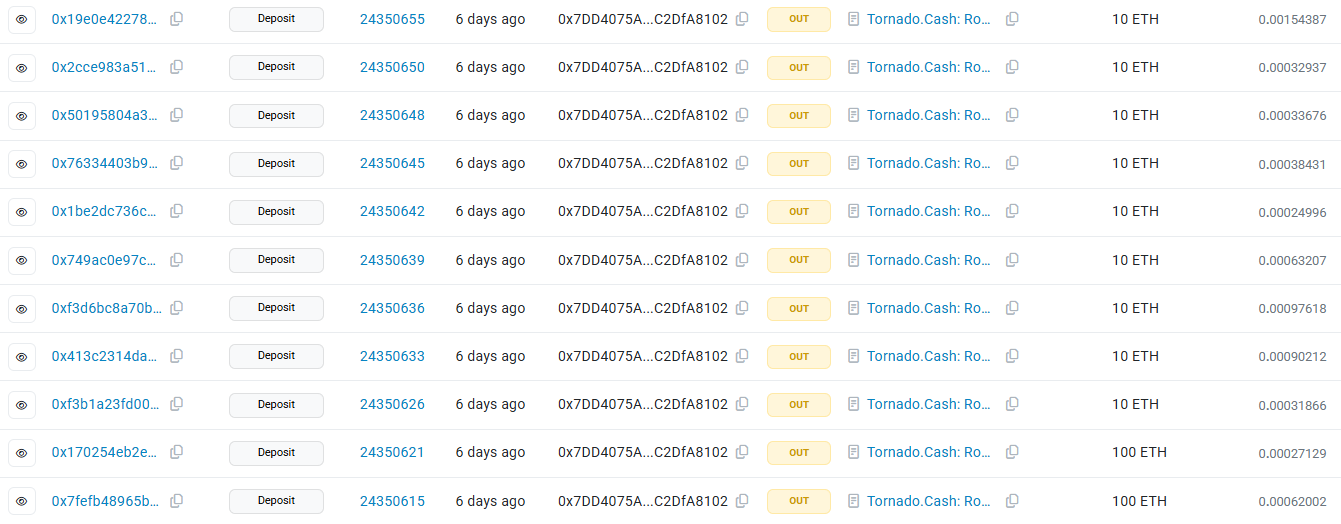
Stolen funds being routed through Tornado Cash.
In total, the attacker transferred 300.2 ETH to Tornado Cash, a service commonly used to obfuscate the origin of funds.

Useful material?
 Telegram
  Twitter
 Research
One and the same cryptocurrency address received two completely opposite assessments from different analytics systems: from an ordinary gambling service to an extremely severe criminal offense. This story has become the starting point for a broader conversation about what the scientific standards of blockchain analysis should look like — and why errors in systems like these can shape the fates of real people.
Jul 1, 2026
Research
The blockchain has helped uncover the ties between cryptocurrency fundraising campaigns, exchangers in Syria, and intermediaries in several countries around the world. A telltale pattern has emerged in which the same addresses were used across multiple donation drives at once
Jun 24, 2026
Research
Four Iranian cryptocurrency exchanges accounted for roughly 78% of all digital asset volume tied to the country in 2025. They have now become the focal point of the largest U.S. sanctions campaign against Iran's cryptocurrency infrastructure.
Jun 5, 2026
Research
A financial system is already up and running on public blockchains, with loans, analogues of U.S. Treasuries, and automated capital markets. More than $551 billion has flowed through DeFi protocols — but most of that activity has nothing to do with the real economy and everything to do with the speculative build-up of risk.
May 29, 2026
Research
Around 97% of Chinese suppliers of chemicals used to make fentanyl accept payment in cryptocurrency. The volume of such transactions continues to grow alongside the global market for synthetic drugs
May 22, 2026
Research
For the first time, the new law makes blockchain analytics an officially mandatory tool of financial oversight in the United States. Authorities will also gain the power to restrict transactions with foreign crypto services tied to money-laundering risks.
May 20, 2026
Cryptocurrency rates
-

Bitcoin
$84 486
BTC
+0.93%
-

Ethereum
$2 690.32
ETH
+0.26%
-

BNB Smart Chain
$769.23
BSC
+0.24%
-

Ripple
$1.42
XRP
+1.04%
-

TRON
$0.33532
TRX
-0.74%
-

Zcash
$1 316.97
ZEC
-7.31%
-

Dogecoin
$0.093836
DOGE
-0.58%
-

Cardano
$0.218269
ADA
+2.11%
-

Stellar XLM
$0.184461
XLM
+2.83%
-

Bitcoin Cash
$307.36
BCH
+0.5%