

Iranians are withdrawing cryptocurrency en masse to personal wallets. Why is this happening?
There has been a sharp surge in activity among Iranian cryptocurrency users amid mass protests in the country and the high probability of a military confrontation with the United States.

16.01.2026
341
6 min
1
Key Takeaways:
- Iran’s cryptocurrency ecosystem exceeded $7.78 billion in 2025, demonstrating faster growth compared to the previous year.
- Cryptocurrency activity in Iran is closely tied to political events and conflicts both inside the country and beyond its borders.
- Activity linked to the Islamic Revolutionary Guard Corps (IRGC) accounted for around 50% of Iran’s entire crypto economy in the fourth quarter of 2025 and has steadily increased its share over time, reflecting the IRGC’s dominant position in the country’s economy as a whole.
- During the recent wave of mass protests, Iranian residents significantly increased bitcoin withdrawals to personal wallets, which may indicate attempts to safeguard their funds amid the collapse of the national currency and ongoing political instability.
Against the backdrop of a weakening Iranian regime under intense pressure both domestically and internationally, cryptocurrency has become an important financial alternative for many Iranians. The authorities are facing large-scale protests, an economic crisis, and the risk of external military intervention. Since 2018, the Iranian rial has lost approximately 90% of its value, with the pace of depreciation accelerating amid escalating regional conflicts. GetBlock AML Research explains the changes taking place within Iran’s cryptocurrency ecosystem.
For ordinary citizens living with inflation of 40–50% and a constant erosion of purchasing power, cryptocurrency has become not only a way to bypass sanctions-related restrictions, but also an opportunity to exit a system that is no longer functioning and is under strict state control. It is important to note that digital assets have attracted not only ordinary Iranians. The Islamic Revolutionary Guard Corps also actively uses cryptocurrencies to finance its activities both within Iran and through a network of affiliated structures across the Middle East.
Blockchain as an Indicator of Instability: User Behavior in Times of Crisis
Iran’s cryptocurrency ecosystem surpassed $7.78 billion in 2025 and grew significantly faster than the year before. As shown by data and previous research, activity involving digital assets in the country spikes sharply during periods of major domestic and international events.
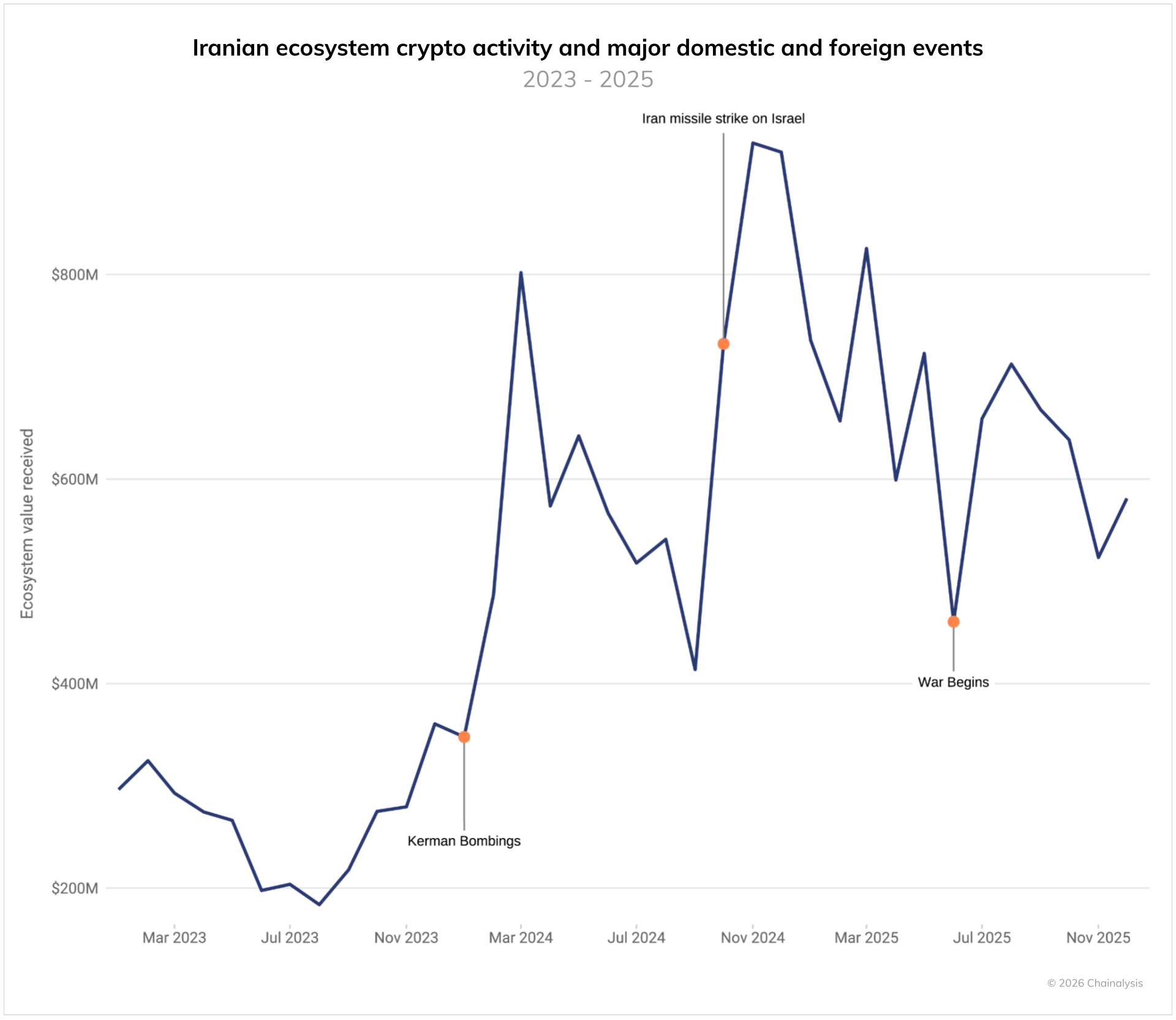
Activity of Iranian cryptocurrency users. Visualization: Chainalysis
Such events include:
- The Kerman bombings in January 2024, which killed nearly 100 people during a memorial ceremony honoring former Quds Force commander Qassem Soleimani.
- Iran’s missile strikes on Israel in October 2024 following the killings of Hamas leader Ismail Haniyeh in Tehran and Hezbollah Secretary-General Hassan Nasrallah in Beirut.
- A smaller but still noticeable surge in activity occurred during the 12-day conflict in June 2025, when the covert confrontation between Iran and Israel reached a critical point. During this period, the United States and Israel carried out joint strikes on Iranian nuclear and missile facilities. At the same time, cyberattacks targeted Nobitex—the largest cryptocurrency exchange in Iran—as well as Bank Sepah, the country’s oldest bank, which is actively used by the IRGC. Hackers also breached Iran’s state television, broadcasting footage of women’s protests and urging citizens to take to the streets.
12 days of war: how the Iranian Nobitex exchange recovered after the hack
The trading platform resumed trading on July 9, but Iranian users are in no hurry to return to the exchange
Growing Influence of the IRGC in Iran’s Cryptocurrency Economy
Particular attention should be paid to the strengthening position of the IRGC in the cryptocurrency sphere. Addresses linked to international networks controlled by the IRGC have shown fluctuations in activity over the years, but overall their share has grown steadily. In the fourth quarter of 2025, these addresses accounted for more than 50% of all inflows within Iran’s crypto economy.
This process reflects a broader trend—the gradual consolidation of IRGC control over the country’s economic and political institutions. In 2024, the volume of funds received by IRGC-linked addresses exceeded $2 billion, and in 2025 it rose to more than $3 billion.
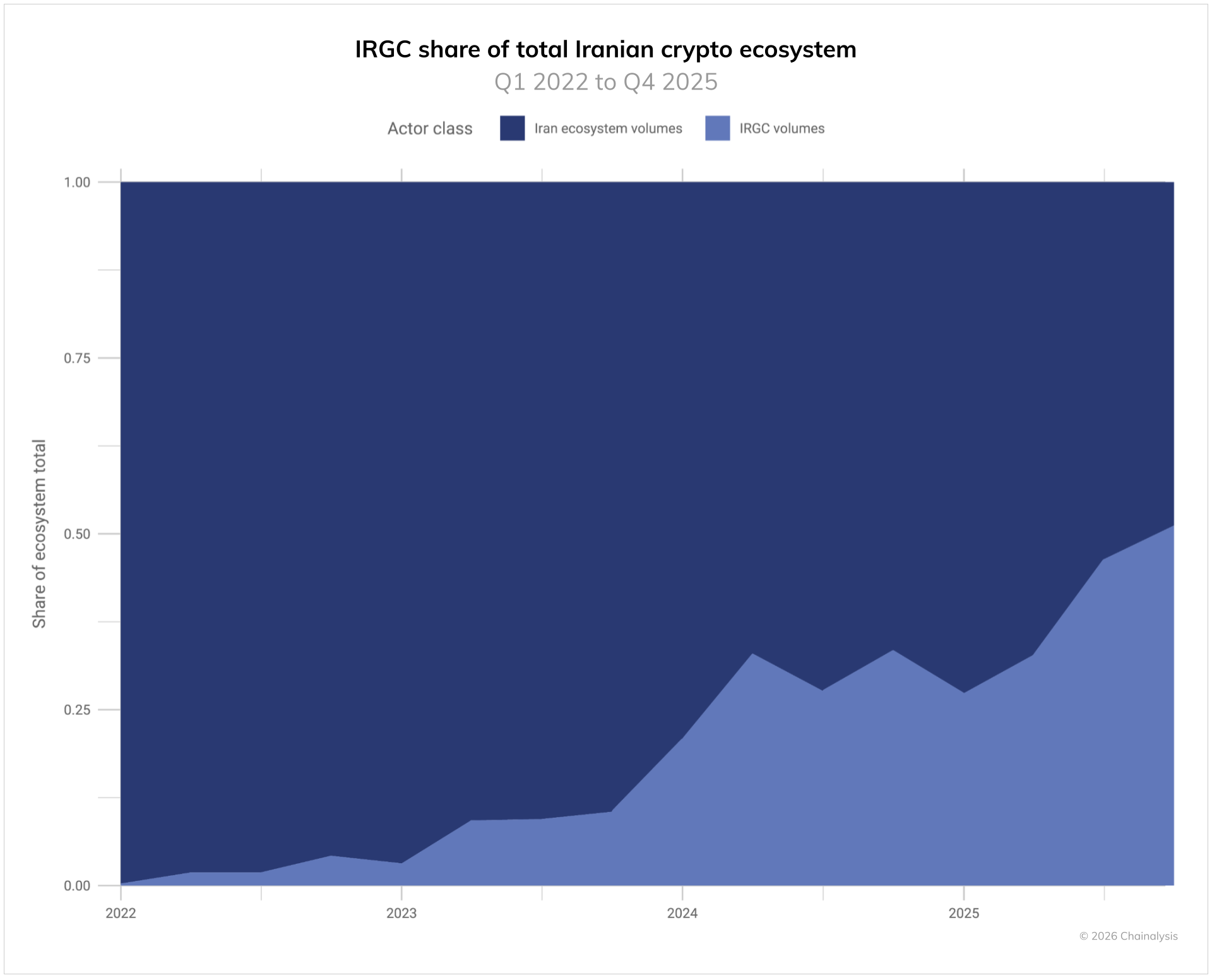
Growth of IRGC volumes in Iran’s cryptocurrency ecosystem. Visualization: Chainalysis
It is important to understand that these figures represent a minimum estimate. The calculations include only a limited set of addresses that have been officially listed in sanctions registers by the U.S. Department of the Treasury and Israel’s National Bureau for Counter Terror Financing. These data do not account for potential shell companies, intermediaries, or wallets that have not yet been publicly linked to the IRGC. As new information emerges and money-laundering schemes are uncovered, further growth in these figures can be expected.
This network includes not only IRGC representatives within Iran itself, but also intermediaries in other countries involved in the movement of goods, illicit oil trade, the transfer of funds and weapons to allied regional groups, and the circumvention of international sanctions.
Bitcoin as a Form of Protest: Fund Withdrawals Amid Civil Unrest
Recent data show a notable shift in user behavior during the current wave of mass protests. Comparing the period before the protests began (from November 1 to December 27, 2025) with the interval from December 28, 2025 to January 8, 2026—when widespread internet shutdowns began—researchers recorded a sharp increase in both the average daily dollar value of transactions and the number of transfers to personal wallets.
Most indicative is the rise in bitcoin withdrawals from Iranian cryptocurrency exchanges to private, non-custodial wallets. This suggests that during the protests, people increasingly chose to take direct control of their crypto assets. Such behavior appears to be a logical response to the collapse of the Iranian rial, which has virtually lost its value against major global currencies, including the euro.
Bitcoin’s role in this situation goes beyond simple capital preservation. For many Iranians, cryptocurrency has become an element of resistance, providing access to money and freedom of choice in an increasingly restricted economy. Unlike traditional assets, which are difficult to sell quickly and are often controlled by the state, bitcoin allows individuals to store and manage their funds independently, without intermediaries.
This is especially important in situations where people may need to leave the country urgently or operate outside the official financial system. Similar spikes in bitcoin withdrawals during periods of instability have been observed in other regions experiencing wars, economic crises, or severe repression by authorities.
As sanctions pressure intensifies, international isolation deepens, and economic instability persists, cryptocurrency is likely to remain an important tool for Iranians seeking financial independence. The clear link between major political events and surges in digital asset activity demonstrates how blockchain data analysis makes it possible to track the economic consequences of geopolitical processes in real time. At the same time, it underscores the evolving role of cryptocurrency—as both a financial lifeline and a potential instrument of resistance in authoritarian economies.

Useful material?
 Telegram
  Twitter
 Research
One and the same cryptocurrency address received two completely opposite assessments from different analytics systems: from an ordinary gambling service to an extremely severe criminal offense. This story has become the starting point for a broader conversation about what the scientific standards of blockchain analysis should look like — and why errors in systems like these can shape the fates of real people.
Jul 1, 2026
Research
The blockchain has helped uncover the ties between cryptocurrency fundraising campaigns, exchangers in Syria, and intermediaries in several countries around the world. A telltale pattern has emerged in which the same addresses were used across multiple donation drives at once
Jun 24, 2026
Research
Four Iranian cryptocurrency exchanges accounted for roughly 78% of all digital asset volume tied to the country in 2025. They have now become the focal point of the largest U.S. sanctions campaign against Iran's cryptocurrency infrastructure.
Jun 5, 2026
Research
A financial system is already up and running on public blockchains, with loans, analogues of U.S. Treasuries, and automated capital markets. More than $551 billion has flowed through DeFi protocols — but most of that activity has nothing to do with the real economy and everything to do with the speculative build-up of risk.
May 29, 2026
Research
Around 97% of Chinese suppliers of chemicals used to make fentanyl accept payment in cryptocurrency. The volume of such transactions continues to grow alongside the global market for synthetic drugs
May 22, 2026
Research
For the first time, the new law makes blockchain analytics an officially mandatory tool of financial oversight in the United States. Authorities will also gain the power to restrict transactions with foreign crypto services tied to money-laundering risks.
May 20, 2026
Cryptocurrency rates
-

Bitcoin
$81 379
BTC
-3.56%
-

Ethereum
$2 387.61
ETH
-4.35%
-

BNB Smart Chain
$731.54
BSC
-2.21%
-

Ripple
$1.42
XRP
+1.04%
-

TRON
$0.327845
TRX
-1.2%
-

Zcash
$1 221.23
ZEC
-9.51%
-

Dogecoin
$0.078853
DOGE
-5%
-

Cardano
$0.218269
ADA
+2.11%
-

Stellar XLM
$0.184461
XLM
+2.83%
-

Bitcoin Cash
$274.27
BCH
-4.37%