

“Pig butchering”: another $47 million belonging to scammers has been frozen
A scheme for laundering criminal proceeds obtained by fraudsters through a sophisticated scam has been uncovered

01.09.2025
657
3 min
0
In recent years, so-called “pig butchering gangs” have evolved into powerful criminal organizations that have defrauded victims around the world of billions of dollars. GetBlock AML Research reveals the modus operandi of one such fraudulent group in Asia.
This type of fraud is also known as “investment” or “romantic” fraud. The essence is simple: the attackers first “fatten up” the victim, that is, win their trust, and then defraud them of as much money as possible. It usually starts with an innocent acquaintance — for example, through a “wrong number” message or a dating app. Gradually, the scammers build a relationship of trust and convince the victim to invest in supposedly profitable investments, most often related to cryptocurrencies. When the person transfers the money, contact is abruptly cut off.
The tragedy is that the victims are not only those who have lost their savings. To operate these schemes, criminals lure other people with deception — promising them legal work abroad, but in reality depriving them of their freedom, locking them up in guarded complexes, and forcing them to work under duress: sending messages, conducting correspondence, and maintaining the appearance of real investments.
For example, in November 2023, it became known about a major investigation that froze about $225 million in stablecoins. This money was directly linked to an international human trafficking network in Southeast Asia that was involved in romance and investment scams. Later, in the summer, the US Secret Service obtained a court order to seize and permanently destroy these funds. This was the largest confiscation in the agency’s history.
According to Tether representatives, the company uses its technical capabilities to freeze illegal funds and actively cooperates with law enforcement agencies around the world to stop such crimes and return money to victims.
Last year, another major scam was uncovered: a “pig butchering” scheme operating in Southeast Asia, through which approximately $50 million in stablecoins passed. Joint action by international organizations and local authorities made it possible to freeze these funds.
How did the scheme work?
The investigation revealed that victims transferred money to the scammers’ crypto wallets over a period of months — some sent funds several times in a short period, while others sent money regularly over a six-month period. All the money was gradually transferred to one main wallet and then redistributed to a chain of other addresses. In total, the attackers transferred nearly $47 million while concealing the traces of the transfers.
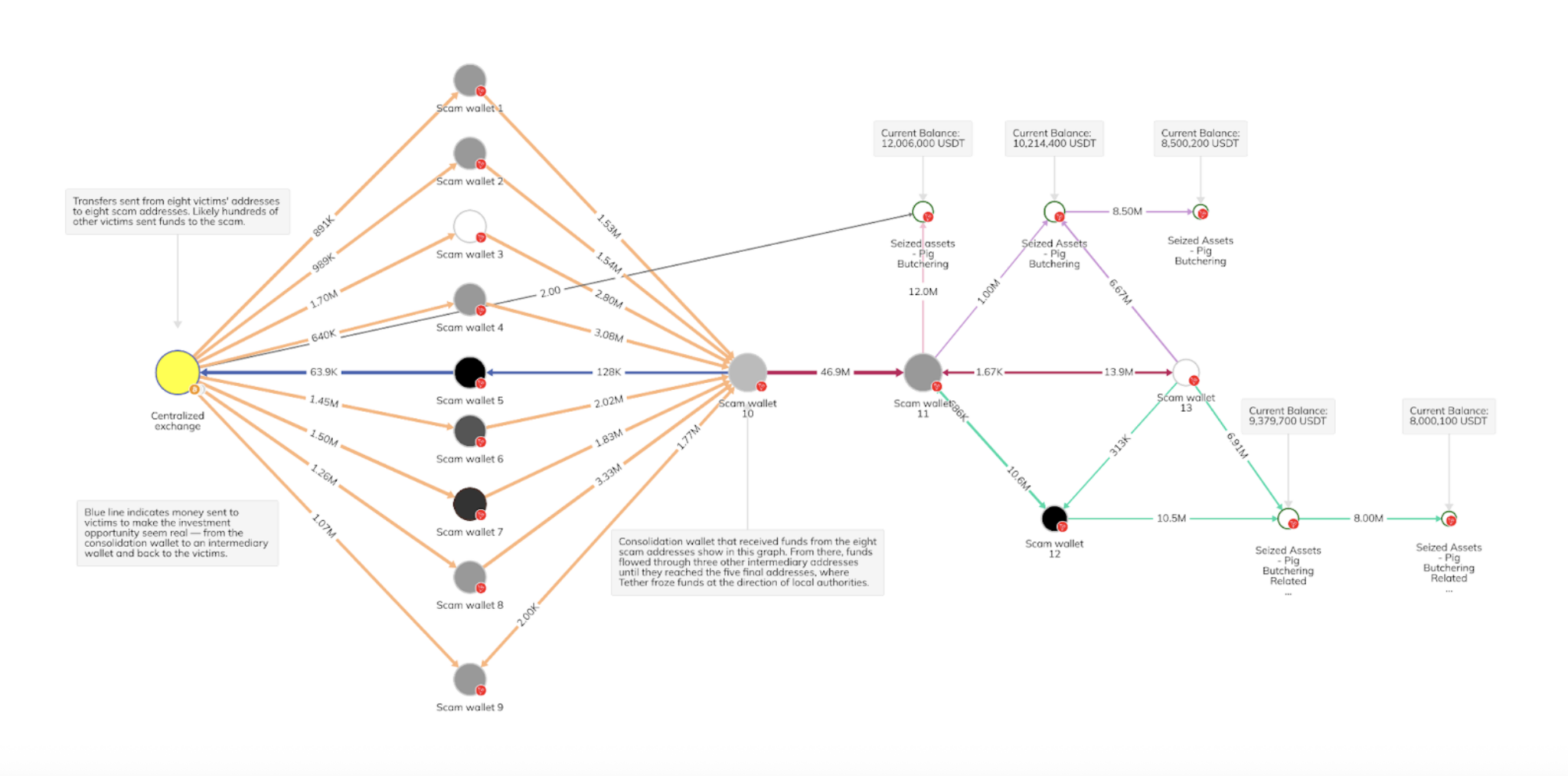
Consolidation of stolen funds in a single wallet belonging to the fraudsters
To instill confidence in their victims and maintain the illusion of real investments, the fraudsters sometimes even made small reverse transfers — sending symbolic amounts of “profits” to reassure people that their investments were working. After that, trust grew, and the victims agreed to even larger transfers.
In the end, it was through these details — small returns, a chain of wallets, and repeated transfers — that law enforcement agencies were able to piece together what was happening. This allowed them to track down the organizers and freeze millions of dollars that were saved from being laundered.

Useful material?
 Telegram
  Twitter
 Research
One and the same cryptocurrency address received two completely opposite assessments from different analytics systems: from an ordinary gambling service to an extremely severe criminal offense. This story has become the starting point for a broader conversation about what the scientific standards of blockchain analysis should look like — and why errors in systems like these can shape the fates of real people.
Jul 1, 2026
Research
The blockchain has helped uncover the ties between cryptocurrency fundraising campaigns, exchangers in Syria, and intermediaries in several countries around the world. A telltale pattern has emerged in which the same addresses were used across multiple donation drives at once
Jun 24, 2026
Research
Four Iranian cryptocurrency exchanges accounted for roughly 78% of all digital asset volume tied to the country in 2025. They have now become the focal point of the largest U.S. sanctions campaign against Iran's cryptocurrency infrastructure.
Jun 5, 2026
Research
A financial system is already up and running on public blockchains, with loans, analogues of U.S. Treasuries, and automated capital markets. More than $551 billion has flowed through DeFi protocols — but most of that activity has nothing to do with the real economy and everything to do with the speculative build-up of risk.
May 29, 2026
Research
Around 97% of Chinese suppliers of chemicals used to make fentanyl accept payment in cryptocurrency. The volume of such transactions continues to grow alongside the global market for synthetic drugs
May 22, 2026
Research
For the first time, the new law makes blockchain analytics an officially mandatory tool of financial oversight in the United States. Authorities will also gain the power to restrict transactions with foreign crypto services tied to money-laundering risks.
May 20, 2026
Cryptocurrency rates
-

Bitcoin
$81 990
BTC
+0.86%
-

Ethereum
$2 405.38
ETH
+0.39%
-

BNB Smart Chain
$722.41
BSC
+0.82%
-

Ripple
$1.42
XRP
+1.04%
-

TRON
$0.332575
TRX
-0.24%
-

Zcash
$1 129.78
ZEC
+0.53%
-

Dogecoin
$0.079363
DOGE
+0.25%
-

Cardano
$0.218269
ADA
+2.11%
-

Stellar XLM
$0.184461
XLM
+2.83%
-

Bitcoin Cash
$276.15
BCH
+0.53%