


Scammer became a victim: steal $10 million worth of crypto and be left with nothing
On the eve of April Fool’s Day, there was a comical event that will be discussed in the crypto community for a long time to come

21.04.2025
674
4 min
0
The classic story of the DeFi protocol hack ended unexpectedly for everyone. The developers of the project were left without liquidity, but the hacker was not able to get unfairly “earned” funds either. GetBlock AML Research has analyzed one of the most unusual situations in the crypto world over the past couple of years.
It started as usual
On February 11, a clever hacker conducted an attack on the zkLend project. He managed to manipulate a smart contract to receive cryptocurrency without collateral. The full chronology and description of the hack can be found on the blog of the protocol’s developers. In the end, the attacker withdrew:
- 2 213,6 ETH
- 1 553 069,4 USDC
- 7 426 029,9 STRK
- 518 225,7 USDT
Total: $9,6 million at the time of the hack.
After the successful attack, the hacker began moving funds through various cross-chain bridges (StarkGate, Orbiter, Layerswap, and rhino.fi), then converted the assets to ETH and concentrated them into a single storage address for later laundering.
The zkLend team sent a message to the hacker in hopes that he would return the stolen assets. As usual in such situations, the developers allowed the hacker to keep 10% of the stolen funds. But days and weeks passed, and the hacker remained silent.
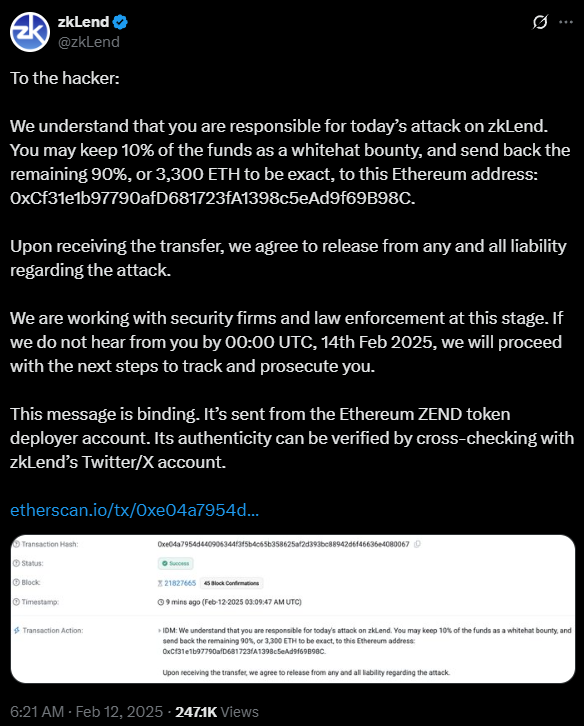
Addressing the hacker on zkLend’s X page
The best part
The culmination of this story took place on the eve of April Fool’s Day, which only adds to the comical nature of this situation. After the stolen cryptocurrency was “settled down” — the hacker moved 2930 ETH to a new address: 0xD89B7236f4eA38a2AfC1d614Dc3De08A190f1Ff5.
Next, the attacker decided to act according to the classic method, to launder ETH through the Tornado Cash mixer. With the help of this protocol, the cryptocurrency passes through hundreds of addresses in a chaotic manner. This is done to interrupt the chain of asset movement and make it impossible to track them on the blockchain.
At this stage, something went wrong and instead of the original Tornado Cash mixer, the hacker used a phishing link that led to a fake project address (tornadoeth[.]cash). At this point, the hacker lost the funds he had previously stolen from the zkLend project. And the scammer, who got them, did not miss the opportunity to inform his “colleague” about this situation.
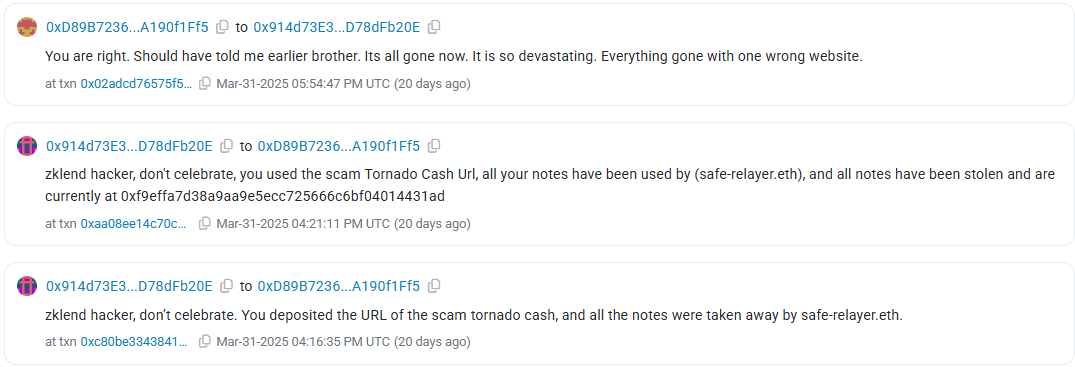
Communication between two attackers on the Ethereum blockchain
After the loser hacker lost his cryptocurrency, he suddenly felt “very sorry” and reported it to zkLend developers. All of the hacker’s messages were sent on the Ethereum blockchain, so the reminder of this story will stay with us for a long time.
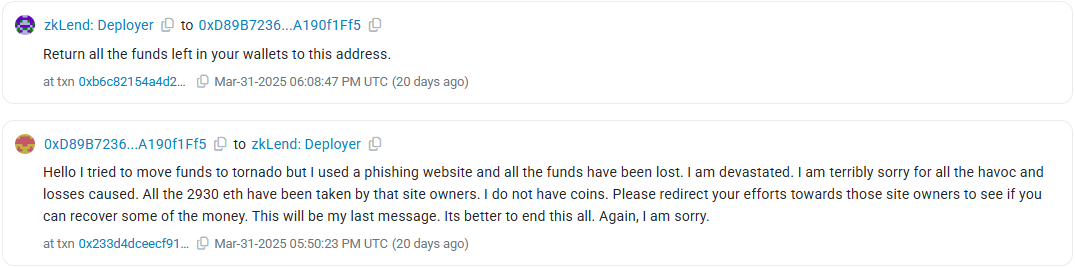
The hacker’s “repentance”
Moral
Despite the comical nature of the situation, there is much to learn from it. For example, when interacting with assets (any assets, not just cryptocurrency), you should always check incoming and outgoing data: addresses, links, senders, recipients, etc. To exclude the possibility of a common mistake or manipulation. And this should always be done. Even knowledge of Solidity (a language for developing smart contracts on Ethereum), skills of auditing smart contracts, detecting bugs, and writing exploits will not save you. The hacker who was the subject of this article was not spared from losses.

Useful material?
 Telegram
  Twitter
 Research
One and the same cryptocurrency address received two completely opposite assessments from different analytics systems: from an ordinary gambling service to an extremely severe criminal offense. This story has become the starting point for a broader conversation about what the scientific standards of blockchain analysis should look like — and why errors in systems like these can shape the fates of real people.
Jul 1, 2026
Research
The blockchain has helped uncover the ties between cryptocurrency fundraising campaigns, exchangers in Syria, and intermediaries in several countries around the world. A telltale pattern has emerged in which the same addresses were used across multiple donation drives at once
Jun 24, 2026
Research
Four Iranian cryptocurrency exchanges accounted for roughly 78% of all digital asset volume tied to the country in 2025. They have now become the focal point of the largest U.S. sanctions campaign against Iran's cryptocurrency infrastructure.
Jun 5, 2026
Research
A financial system is already up and running on public blockchains, with loans, analogues of U.S. Treasuries, and automated capital markets. More than $551 billion has flowed through DeFi protocols — but most of that activity has nothing to do with the real economy and everything to do with the speculative build-up of risk.
May 29, 2026
Research
Around 97% of Chinese suppliers of chemicals used to make fentanyl accept payment in cryptocurrency. The volume of such transactions continues to grow alongside the global market for synthetic drugs
May 22, 2026
Research
For the first time, the new law makes blockchain analytics an officially mandatory tool of financial oversight in the United States. Authorities will also gain the power to restrict transactions with foreign crypto services tied to money-laundering risks.
May 20, 2026
Cryptocurrency rates
-

Bitcoin
$84 571
BTC
-1.56%
-

Ethereum
$2 679.94
ETH
-1.73%
-

BNB Smart Chain
$765.36
BSC
-1.41%
-

Ripple
$1.42
XRP
+1.04%
-

TRON
$0.335233
TRX
+0.33%
-

Zcash
$1 311.79
ZEC
-4.69%
-

Dogecoin
$0.092762
DOGE
-3.07%
-

Cardano
$0.218269
ADA
+2.11%
-

Stellar XLM
$0.184461
XLM
+2.83%
-

Bitcoin Cash
$310.65
BCH
-1.02%