

What connects the Aperture and 0xswapnet hacks
Two major attacks that occurred in January 2026 share common characteristics. There is strong reason to believe they were carried out by the same threat actor.

04.02.2026
360
6 min
0
In late January 2026, the decentralized finance (DeFi) ecosystem was hit by a series of linked attacks targeting two crypto projects — Aperture Finance and 0xswapnet. While the protocols served different purposes and catered to different user segments, both were compromised for the same underlying reason. GetBlock AML Research explains why both projects lost funds.
At the core of the attacks was a critical architectural flaw related to the improper handling of so-called unlimited token approvals. On-chain analysis of the stolen funds revealed a well-structured laundering operation and a direct connection to a known threat actor previously involved in attacks on the Li.Fi protocol.
How the attack worked
The exploit was made possible by an arbitrary call vulnerability. In simple terms, the attackers found a way to force a smart contract to execute instructions it was never designed to perform.

How a hacker got trillions of tokens for free: why the Truebit project was exploited
The attacker exploited a smart contract flaw that made it possible to mint 240,442,509,453,545,333,947,284,131 TRU tokens while paying 0 ETH
What “unlimited token approval” means — in plain English
When a user connects their wallet to a DeFi application, they are typically asked to approve token usage.
In most cases, there are two options:
- approve a limited amount, or
- approve unlimited usage — commonly referred to as an unlimited approval.
This is similar to either:
- lending someone exactly $1,000, or
- handing them your debit card with no spending limit, trusting they’ll only take what’s necessary.
Across DeFi, users often leave these unlimited approvals active for years, unaware of the risk. The attackers exploited exactly this behavior.
How funds were stolen
By abusing the vulnerability in the contract logic, the attackers were able to:
- execute calls that appeared legitimate on the surface,
- but in reality triggered unauthorized token transfers from user wallets,
- without compromising the wallets themselves.
Any user who had previously granted unlimited approval to the affected protocols was at risk. Their balances were drained directly to attacker-controlled addresses.

The LastPass hack in 2022: consequences and the Russian connection
Over the past few years, hackers have used stolen data from LastPass to steal $28 million worth of assets.
Tracking the stolen funds on-chain
Transaction analysis made it possible to reconstruct the primary flow of funds, starting from a key attacker address on Base, an Ethereum-compatible blockchain network.
Primary attacker address (Base):
| Primary attacker address (Base) |
| 0x6cAad74121bF602e71386505A4687f310e0D833e |
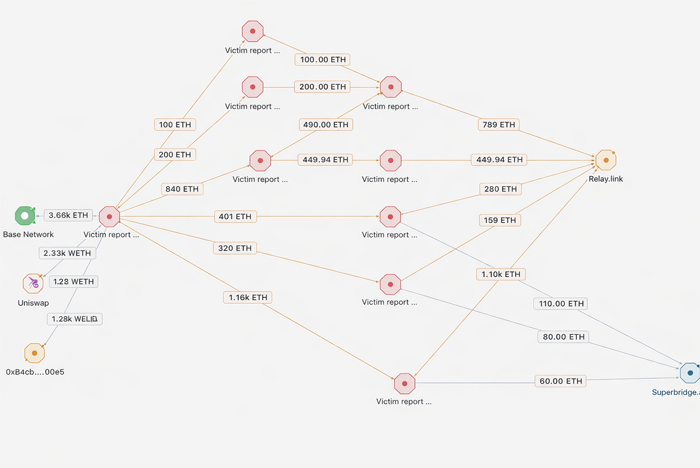
Stolen funds flow graph
The Aperture Finance and 0xswapnet hack — step by step
Phase 1: Aggregation and conversion of stolen assets
In total, the attacker extracted approximately $13 million across multiple crypto assets.
What happened next:
Roughly $3 million in USDC remained on the original Base address. This was likely due to concerns that stablecoins could be:
- frozen,
- easily traced,
- or flagged due to their transparency.
All other tokens were quickly swapped into ETH, a more liquid and operationally flexible asset.
As a result, around 540 ETH accumulated on the primary address, serving as the launch point for the next stage.

The math of crime: how a hacker managed to hack Yearn for $9 million
A minor error in the calculation algorithm led to the theft of crypto assets from one of the oldest and most reputable projects on the crypto market.
Phase 2: Cross-chain laundering
To further obscure the trail, the attacker employed a professional laundering strategy typical of experienced hacking groups. Funds were bridged from Base to Ethereum mainnet using high-throughput cross-chain bridges — services that allow assets to move between different blockchains.
In simple terms, this is similar to routing money through multiple payment networks across different banks.
Once on Ethereum mainnet:
- ETH was distributed across numerous newly created, previously inactive wallets.
- These wallets currently remain dormant, holding large balances without further activity.
An interesting side effect: due to the sizable balances, these addresses became targets of address poisoning attacks, where unrelated scammers send small transfers in an attempt to trick owners into sending funds to the wrong address later.
Secondary attack phase and links to previous exploits
Several hours after the initial exploit, a second wave of activity was observed, this time involving Aperture Finance only.
| The secondary attacker held funds at the following addresses |
| 0xe3E73f1E6acE2B27891D41369919e8F57129e8eA |
| 0x5FF8645BbC6c8B4390aA228A3e8bf08240F333b4 |
Connection to earlier attacks
These addresses have previously appeared in exploits involving Li.Fi and Jumper Exchange.
This strongly suggests the incidents were not isolated or opportunistic. Instead, they point to a single, experienced threat group specializing in vulnerabilities related to unlimited token approvals.

Useful material?
 Telegram
  Twitter
 Research
One and the same cryptocurrency address received two completely opposite assessments from different analytics systems: from an ordinary gambling service to an extremely severe criminal offense. This story has become the starting point for a broader conversation about what the scientific standards of blockchain analysis should look like — and why errors in systems like these can shape the fates of real people.
Jul 1, 2026
Research
The blockchain has helped uncover the ties between cryptocurrency fundraising campaigns, exchangers in Syria, and intermediaries in several countries around the world. A telltale pattern has emerged in which the same addresses were used across multiple donation drives at once
Jun 24, 2026
Research
Four Iranian cryptocurrency exchanges accounted for roughly 78% of all digital asset volume tied to the country in 2025. They have now become the focal point of the largest U.S. sanctions campaign against Iran's cryptocurrency infrastructure.
Jun 5, 2026
Research
A financial system is already up and running on public blockchains, with loans, analogues of U.S. Treasuries, and automated capital markets. More than $551 billion has flowed through DeFi protocols — but most of that activity has nothing to do with the real economy and everything to do with the speculative build-up of risk.
May 29, 2026
Research
Around 97% of Chinese suppliers of chemicals used to make fentanyl accept payment in cryptocurrency. The volume of such transactions continues to grow alongside the global market for synthetic drugs
May 22, 2026
Research
For the first time, the new law makes blockchain analytics an officially mandatory tool of financial oversight in the United States. Authorities will also gain the power to restrict transactions with foreign crypto services tied to money-laundering risks.
May 20, 2026
Cryptocurrency rates
-

Bitcoin
$81 285
BTC
-1.97%
-

Ethereum
$2 377.82
ETH
-2.59%
-

BNB Smart Chain
$726.39
BSC
-0.02%
-

Ripple
$1.42
XRP
+1.04%
-

TRON
$0.332031
TRX
+0.3%
-

Zcash
$1 126
ZEC
-3.49%
-

Dogecoin
$0.078743
DOGE
-1.36%
-

Cardano
$0.218269
ADA
+2.11%
-

Stellar XLM
$0.184461
XLM
+2.83%
-

Bitcoin Cash
$272.5
BCH
-2.49%