

Which platforms help Russia evade sanctions: a complete list
We examine cryptocurrency platforms used for cross-border settlements that bypass sanctions. The report is based on blockchain analytics and reveals specific connections, transaction volumes, and operational infrastructure.

23.02.2026
710
4 min
0
Cryptocurrency exchanges that maintain business or financial ties to Russia continue to help circumvent international sanctions. These platforms create payment pathways that allow Russian companies and individuals to transfer money abroad outside the traditional banking system. GetBlock AML Research has compiled information on crypto platforms with confirmed links to Russia.
Traditional currency, such as rubles, can be exchanged for cryptocurrency through these services and then transferred abroad directly, without banks or intermediaries. Once overseas, the cryptocurrency can be converted back into local currency through foreign brokers or exchanges.
Despite increasing regulatory pressure, many of these platforms—some of which are formally registered outside Russia—continue processing large volumes of transactions connected to sanctioned individuals and entities. This article reviews several such services, many of which have not yet been sanctioned themselves.
Bitpapa
Bitpapa is a peer-to-peer (P2P) cryptocurrency exchange registered in the United Arab Emirates. However, it primarily targets Russian users and allows ruble-to-crypto exchanges.
In March 2024, the U.S. Office of Foreign Assets Control (OFAC) imposed sanctions on the platform for helping circumvent restrictions placed on Russia. One indication of Bitpapa’s involvement in sanctions evasion is its significant share of transactions with already sanctioned entities: approximately 9.7% of the cryptocurrency it sends goes to recipients listed on OFAC’s sanctions lists, with around 5% directed to the sanctioned exchange Garantex.
Additionally, blockchain analysis shows that Bitpapa manages its crypto wallets in a way that makes tracking more difficult: addresses are constantly rotated. This tactic is used to prevent monitoring systems from identifying Bitpapa as a transaction participant and to obscure the Russian origin of funds from downstream services.
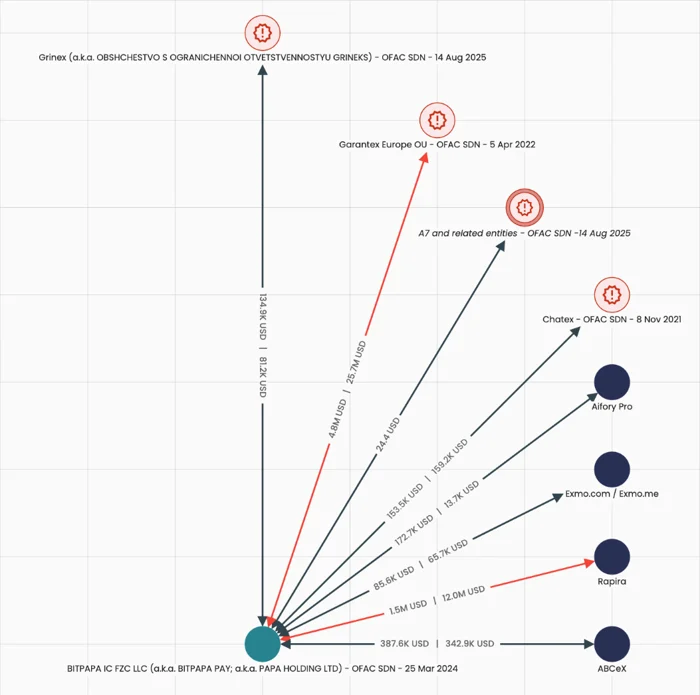
Bitpapa address links to Russian sanctioned platforms. Visualization: Elliptic
ABCeX
ABCeX offers both traditional exchange trading (via an order book) and direct ruble-to-crypto peer transactions. The company has an office in Moscow’s Federation Tower, in premises previously occupied by the sanctioned exchange Garantex. ABCeX uses wallet obfuscation techniques to make it harder to link cryptocurrency transactions to the platform.
At least $11 billion in cryptocurrency has passed through ABCeX, with substantial amounts transferred to the sanctioned exchange Garantex and to Aifory Pro (described below), which is considered high-risk or sanctioned.
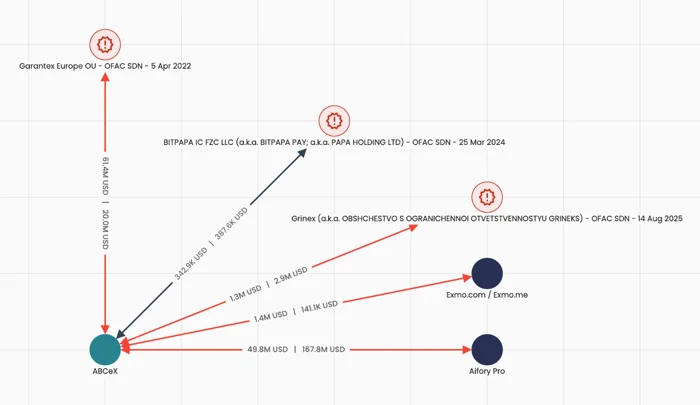
ABCeX address links to Russian sanctioned platforms. Visualization: Elliptic
Exmo (Exmo.com and Exmo.me)
The Exmo case illustrates how a publicly announced geographic business split may not align with on-chain evidence. After the start of the war in Ukraine in 2022, Exmo stated that it had exited the Russian market by selling its regional business to Exmo.me.
However, blockchain analysis indicates that Exmo.com and Exmo.me continue to use the same infrastructure to store customer funds. Cryptocurrency deposited on either platform flows into the same hot wallets (internet-connected wallets used for operational purposes), and withdrawals from both platforms are executed from the same addresses.
This suggests there is no real operational separation, and funds from the Russia-focused platform may be commingled with those of the Western division. Exmo conducted more than $19.5 million in direct transactions with sanctioned or Russia-linked entities, including Garantex, Grinex, and Chatex.
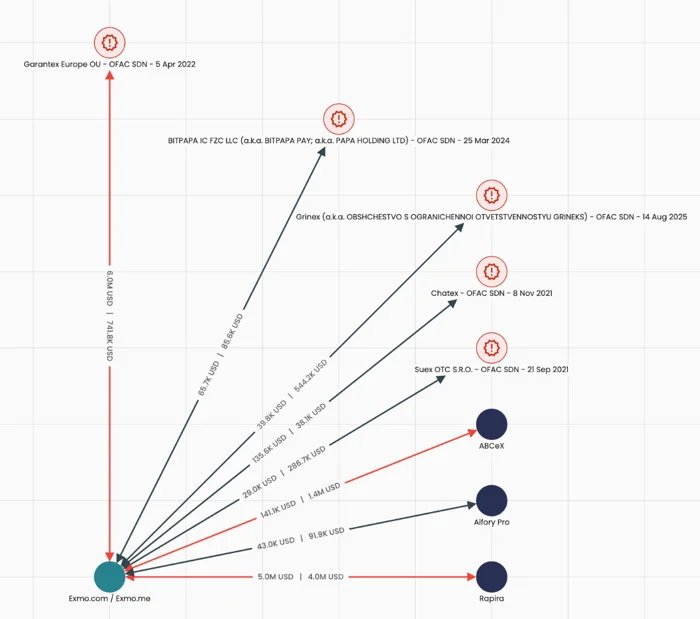
Rapira
Rapira is a Georgia-registered exchange with an office in Moscow that allows cryptocurrency trading for rubles. It conducted direct cryptocurrency transfers totaling more than $72 million with the sanctioned exchange Grinex. Reports indicate that Rapira’s Moscow offices were searched as part of an investigation into alleged capital outflows to Dubai.
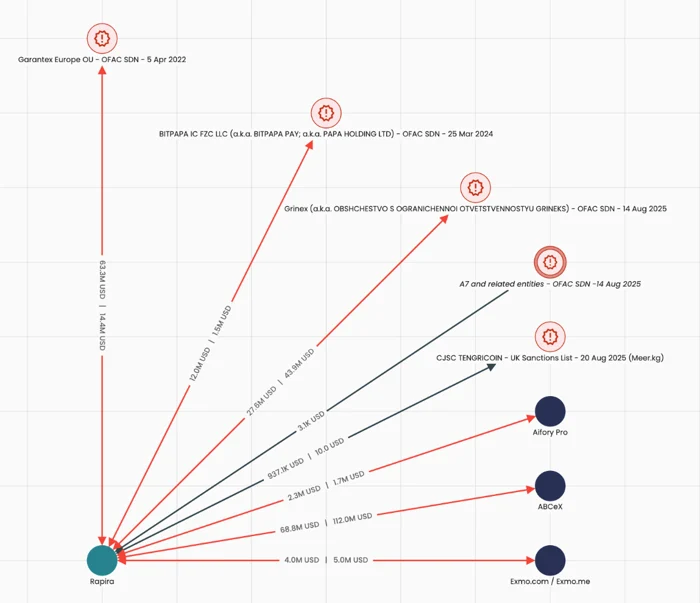
Aifory Pro
Aifory Pro specializes in cash-to-crypto exchange services in Moscow, Dubai, and Turkey. The company also acts as a payment agent for international trade, for example between Russia and China.
Additionally, it openly offers ways to bypass restrictions on foreign services: it issues virtual payment cards and Apple Pay–enabled cards that use customers’ USDT crypto balances to pay for international services such as Airbnb and ChatGPT, access to which is restricted in Russia.
Another indicator of elevated risk is its direct financial relationship with the Iranian exchange Abantether, to which it transferred nearly $2 million in cryptocurrency.
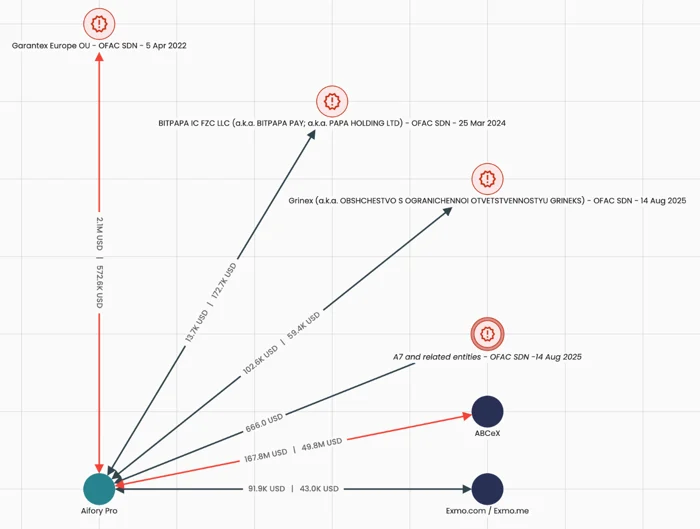
Aifory Pro address links to Russian sanctioned platforms. Visualization: Elliptic

Useful material?
 Telegram
  Twitter
 Research
One and the same cryptocurrency address received two completely opposite assessments from different analytics systems: from an ordinary gambling service to an extremely severe criminal offense. This story has become the starting point for a broader conversation about what the scientific standards of blockchain analysis should look like — and why errors in systems like these can shape the fates of real people.
Jul 1, 2026
Research
The blockchain has helped uncover the ties between cryptocurrency fundraising campaigns, exchangers in Syria, and intermediaries in several countries around the world. A telltale pattern has emerged in which the same addresses were used across multiple donation drives at once
Jun 24, 2026
Research
Four Iranian cryptocurrency exchanges accounted for roughly 78% of all digital asset volume tied to the country in 2025. They have now become the focal point of the largest U.S. sanctions campaign against Iran's cryptocurrency infrastructure.
Jun 5, 2026
Research
A financial system is already up and running on public blockchains, with loans, analogues of U.S. Treasuries, and automated capital markets. More than $551 billion has flowed through DeFi protocols — but most of that activity has nothing to do with the real economy and everything to do with the speculative build-up of risk.
May 29, 2026
Research
Around 97% of Chinese suppliers of chemicals used to make fentanyl accept payment in cryptocurrency. The volume of such transactions continues to grow alongside the global market for synthetic drugs
May 22, 2026
Research
For the first time, the new law makes blockchain analytics an officially mandatory tool of financial oversight in the United States. Authorities will also gain the power to restrict transactions with foreign crypto services tied to money-laundering risks.
May 20, 2026
Cryptocurrency rates
-

Bitcoin
$81 814
BTC
-1.01%
-

Ethereum
$2 404.29
ETH
-1.22%
-

BNB Smart Chain
$742.73
BSC
+0.53%
-

Ripple
$1.42
XRP
+1.04%
-

TRON
$0.329431
TRX
-0.24%
-

Zcash
$1 230.43
ZEC
-2.43%
-

Dogecoin
$0.079932
DOGE
+0.18%
-

Cardano
$0.218269
ADA
+2.11%
-

Stellar XLM
$0.184461
XLM
+2.83%
-

Bitcoin Cash
$285.64
BCH
+2.72%