

Zoomer or boomer: who is more likely to be victimized by crypto fraud — the answer in the FBI report
The US Federal Bureau of Investigation has released some interesting statistics on internet crime and fraud related to digital assets

07.05.2025
803
5 min
1
In April, the US Federal Bureau of Investigation (FBI) released its annual cybercrime report 2024 (IC3). The document contains detailed statistics about internet crime for the whole of last year. GetBlock AML Research publishes the top numbers, facts, and details from the document.
1. General Information
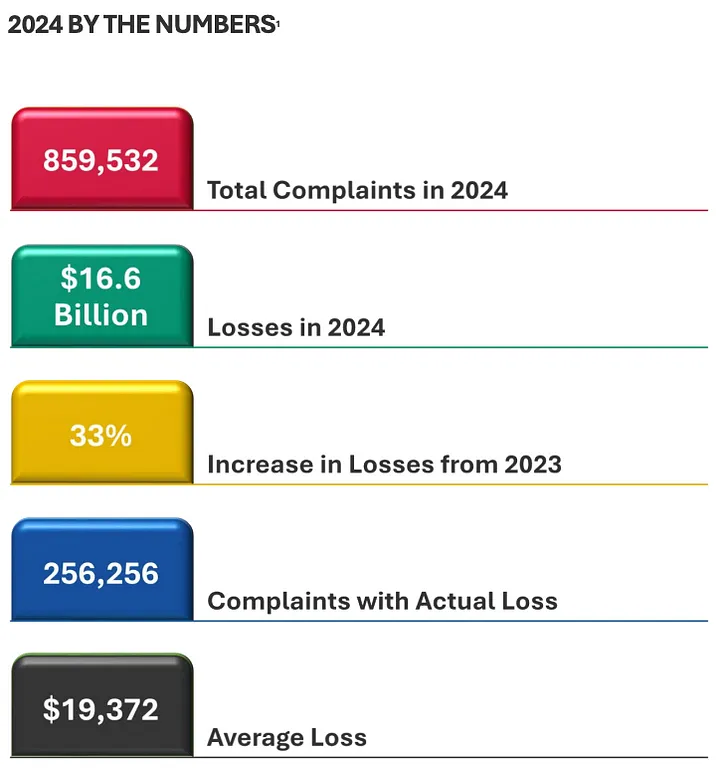
For the entire year of 2024, the FBI’s Internet Crime Complaint Center received 859 532 cases of illegal activities on the global network. The damages from these cases totaled $16,6 billion (33% more than in 2023). About 83% of the total losses were related to online fraud. The average loss per applicant amounted to $19 300.
2. Cryptocurrency category
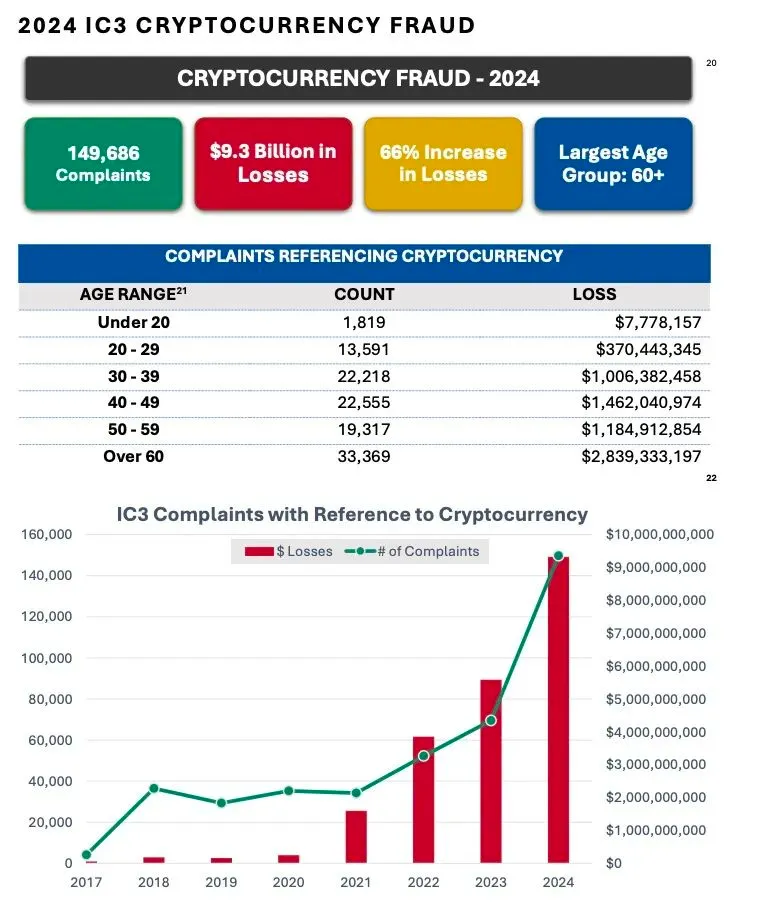
The number of appeals related to cryptocurrencies amounted to 149 686 cases. Losses from these cases totaled $9,3 billion (66% more than in 2023). The majority of victims are in the 60+ age group.
3. Age group 60+
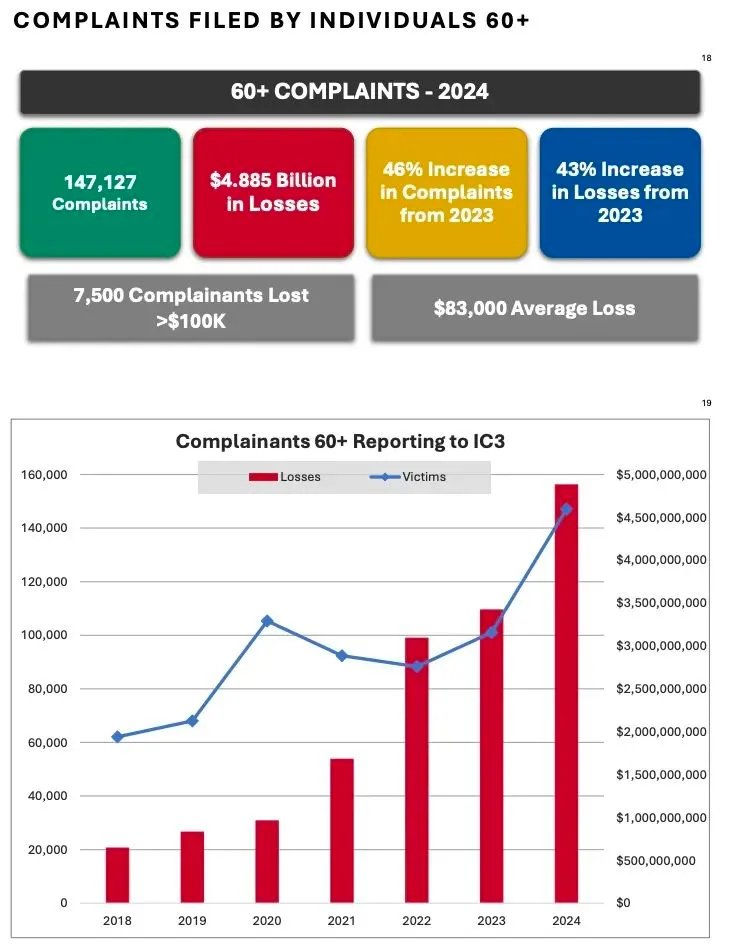
Cumulatively, people over the age of 60 filed 147 127 complaints, reporting a loss of $4,88 billion. The number of complaints and loss volume for this age group increased by 46% and 43%, respectively, compared to 2023. The average loss per person over age 60 was $83 000.
4. Victim demographics
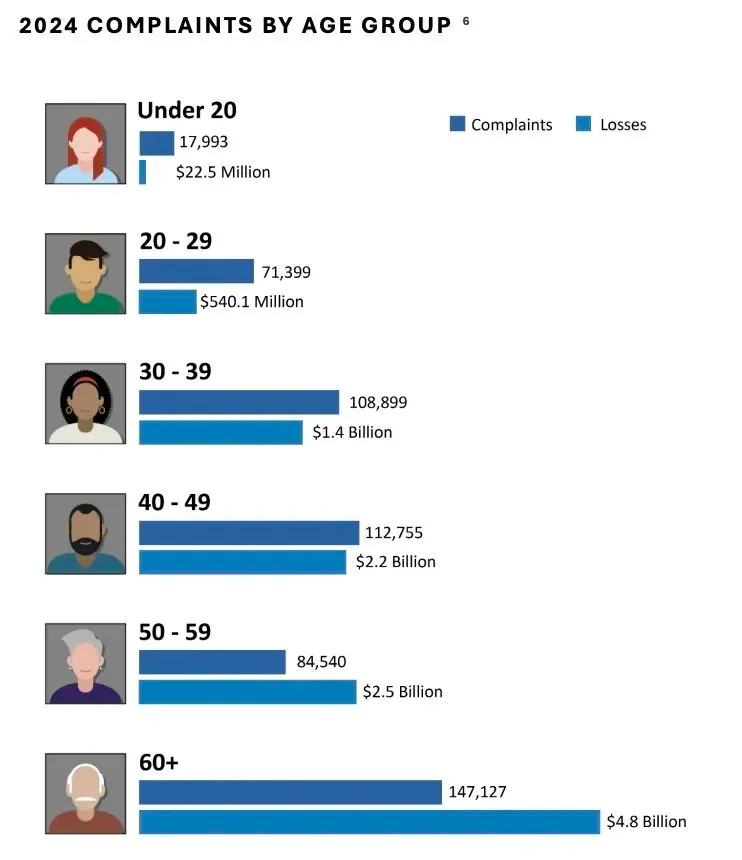
- Victims under age 20: 17 993 complaints, $22,5 million in losses;
- Victims 20 to 29 years old: 71 399 complaints, $540,1 million in losses
- Victims 30 to 39 years old: 108 899 complaints, $1,4 billion in losses
- Victims 40 to 49 years old: 112 755 complaints, $2,2 billion in losses
- Victims 50 to 59 years old: 84 540 complaints, $2,5 billion in losses
- Victims 60 and older: 147 127 complaints, $4,8 billion in losses
In cryptocurrency-related fraud, the 60+ age group also had the highest number of victims (8043 complaints for a total loss of $1,6 billion). This same age group also suffered the highest number of extortion and sex blackmail scams (20 445 complaints, $724,2 million in losses).
5. Breakdown by type of crime
Phishing/spoofing: 193 407 cases
Extortion: 86 415 cases
Personal data breach: 64 882 cases
Non-payment/non-delivery: 49 572 cases
Investment: 47 919 cases
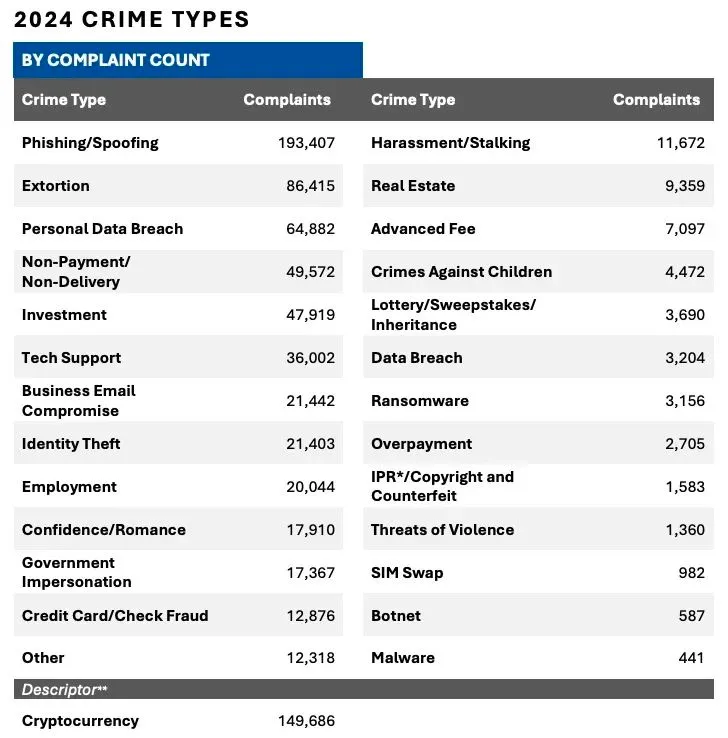
By total losses:
Investment: $6,57 billion;
Email compromise: $2,77 billion;
Fake tech support: $1,46 billion;
Personal data breach: $1,45 billion;
Non-payment/non-delivery: $785 million.
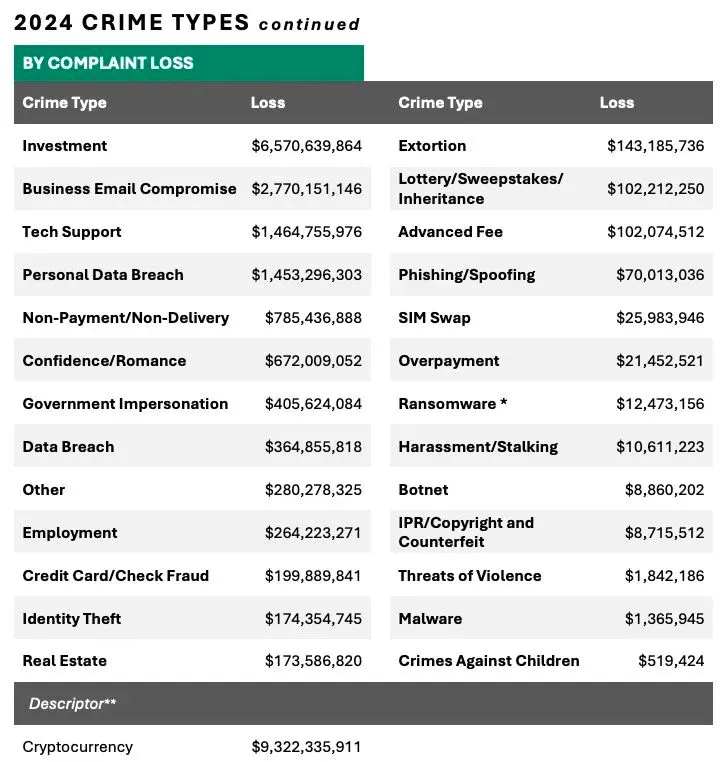
Cryptocurrency-related crimes
- Extortion (47 054 cases) and investment (41 557 cases) received the most complaints.
- Biggest losses: investment ($5,8 billion), a personal data breach ($1,1 billion).
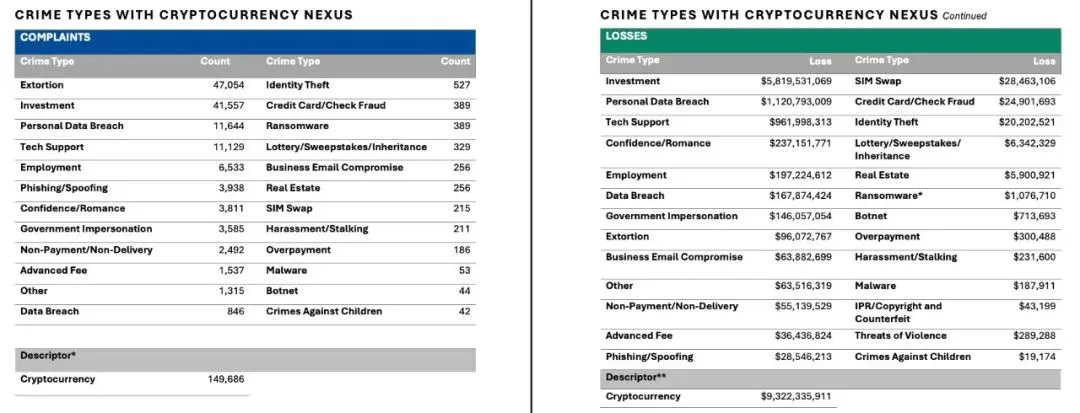
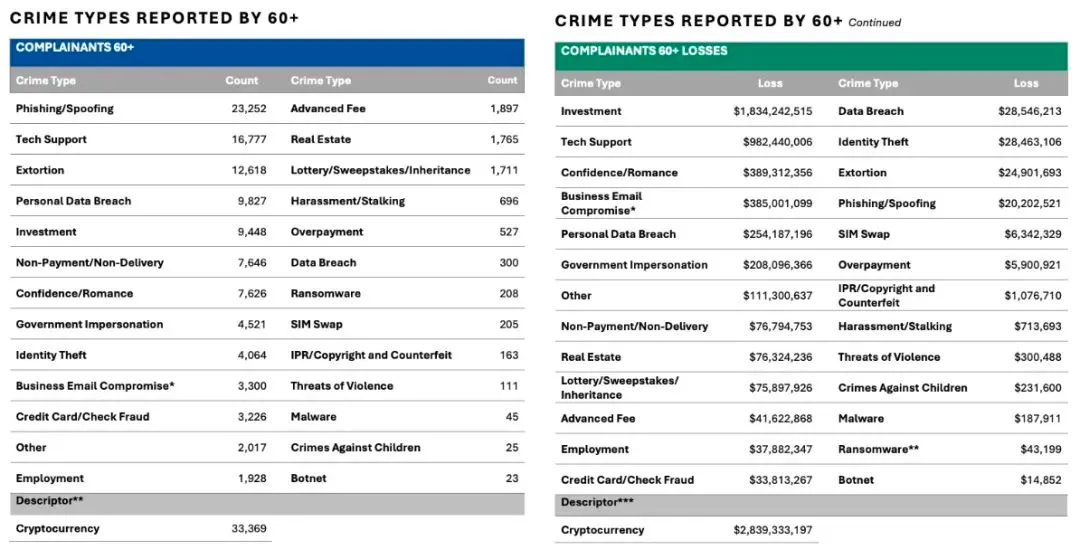
Types of fraud affecting the 60+ age group
- Most common by number of complaints: phishing, tech support, extortion, personal data breach, investment;
- Highest financial losses: investment, tech support, confidence/romance, email compromise, personal data breach.
6. Online fraud and recovery of stolen funds
For all of 2024, the FBI received 333 981 online fraud complaints, resulting in $13,7 billion in losses — 83% of total losses for the year. The main payment methods were cryptocurrency, wire transfers, and credit card payments.
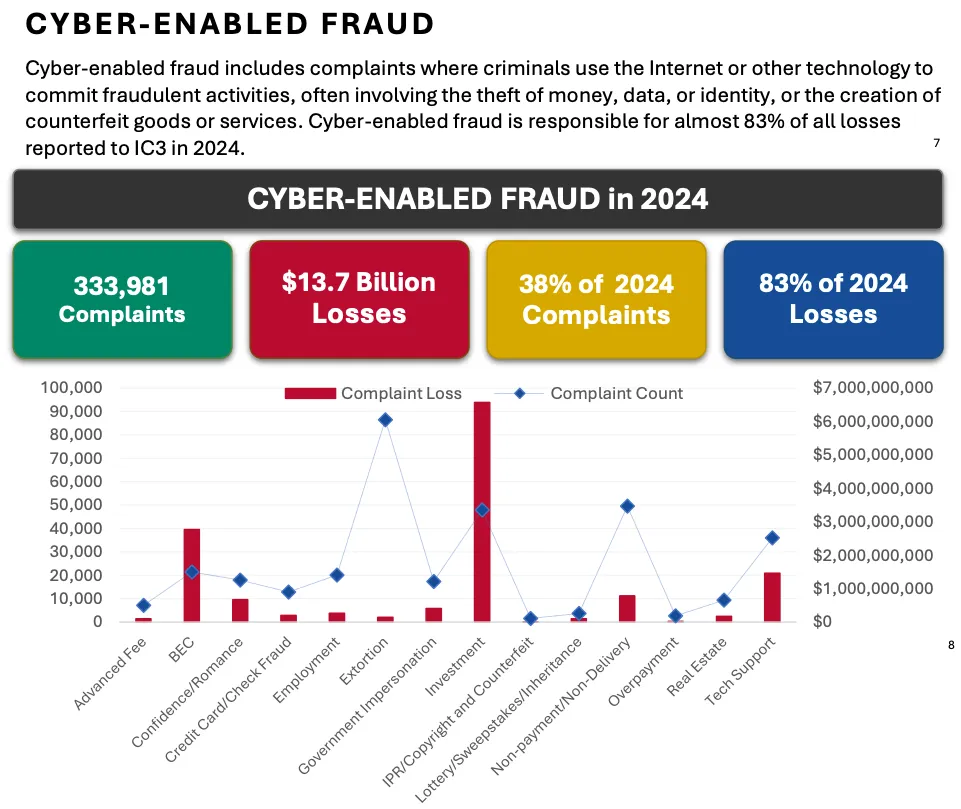
Top fraudulent schemes:
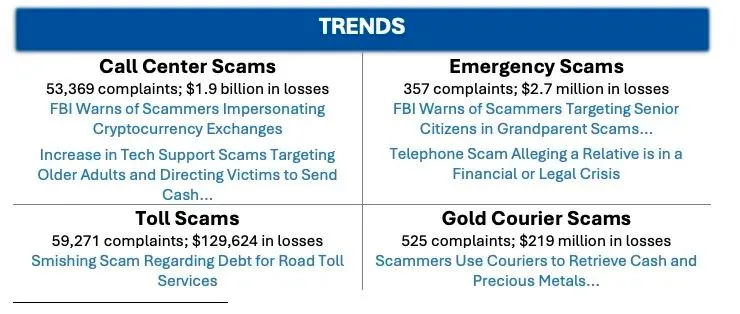
- Call center scams (in which fraudsters pose as representatives of some companies, such as banks or crypto exchanges): 53 369 cases, $1,9 billion in losses;
- Emergency scams (where fraudsters pose as relatives of a victim in distress): 357 cases, $2,7 million in losses;
- Toll scams: 59 271 cases, $129 000 in losses;
- Gold courier scams: 525 cases, $219 million in losses.
Cyber threats and ransomware
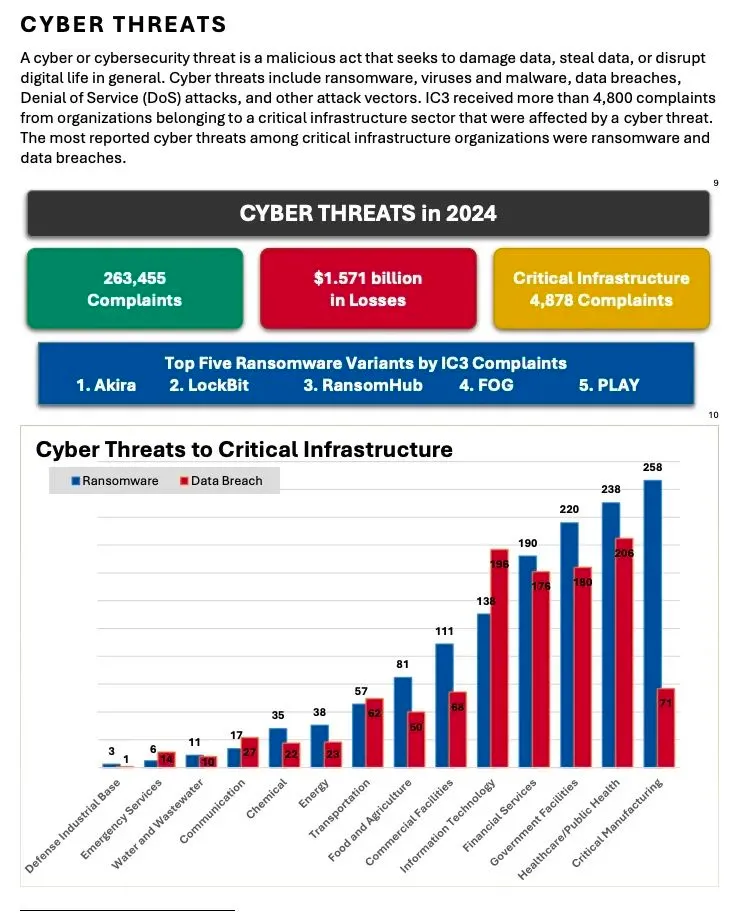
Received 263 455 complaints related to cyber threats, resulting in $1,571 billion in losses. The most popular ransomware programs were Akira, LockBit, RansomHub, FOG, and PLAY.
Recovery of stolen funds
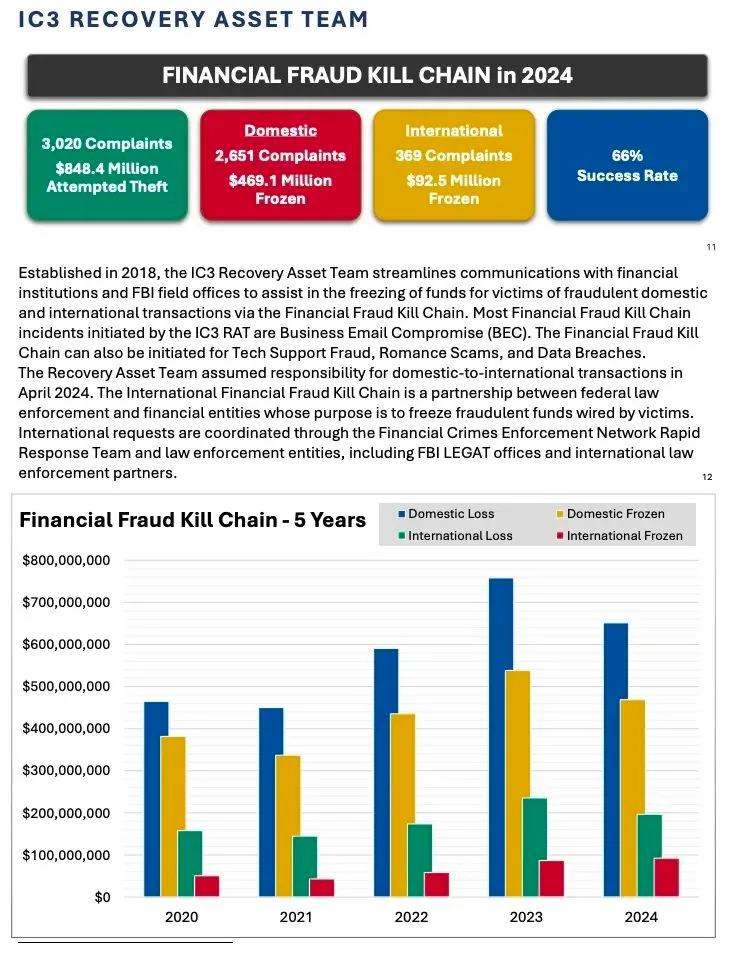
- Processed 3020 asset freeze requests, blocking $560 million in funds, with a 66% success rate in recovering funds;
- “Operation Level Up” successfully alerted 4323 crypto fraud victims, helping prevent potential losses of $285 million;
- Collaborated with Indian law enforcement agencies to arrest 215 call center fraud suspects, a 700% increase from 2023.
7. How not to become a victim of cryptocurrency scams
- Be vigilant and skeptical of promises of high returns: if an investment promises high returns with zero risk, it is very likely to be a scam;
- Check the legitimacy of platforms: use reputable, regulated exchanges, and avoid clicking on suspicious links on social media ads;
- Never transfer funds to strangers: don’t trust “investment coaches” or other suspicious individuals who suddenly approach you with offers;
- Be careful with transactions through cryptocurrency ATMs: scammers often advise victims to make payments through cryptocurrency ATMs — be especially vigilant;
- Use two-factor authentication (2FA): increase account security and prevent hacking attempts.

Useful material?
 Telegram
  Twitter
 Research
One and the same cryptocurrency address received two completely opposite assessments from different analytics systems: from an ordinary gambling service to an extremely severe criminal offense. This story has become the starting point for a broader conversation about what the scientific standards of blockchain analysis should look like — and why errors in systems like these can shape the fates of real people.
Jul 1, 2026
Research
The blockchain has helped uncover the ties between cryptocurrency fundraising campaigns, exchangers in Syria, and intermediaries in several countries around the world. A telltale pattern has emerged in which the same addresses were used across multiple donation drives at once
Jun 24, 2026
Research
Four Iranian cryptocurrency exchanges accounted for roughly 78% of all digital asset volume tied to the country in 2025. They have now become the focal point of the largest U.S. sanctions campaign against Iran's cryptocurrency infrastructure.
Jun 5, 2026
Research
A financial system is already up and running on public blockchains, with loans, analogues of U.S. Treasuries, and automated capital markets. More than $551 billion has flowed through DeFi protocols — but most of that activity has nothing to do with the real economy and everything to do with the speculative build-up of risk.
May 29, 2026
Research
Around 97% of Chinese suppliers of chemicals used to make fentanyl accept payment in cryptocurrency. The volume of such transactions continues to grow alongside the global market for synthetic drugs
May 22, 2026
Research
For the first time, the new law makes blockchain analytics an officially mandatory tool of financial oversight in the United States. Authorities will also gain the power to restrict transactions with foreign crypto services tied to money-laundering risks.
May 20, 2026
Cryptocurrency rates
-

Bitcoin
$82 702
BTC
+1.01%
-

Ethereum
$2 448.13
ETH
+2.03%
-

BNB Smart Chain
$736.49
BSC
+1.4%
-

Ripple
$1.42
XRP
+1.04%
-

TRON
$0.331024
TRX
-0.01%
-

Zcash
$1 217.73
ZEC
+6.95%
-

Dogecoin
$0.081106
DOGE
+2.39%
-

Cardano
$0.218269
ADA
+2.11%
-

Stellar XLM
$0.184461
XLM
+2.83%
-

Bitcoin Cash
$278.63
BCH
+0.22%