

A stranger among his own: how a police officer stole 50 BTC and tried to launder them
In the UK, an intelligence officer took possession of cryptocurrency that was seized when the Silk Road 2.0 dark web marketplace was shut down
04.08.2025
349
3 min
0
In the UK, a court has sentenced a former police officer who exploited his official position to steal 50 bitcoins. GetBlock AML Research explains why even a professional couldn’t hide the criminal financial flow that eventually led the former police officer to prison.
Good catch
In 2013, law enforcement shut down Silk Road, a dark web marketplace that used cryptocurrency in its operations. Immediately after the site’s closure, British citizen Thomas White launched his own marketplace called Silk Road 2.0, which operated for less than a year.
In 2014, British security services liquidated Silk Road 2.0, and 97 BTC were seized from its creator. The seizure and subsequent storage of the cryptocurrency were handled by Paul Chowles of the National Crime Agency (NCA).
Going to the dark side

Paul Chowles
Already in 2017, Paul Chowles decided to steal some of the bitcoins seized in the Silk Road 2.0 case. He had physical access to the wallet where the cryptocurrency was stored, so he transferred 50 BTC ($79 000 at the time of the theft) to another address. To embezzle the funds for himself, Chowles split the cryptocurrency into smaller amounts, which he then ran through the Bitcoin Fog crypto mixer.
It took four years before Chowles began exchanging the stolen bitcoins for fiat. It wasn’t until 2021, when the BTC exchange rate rose significantly, that Chowles began using major cryptocurrency platforms (Cryptopay and Wirex) to withdraw funds to his bank cards. By this time, the National Crime Agency had already decided that they would not be able to trace the stolen assets.
As the investigation later revealed, Chowles made 279 transactions and received illegal income of $824 600.
Chowles’ collapse
In early 2022, Silk Road 2.0 organizer Thomas White was released from prison and told law enforcers that only an NCA employee who had physical access to the seized wallet could access the stolen 50 BTC. Law enforcers began checking NCA employees and discovered strange receipts of funds from cryptocurrency platforms into Paul Chowles’ bank accounts.
Chowles became the main suspect in the case of the theft of 50 BTC: his home was searched, personal records and a computer were seized. Evidence was found in Chowles’ browser history that linked him to the stolen cryptocurrency. Then, the path of 50 BTC from the seized wallet to Chowles’ accounts was traced.
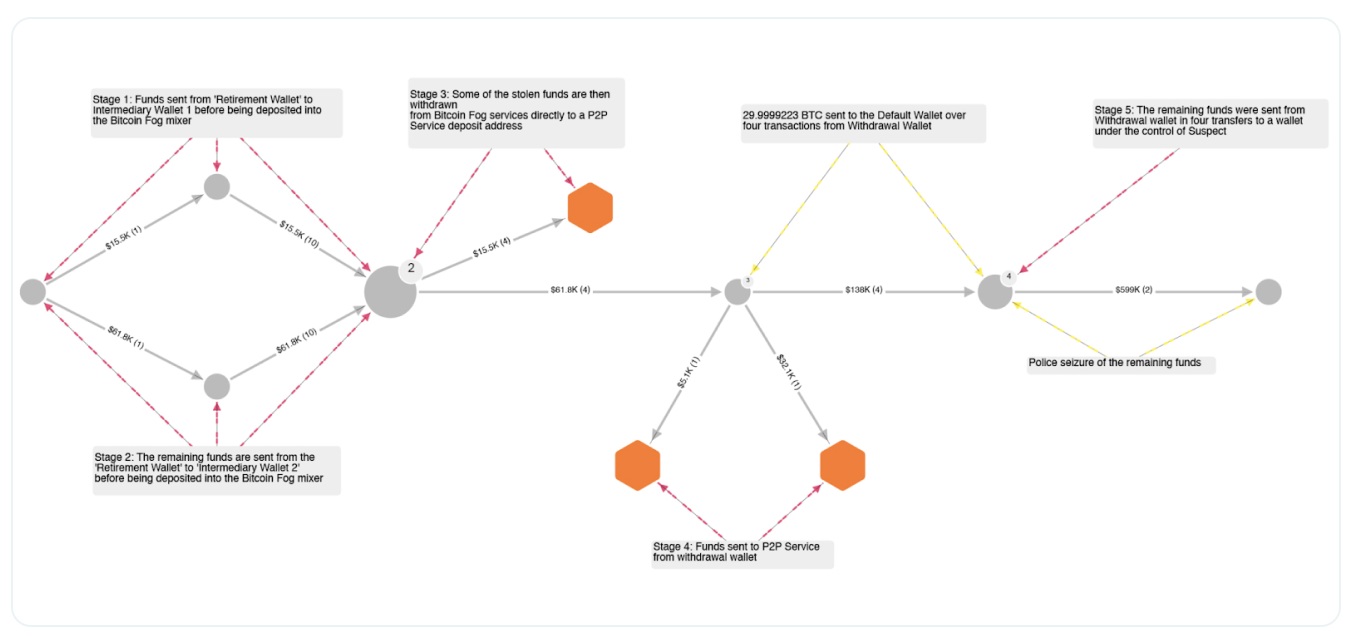
Pattern of bitcoin withdrawal to Chowles’ accounts. Visualization: Chainalysis
In July 2025, Paul Chowles was sentenced to five and a half years in prison by Liverpool Crown Court. Immediately after his sentencing, he was dismissed from the National Crime Agency. From the bank accounts of Chowles seized about $620 000, which the ex-police officer received as a result of the sale of cryptocurrency.

Useful material?
 Telegram
  Twitter
 Research
One and the same cryptocurrency address received two completely opposite assessments from different analytics systems: from an ordinary gambling service to an extremely severe criminal offense. This story has become the starting point for a broader conversation about what the scientific standards of blockchain analysis should look like — and why errors in systems like these can shape the fates of real people.
Jul 1, 2026
Research
The blockchain has helped uncover the ties between cryptocurrency fundraising campaigns, exchangers in Syria, and intermediaries in several countries around the world. A telltale pattern has emerged in which the same addresses were used across multiple donation drives at once
Jun 24, 2026
Research
Four Iranian cryptocurrency exchanges accounted for roughly 78% of all digital asset volume tied to the country in 2025. They have now become the focal point of the largest U.S. sanctions campaign against Iran's cryptocurrency infrastructure.
Jun 5, 2026
Research
A financial system is already up and running on public blockchains, with loans, analogues of U.S. Treasuries, and automated capital markets. More than $551 billion has flowed through DeFi protocols — but most of that activity has nothing to do with the real economy and everything to do with the speculative build-up of risk.
May 29, 2026
Research
Around 97% of Chinese suppliers of chemicals used to make fentanyl accept payment in cryptocurrency. The volume of such transactions continues to grow alongside the global market for synthetic drugs
May 22, 2026
Research
For the first time, the new law makes blockchain analytics an officially mandatory tool of financial oversight in the United States. Authorities will also gain the power to restrict transactions with foreign crypto services tied to money-laundering risks.
May 20, 2026
Cryptocurrency rates
-

Bitcoin
$80 872
BTC
+1.1%
-

Ethereum
$2 351.17
ETH
+1.83%
-

BNB Smart Chain
$746.35
BSC
+0.59%
-

Ripple
$1.42
XRP
+1.04%
-

TRON
$0.331139
TRX
+0.5%
-

Zcash
$1 307.4
ZEC
+6.69%
-

Dogecoin
$0.078542
DOGE
+1.7%
-

Cardano
$0.218269
ADA
+2.11%
-

Stellar XLM
$0.184461
XLM
+2.83%
-

Bitcoin Cash
$292.25
BCH
+4.71%