

Hackers from North Korea find jobs in foreign IT companies. How it happens
North Korea has found another source of funding — using large international technology and crypto companies
09.07.2025
730
3 min
0
The US Department of the Treasury’s Office of Foreign Assets Control (OFAC) has added North Korean citizen Song Kum Hyok to its sanctions list. GetBlock AML Research explains why this individual has caught the attention of US authorities.
Andariel group
OFAC believes that Song Kum Hyok was responsible for creating and organizing the successful operation of the Andariel special group. The group consists of North Korean IT specialists who, disguised as citizens of other countries, infiltrated large companies and transferred the proceeds to the North Korean government. Members of the group used fake identities to disguise themselves.
Some of the Andariel group was physically located in China and Russia. OFAC imposed sanctions against one individual and four organizations from Russia that helped members of the group conduct illegal activities.
Russian trace
Russian citizen Gayk Asatryan and companies controlled by him (Asatryan LLC and Fortuna LLC) came under US sanctions for assisting the North Korean group Andariel. In total, Asatryan’s organizations hired more than 80 North Korean IT specialists who were brought to Russia.
Andariel’s targets
According to an OFAC investigation, the group of IT specialists is targeting primarily large technology organizations and blockchain companies. US authorities estimate that thousands of employees from North Korea may currently be embedded in large companies around the world. They use fake or stolen documents, VPNs, and proxy servers to hide their true origin.
The transfer of revenue to the North Korean government occurs using USDC and USDT stablecoins through a complex blockchain obfuscation scheme. Song Kum Hyok acted as a handler for the Andariel group and was responsible for creating fake identities as well as stealing the identities of US citizens.
Footprints on the blockchain
Restrictive measures against Song Kum Hyok and his group followed the discovery by US authorities of an Andariel cell that attempted to conceal $7,7 million in cryptocurrency transfers. They also identified members of the group who worked for large companies with fake documents in the names of Joshua Palmer and Alex Hong.
Using disposable addresses, cross-chain bridges, and centralized exchanges, cryptocurrency was transferred to high-ranking DPRK officials (Kim Sang Man and Sim Hyun Soo), who are already under US sanctions. The Andariel group uses the technological infrastructure of Russia and the UAE to carry out illegal activities.
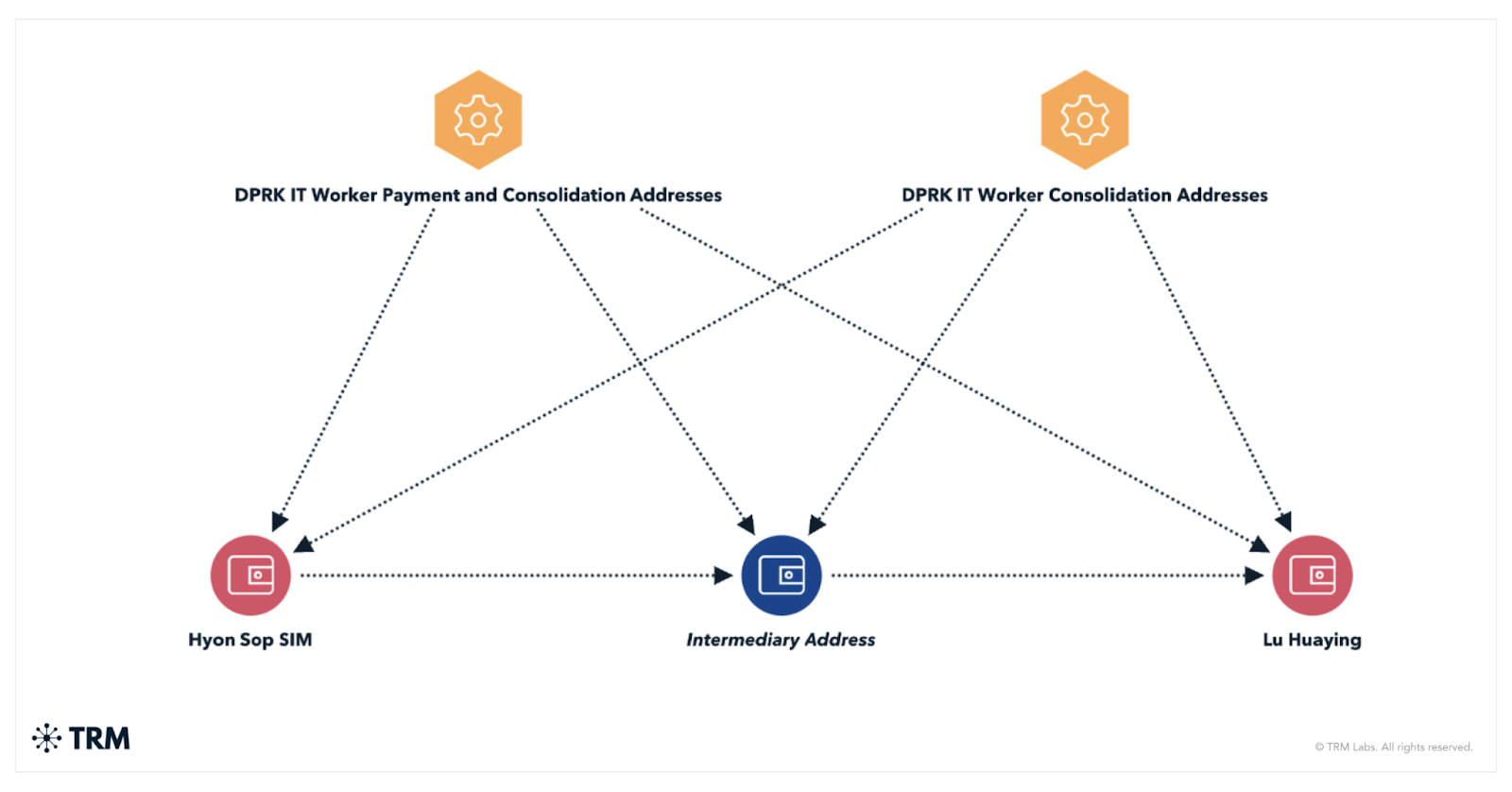
Structure of transfers to Kim Sang Man and Sim Hyun Soo’s wallets.
The $7,7 million discovered by OFAC that North Korean fraudsters received from US employers was seized by law enforcement. The US Treasury Department has asked the Justice Department to turn over the seized funds for government use.
GetBlock AML Research has previously alerted readers to the danger of North Korean hackers posing as IT specialists. Hackers from North Korea disguised as qualified specialists got a job in the company of Pepe meme creator Matt Furie, gained access to smart contracts of several projects, and withdrew assets from them.

Useful material?
 Telegram
  Twitter
 Research
One and the same cryptocurrency address received two completely opposite assessments from different analytics systems: from an ordinary gambling service to an extremely severe criminal offense. This story has become the starting point for a broader conversation about what the scientific standards of blockchain analysis should look like — and why errors in systems like these can shape the fates of real people.
Jul 1, 2026
Research
The blockchain has helped uncover the ties between cryptocurrency fundraising campaigns, exchangers in Syria, and intermediaries in several countries around the world. A telltale pattern has emerged in which the same addresses were used across multiple donation drives at once
Jun 24, 2026
Research
Four Iranian cryptocurrency exchanges accounted for roughly 78% of all digital asset volume tied to the country in 2025. They have now become the focal point of the largest U.S. sanctions campaign against Iran's cryptocurrency infrastructure.
Jun 5, 2026
Research
A financial system is already up and running on public blockchains, with loans, analogues of U.S. Treasuries, and automated capital markets. More than $551 billion has flowed through DeFi protocols — but most of that activity has nothing to do with the real economy and everything to do with the speculative build-up of risk.
May 29, 2026
Research
Around 97% of Chinese suppliers of chemicals used to make fentanyl accept payment in cryptocurrency. The volume of such transactions continues to grow alongside the global market for synthetic drugs
May 22, 2026
Research
For the first time, the new law makes blockchain analytics an officially mandatory tool of financial oversight in the United States. Authorities will also gain the power to restrict transactions with foreign crypto services tied to money-laundering risks.
May 20, 2026
Cryptocurrency rates
-

Bitcoin
$81 469
BTC
-1.04%
-

Ethereum
$2 383.16
ETH
-1.69%
-

BNB Smart Chain
$728.56
BSC
+0.59%
-

Ripple
$1.42
XRP
+1.04%
-

TRON
$0.332134
TRX
+0.45%
-

Zcash
$1 138.03
ZEC
-0.58%
-

Dogecoin
$0.078978
DOGE
-0.19%
-

Cardano
$0.218269
ADA
+2.11%
-

Stellar XLM
$0.184461
XLM
+2.83%
-

Bitcoin Cash
$273.38
BCH
-1.5%