

How hackers minted 1 billion DOT tokens out of thin air: the Hyperbridge exploit breakdown
The attacker exploited a code vulnerability and created 1 billion tokens — roughly 2,800 times the actual circulating supply. Losses totaled $237,000, but the real issue runs much deeper: the system accepted fake data as legitimate

20.04.2026
224
4 min
0
Key points:
- Polkadot confirmed that the Hyperbridge bridge issue only affected “wrapped” DOT tokens on Ethereum, not the native assets inside the Polkadot network or any connected projects.
- The attack resulted in approximately $237,000 in losses: the hacker minted 1 billion fake tokens — more than 2,800 times the actual circulating supply of the wrapped DOT.
- The Hyperbridge team has paused the bridge to investigate the vulnerability in the code, specifically a flaw in the Merkle Mountain Range data verification logic.
On April 13, 2026, Polkadot issued a statement following the discovery of a security issue in the contract connecting Ethereum to Hyperbridge. The team confirmed the attack was limited to wrapped DOT tokens on Ethereum. GetBlock AML Research breaks down the Hyperbridge hack.

Rhea Finance hack: DeFi platform loses over $7.6M
Part of the stolen USDT has already been frozen by Tether.
What caused the Hyperbridge hack: code error
Hyperbridge explained that its system was designed to reduce risks by using mathematical proofs from the blockchain instead of relying on trusted parties. This means the core security concept itself was not broken.
According to the investigation, the root cause was a bug in the Solidity code responsible for verifying data. The flaw allowed the system to accept fake proofs as valid.
This vulnerability enabled the attacker to bypass security checks, gain control over the token contract, and mint 1 billion new tokens — more than 2,800 times the real supply of roughly 356,000 tokens.
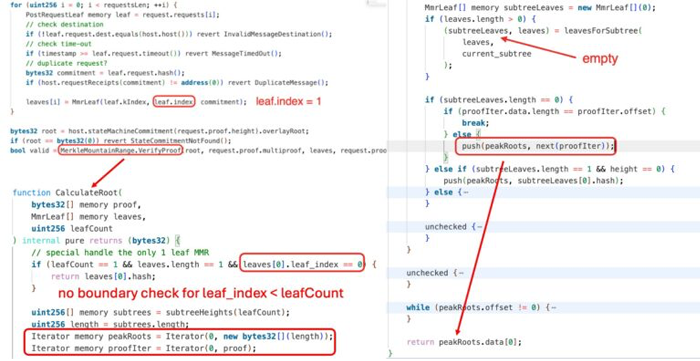
Vulnerabilities that led to the hack
The newly minted tokens were quickly sent to decentralized exchanges and sold. Hyperbridge said it is working with security partners to track the funds and attempt recovery. The team also promised to share updates as the investigation progresses.

Operation Atlantic: 20,000 victims and $12m frozen in major crackdown on crypto fraud
Scammers have figured out how to drain crypto wallets without ever stealing your password. We break down the new tactic called approval phishing and just how big the threat has become.
What happened to the DOT tokens and what risks remain
In its statement, Polkadot said: “We are aware of an issue affecting the Hyperbridge contract on Ethereum.” The team stressed that the problem is isolated to a specific part of the system and does not impact the broader Polkadot network.
They further clarified: “The attack only concerns DOT tokens on Ethereum that were bridged through Hyperbridge. It does not affect tokens within the Polkadot ecosystem or tokens bridged through other bridges.”
As a result, native DOT tokens inside the Polkadot network (including the relay chain and parachains) remain safe. As a precaution, all operations through the affected bridge were immediately paused.
Polkadot stated: “Hyperbridge has been paused pending further investigation.” This decision was made right after suspicious activity was detected.
Later, the Hyperbridge team published a detailed incident report, stating: “On April 13, 2026, a vulnerability in the Hyperbridge token bridging system was exploited, resulting in approximately $237,000 in losses on Ethereum.”
The platform also noted that many cross-chain bridging systems rely on trusted validators or special permissions, which introduce additional risks. Overall, such vulnerabilities have already caused over $2 billion in losses across the industry.

Useful material?
 Telegram
  Twitter
 Research
One and the same cryptocurrency address received two completely opposite assessments from different analytics systems: from an ordinary gambling service to an extremely severe criminal offense. This story has become the starting point for a broader conversation about what the scientific standards of blockchain analysis should look like — and why errors in systems like these can shape the fates of real people.
Jul 1, 2026
Research
The blockchain has helped uncover the ties between cryptocurrency fundraising campaigns, exchangers in Syria, and intermediaries in several countries around the world. A telltale pattern has emerged in which the same addresses were used across multiple donation drives at once
Jun 24, 2026
Research
Four Iranian cryptocurrency exchanges accounted for roughly 78% of all digital asset volume tied to the country in 2025. They have now become the focal point of the largest U.S. sanctions campaign against Iran's cryptocurrency infrastructure.
Jun 5, 2026
Research
A financial system is already up and running on public blockchains, with loans, analogues of U.S. Treasuries, and automated capital markets. More than $551 billion has flowed through DeFi protocols — but most of that activity has nothing to do with the real economy and everything to do with the speculative build-up of risk.
May 29, 2026
Research
Around 97% of Chinese suppliers of chemicals used to make fentanyl accept payment in cryptocurrency. The volume of such transactions continues to grow alongside the global market for synthetic drugs
May 22, 2026
Research
For the first time, the new law makes blockchain analytics an officially mandatory tool of financial oversight in the United States. Authorities will also gain the power to restrict transactions with foreign crypto services tied to money-laundering risks.
May 20, 2026
Cryptocurrency rates
-

Bitcoin
$82 327
BTC
-1.45%
-

Ethereum
$2 531.48
ETH
-1.71%
-

BNB Smart Chain
$759.33
BSC
-0.93%
-

Ripple
$1.42
XRP
+1.04%
-

TRON
$0.335126
TRX
+0.42%
-

Zcash
$1 198.81
ZEC
-8.46%
-

Dogecoin
$0.086832
DOGE
-2.32%
-

Cardano
$0.218269
ADA
+2.11%
-

Stellar XLM
$0.184461
XLM
+2.83%
-

Bitcoin Cash
$294.05
BCH
-2.71%