

International drug money laundering network uncovered. Three Mexican banks implicated
CIBanco, Intercam Banco, and Vector Casa de Bolsa assisted Mexican drug cartels, which the US has equated with international terrorist organizations
27.06.2025
732
2 min
0
Law enforcers uncovered yet another scheme that allowed drug cartels to legalize illicit proceeds using cryptocurrency. GetBlock AML Research publishes details of the investigation.
On June 25, the US Treasury Department’s Financial Crimes Enforcement Network (FinCEN) imposed sanctions against three Mexican banks (CIBanco, Intercam Banco, and Vector Casa de Bolsa). The organizations helped drug cartels launder funds derived from the sale of narcotic substances.
According to FinCEN, CIBanco, Intercam Banco, and Vector Casa de Bolsa helped the major international drug cartels CJNG, Gulf Cartel, Beltran-Leyva Organization, and Sinaloa Cartel hide criminal proceeds. The financial organizations also facilitated cash flows to Chinese suppliers of precursors used in the production of fentanyl.
Fentanyl is a narcotic opioid analgesic that was developed in the 1960s. It is used in medicine as a strong anesthetic.
Financial structure
Drug cartels have recently significantly increased their use of stablecoins in their operations. To remain undetected, they employ complex schemes involving asset splits, cross-chain exchanges, extensive drop networks, and trading platforms that lack AML and KYC procedures. The laundered funds were transferred to Mexican banks for further use in circulation.
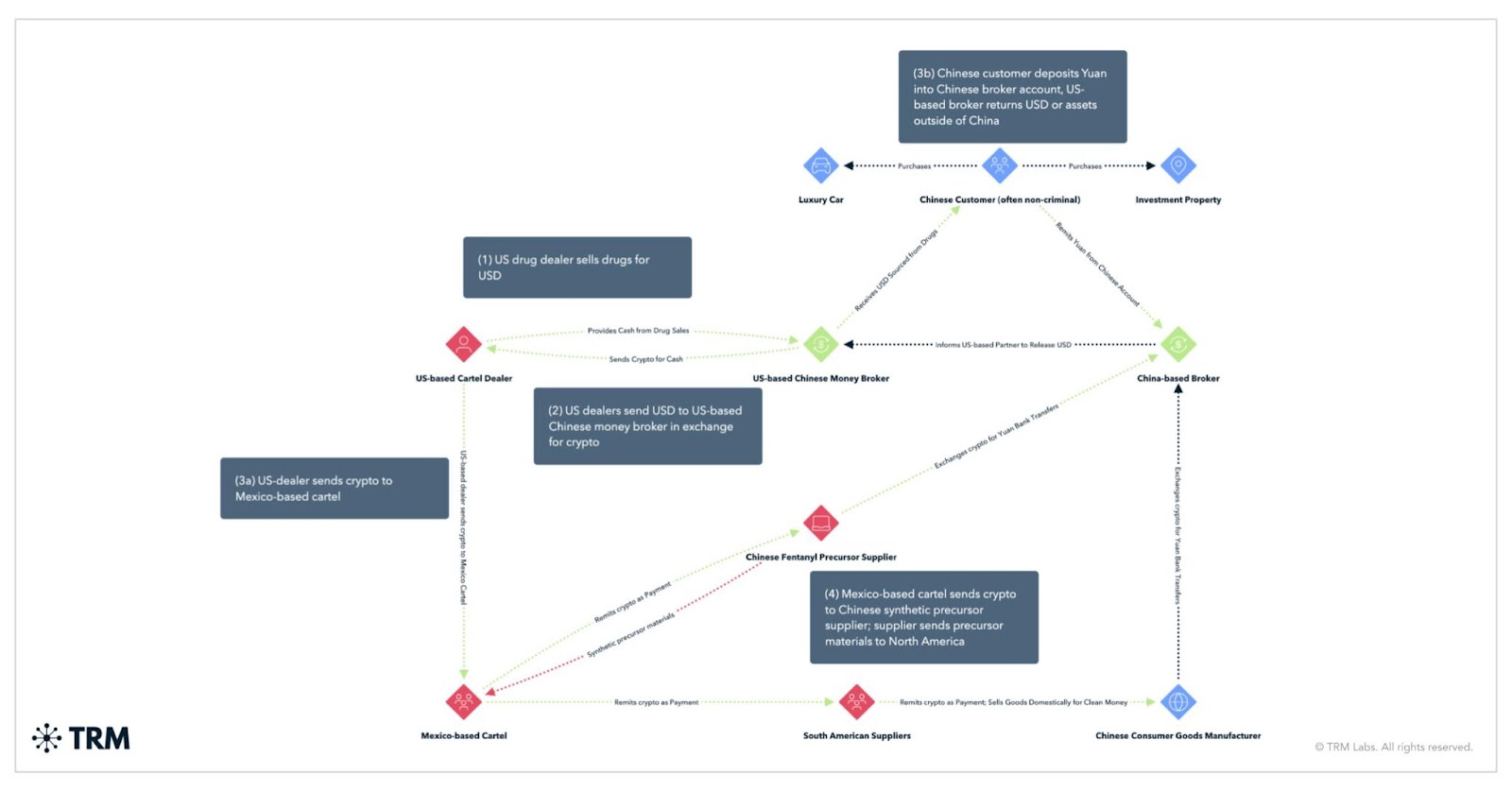
A scheme to launder drug trafficking proceeds through Mexican banks. Data: TRM Labs
Once the illicit proceeds were legalized, the cartels used them to purchase reagents in Wuhan, China.
In early 2025, the administration of US President Donald Trump instructed law enforcement agencies to equate Mexican drug cartels with international terrorist organizations and to step up counteraction against them.

Useful material?
 Telegram
  Twitter
 Research
One and the same cryptocurrency address received two completely opposite assessments from different analytics systems: from an ordinary gambling service to an extremely severe criminal offense. This story has become the starting point for a broader conversation about what the scientific standards of blockchain analysis should look like — and why errors in systems like these can shape the fates of real people.
Jul 1, 2026
Research
The blockchain has helped uncover the ties between cryptocurrency fundraising campaigns, exchangers in Syria, and intermediaries in several countries around the world. A telltale pattern has emerged in which the same addresses were used across multiple donation drives at once
Jun 24, 2026
Research
Four Iranian cryptocurrency exchanges accounted for roughly 78% of all digital asset volume tied to the country in 2025. They have now become the focal point of the largest U.S. sanctions campaign against Iran's cryptocurrency infrastructure.
Jun 5, 2026
Research
A financial system is already up and running on public blockchains, with loans, analogues of U.S. Treasuries, and automated capital markets. More than $551 billion has flowed through DeFi protocols — but most of that activity has nothing to do with the real economy and everything to do with the speculative build-up of risk.
May 29, 2026
Research
Around 97% of Chinese suppliers of chemicals used to make fentanyl accept payment in cryptocurrency. The volume of such transactions continues to grow alongside the global market for synthetic drugs
May 22, 2026
Research
For the first time, the new law makes blockchain analytics an officially mandatory tool of financial oversight in the United States. Authorities will also gain the power to restrict transactions with foreign crypto services tied to money-laundering risks.
May 20, 2026
Cryptocurrency rates
-

Bitcoin
$81 254
BTC
-0.15%
-

Ethereum
$2 394.92
ETH
+0.33%
-

BNB Smart Chain
$740.37
BSC
+1.22%
-

Ripple
$1.42
XRP
+1.04%
-

TRON
$0.329559
TRX
+0.5%
-

Zcash
$1 228.08
ZEC
+0.62%
-

Dogecoin
$0.079098
DOGE
+0.34%
-

Cardano
$0.218269
ADA
+2.11%
-

Stellar XLM
$0.184461
XLM
+2.83%
-

Bitcoin Cash
$284.69
BCH
+3.8%