


“Make a deal”: How the KiloEx exchange recovered $8,4 million in stolen assets
Exchange developers and hacker resolve Trump-style conflict of interest and make a favorable deal

23.04.2025
681
4 min
0
On April 14, decentralized crypto derivatives exchange KiloEx was hacked, with the help of which the hacker managed to withdraw $8,4 million in assets. A few days later, the trading platform was able to get the cryptocurrency back. GetBlock AML Research explains how this happened and what will happen to the exchange next.
The reason for the hack
After the attack, KiloEx discovered that the attacker had exploited an internal smart contract vulnerability that allowed them to bypass all checks and permissions to open positions and withdraw funds. The vulnerability was in the execute method of the TrustedForwarder contract, which inherited the MinimalForwarderUpgradeable contract without overriding the method.
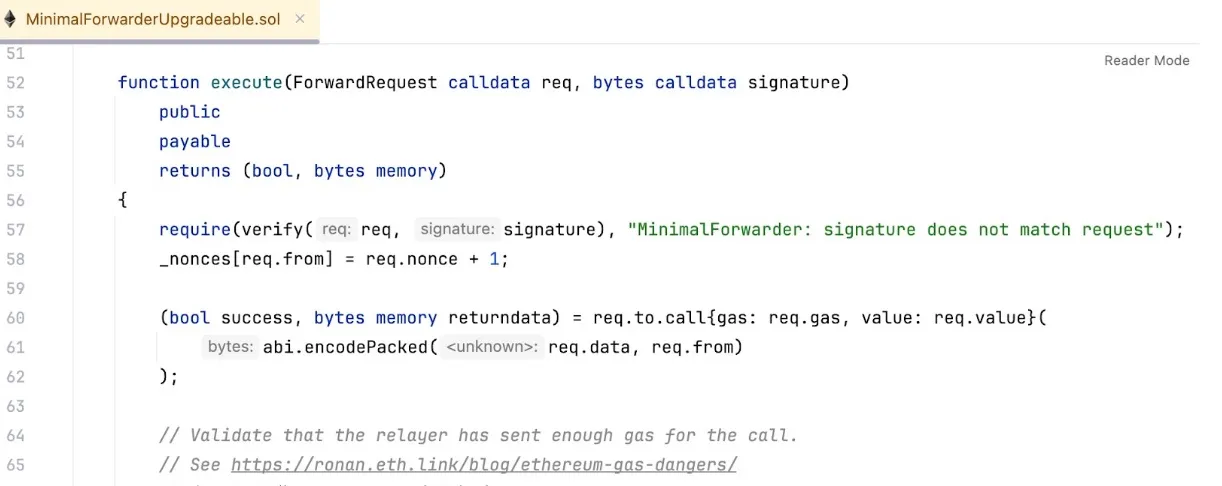
execute method source code
Attack chronology
13.04.25 23:31:59 UTC. An address belonging to the hacker (0x00faC92881556A90FdB19eAe9F23640B95B4bcBd) received 1 ETH from Tornado Cash as primary funding;
14.04.25 01:21:36 UTC. The hacker distributed funds to different networks (opBNB, Base, BSC, Taiko, B2, and Manta) using cross-chain bridges;
14.04.25 19:36:49 UTC. Malicious smart contracts with exploits were deployed in the networks described above;
14.04.25 19:40:49 UTC. The hacker conducted a successful attack using the deployed contracts.
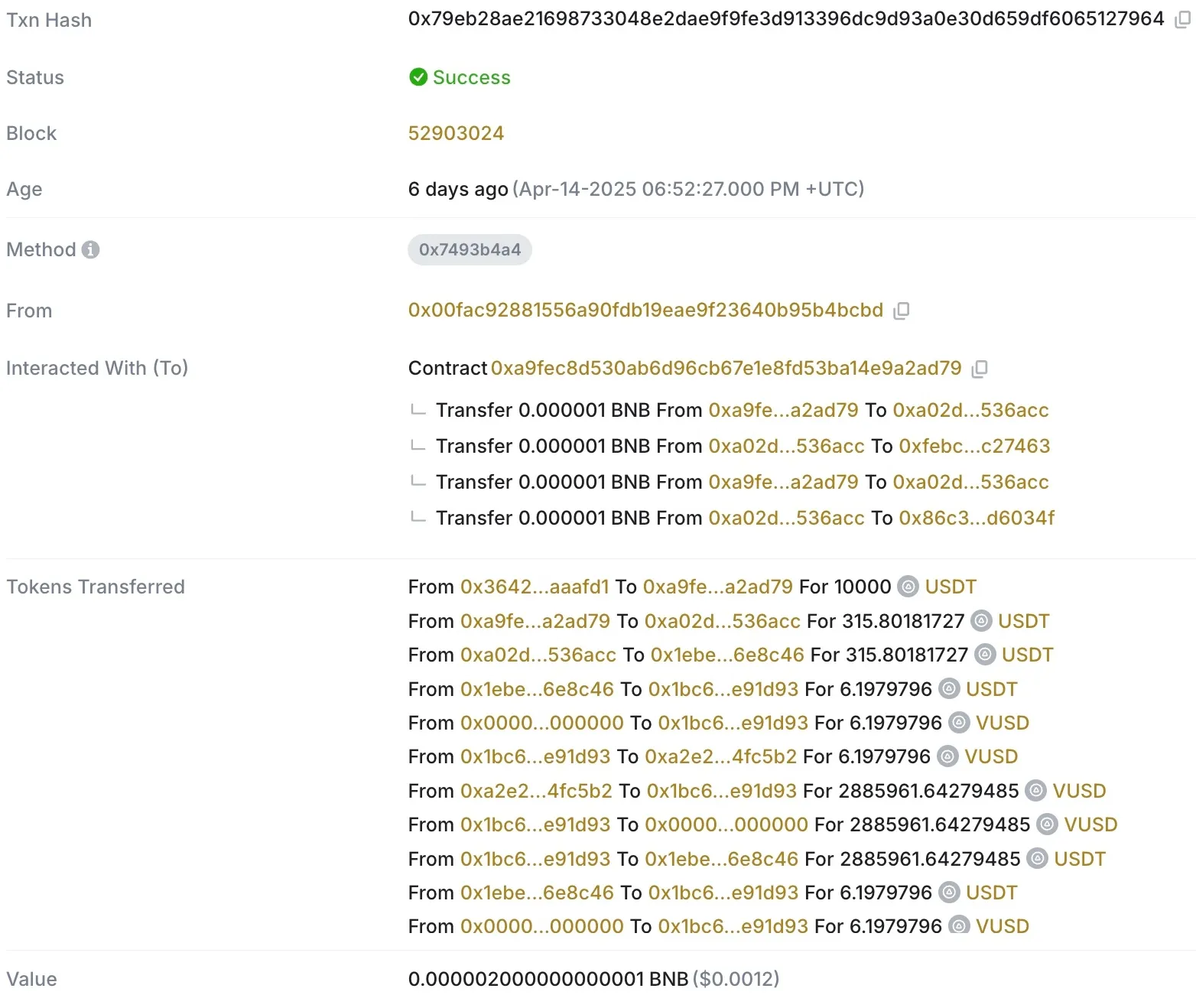
One of the malicious contracts on the opBNB network
KiloEx team response
The developers of the KiloEx exchange reacted to the attack lightning fast, analyzed and discovered the vulnerability used by the attacker. Having no alternatives, the KiloEx team quickly made the only correct decision — to contact the hacker and offer him to settle the situation by returning the funds. Under KiloEx’s terms, the hacker could keep 10% of the hack as a reward for finding the vulnerability.
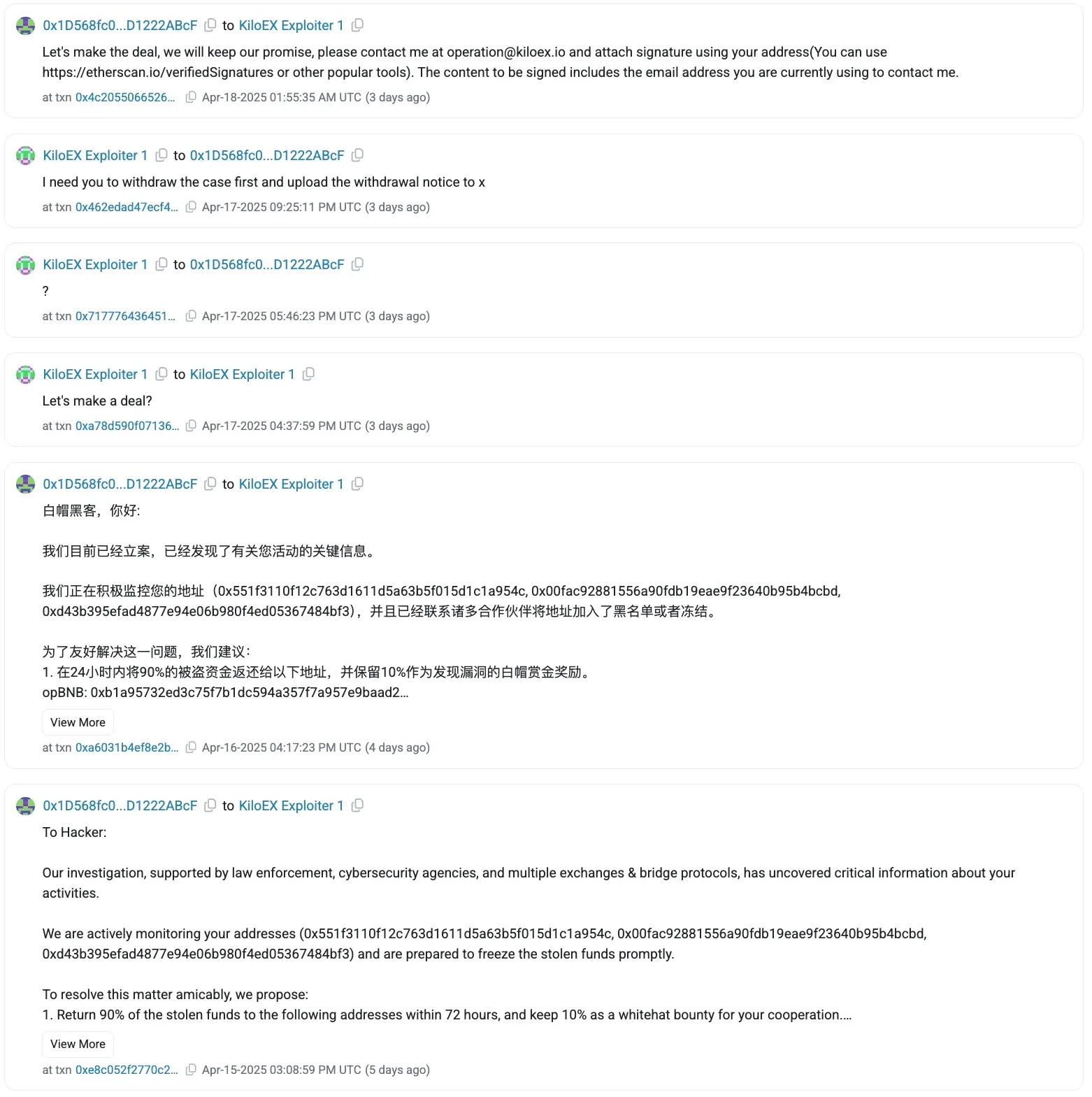
Communication between the KiloEx team and the hacker on the Ethereum blockchain
The hacker agreed to the KiloEx developers’ terms and returned the stolen assets to the exchange’s new secure wallets, except for his reward.
The addresses used by KiloEx to store the assets are:
- 0xb1a95732ed3c75f7b1dc594a357f7a957e9baad2 (opBNB network)
- 0xd38a22f5330f45162f13086d6ccbde0335c1ae9e (Ethereum network)
- 0x0f9c71f888c1d263eab34d6d9360a3a45855365d (Manta network)
It was the KiloEx team’s reaction speed and quick contact with the hacker that was able to resolve the situation and save the project, as the exchange developers contacted the hacker before he had a chance to launder funds.
Future plans have not been determined
After successfully recovering the stolen funds, the KiloEx team did not rush to relaunch the exchange. They said on their X social media page that they will first conduct a comprehensive security check to find other vulnerabilities and rule out the possibility of another hack. After that, KiloEx will conduct a full audit of the exchange’s logic and economic model. The duration of the technical work is estimated by the developers at about 45 days. After that, the KiloEx team will inform about further actions.
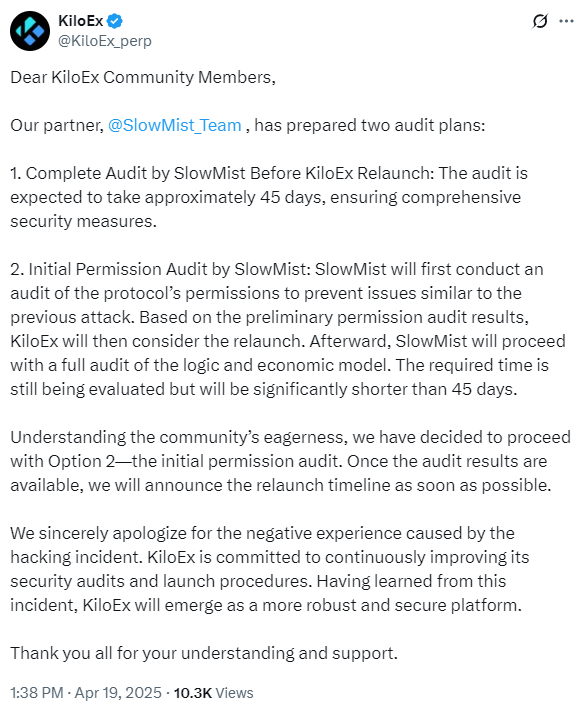
KiloEx team’s appeal on X

Useful material?
 Telegram
  Twitter
 Research
One and the same cryptocurrency address received two completely opposite assessments from different analytics systems: from an ordinary gambling service to an extremely severe criminal offense. This story has become the starting point for a broader conversation about what the scientific standards of blockchain analysis should look like — and why errors in systems like these can shape the fates of real people.
Jul 1, 2026
Research
The blockchain has helped uncover the ties between cryptocurrency fundraising campaigns, exchangers in Syria, and intermediaries in several countries around the world. A telltale pattern has emerged in which the same addresses were used across multiple donation drives at once
Jun 24, 2026
Research
Four Iranian cryptocurrency exchanges accounted for roughly 78% of all digital asset volume tied to the country in 2025. They have now become the focal point of the largest U.S. sanctions campaign against Iran's cryptocurrency infrastructure.
Jun 5, 2026
Research
A financial system is already up and running on public blockchains, with loans, analogues of U.S. Treasuries, and automated capital markets. More than $551 billion has flowed through DeFi protocols — but most of that activity has nothing to do with the real economy and everything to do with the speculative build-up of risk.
May 29, 2026
Research
Around 97% of Chinese suppliers of chemicals used to make fentanyl accept payment in cryptocurrency. The volume of such transactions continues to grow alongside the global market for synthetic drugs
May 22, 2026
Research
For the first time, the new law makes blockchain analytics an officially mandatory tool of financial oversight in the United States. Authorities will also gain the power to restrict transactions with foreign crypto services tied to money-laundering risks.
May 20, 2026
Cryptocurrency rates
-

Bitcoin
$84 571
BTC
-1.56%
-

Ethereum
$2 679.94
ETH
-1.73%
-

BNB Smart Chain
$765.36
BSC
-1.41%
-

Ripple
$1.42
XRP
+1.04%
-

TRON
$0.335233
TRX
+0.33%
-

Zcash
$1 311.79
ZEC
-4.69%
-

Dogecoin
$0.092762
DOGE
-3.07%
-

Cardano
$0.218269
ADA
+2.11%
-

Stellar XLM
$0.184461
XLM
+2.83%
-

Bitcoin Cash
$310.65
BCH
-1.02%