

The EU has imposed sanctions against the issuer of ruble-stablecoin A7A5. What’s important to know
Kyrgyz company A7, linked to Russian bank PSB, helped the sub-sanctioned crypto exchange Garantex withdraw liquidity from blocked addresses

16.07.2025
999
3 min
0
On July 15, the European Union imposed sanctions on Kyrgyz company A7, which is the issuer of the A7A5 ruble-stablecoin. GetBlock AML Research explains how, by whom, and for what purposes the issuer of the ruble-stablecoin is being used.
What is known
Kyrgyz company A7 appeared on the radar of financial controllers back in January 2025. At that time, the company issued more than 8 billion A7A5 coins on the Tron blockchain. The coin rate is linked to the value of the Russian ruble and is backed by foreign currency deposits at the Russian bank PSB (formerly Promsvyazbank). The owner of A7 is the Moldovan-born oligarch Ilan Shor, now living in Russia.
The Russian government owns PSB and has been the backbone bank for the defense-industrial complex since 2019. This enables the bank to fulfill the role of the primary financial institution serving the defense industry enterprises, including within the framework of the state defense order.
Most of the issued A7A5 coins (more than 5 billion) were transferred to the Russian sub-sanctioned crypto exchange Garantex (now Grinex). Already in March 2025, the ruble-stablecoin was used to withdraw liquidity from addresses that had been blacklisted by Tether (issuer of USDT). As a result of blocking the addresses, Garantex lost about $60 million in USDT. But the next month, the exchange resumed operations and moved operational flows to A7A5.
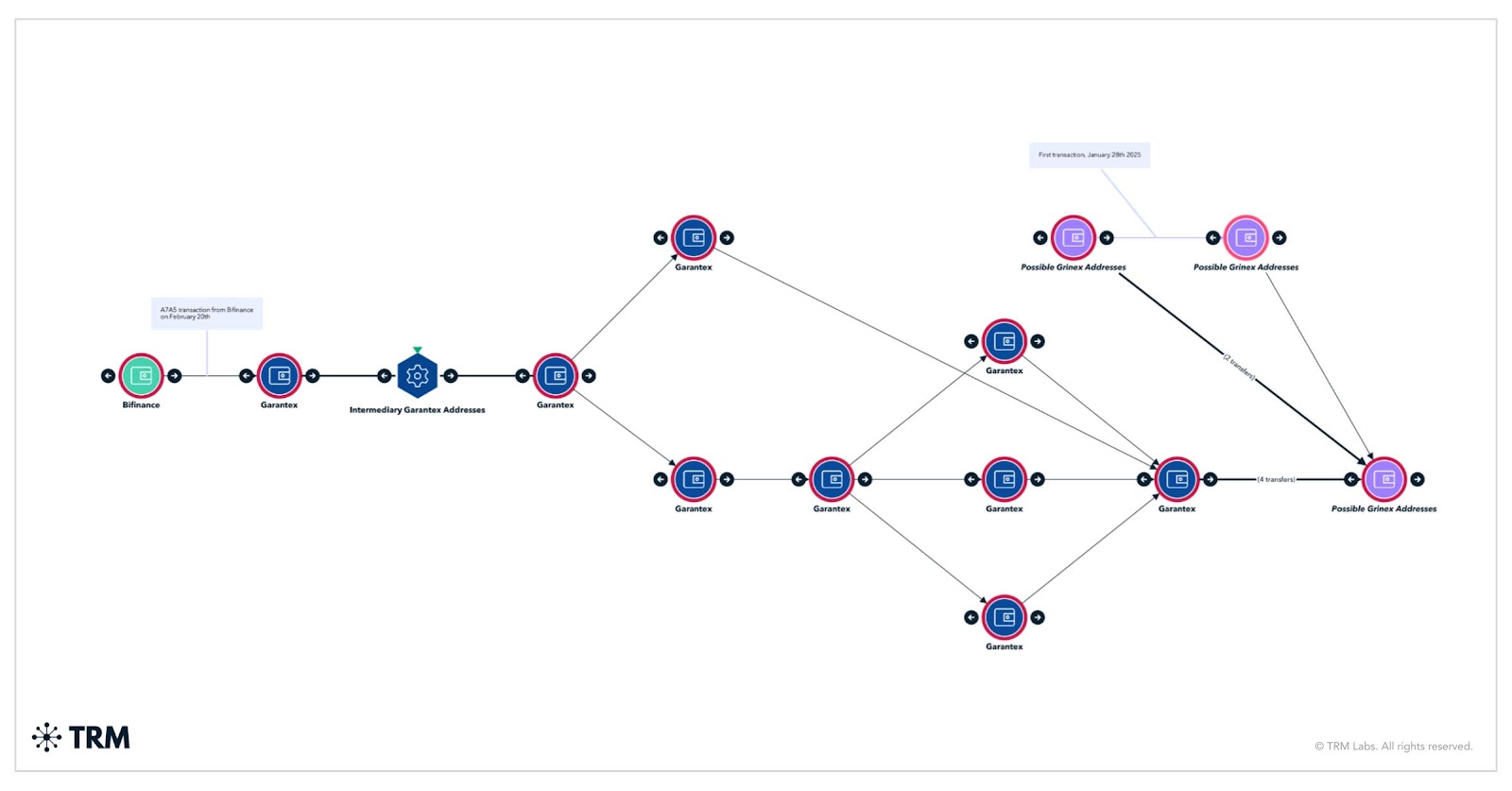
Migration of liquidity from Garantex wallets using A7A5 ruble-stablecoin. Visualization
EU attention
The inclusion of the company A7 in the European Union sanctions list is due to the fact that the organization tried to influence the presidential elections and the referendum on EU accession in the Republic of Moldova in 2024. The EU alleges that Shor used A7’s platform to bribe voters.
According to TRM Labs, in addition to illegal activities in Moldova, A7 and the Grinex exchange are linked to the importation of dual-use goods from China to Russia via Central Asian countries.
Storm-1516
The European Union has also placed Simeon Boikov, known by the pseudonym “Aussie Cossack,” on the sanctions list. According to the EU, Boikov has been spreading disinformation about the 2024 US presidential election and is also linked to Operation Storm-1516.
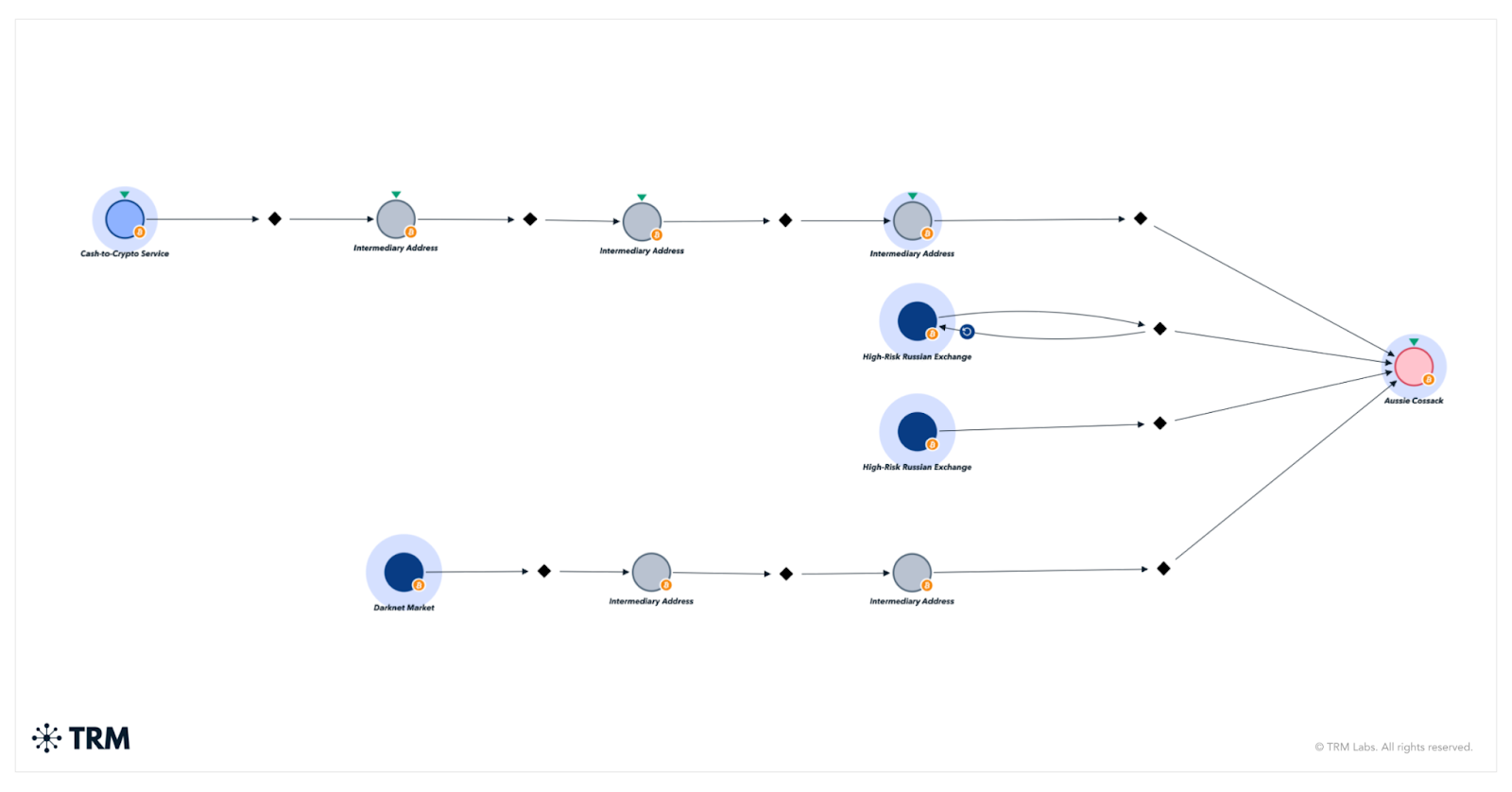
Linking Boikov’s donation addresses to Russian crypto exchanges
Operation Storm-1516 was organized by the Russian “Foundation to Battle Injustice” (R-FBI), which was founded in 2021 by businessman and head of PMC “Wagner” Yevgeny Prigozhin. As part of the operation, hundreds of fake news sites were created in the European information space, which promoted Russian propaganda. Influencers who spread disinformation and fakes were also recruited as part of Storm-1516.
Consequences of sanctions
Users who used their addresses on the Tron network to transact with A7A5 ruble-stablecoin may face asset blocking on trading platforms that comply with MiCA and provide services in the European Union. As of July 2025, exchanges Coinbase, Kraken, OKX, Bitstamp, and Bybit have already received such licenses.
Important: the compliance departments of these platforms may identify addresses that have transacted with A7A5 as high risk and block transactions that originate from these wallets to the exchanges.

Useful material?
 Telegram
  Twitter
 Research
One and the same cryptocurrency address received two completely opposite assessments from different analytics systems: from an ordinary gambling service to an extremely severe criminal offense. This story has become the starting point for a broader conversation about what the scientific standards of blockchain analysis should look like — and why errors in systems like these can shape the fates of real people.
Jul 1, 2026
Research
The blockchain has helped uncover the ties between cryptocurrency fundraising campaigns, exchangers in Syria, and intermediaries in several countries around the world. A telltale pattern has emerged in which the same addresses were used across multiple donation drives at once
Jun 24, 2026
Research
Four Iranian cryptocurrency exchanges accounted for roughly 78% of all digital asset volume tied to the country in 2025. They have now become the focal point of the largest U.S. sanctions campaign against Iran's cryptocurrency infrastructure.
Jun 5, 2026
Research
A financial system is already up and running on public blockchains, with loans, analogues of U.S. Treasuries, and automated capital markets. More than $551 billion has flowed through DeFi protocols — but most of that activity has nothing to do with the real economy and everything to do with the speculative build-up of risk.
May 29, 2026
Research
Around 97% of Chinese suppliers of chemicals used to make fentanyl accept payment in cryptocurrency. The volume of such transactions continues to grow alongside the global market for synthetic drugs
May 22, 2026
Research
For the first time, the new law makes blockchain analytics an officially mandatory tool of financial oversight in the United States. Authorities will also gain the power to restrict transactions with foreign crypto services tied to money-laundering risks.
May 20, 2026
Cryptocurrency rates
-

Bitcoin
$82 921
BTC
+2.18%
-

Ethereum
$2 488.88
ETH
+1.6%
-

BNB Smart Chain
$739.79
BSC
+0.51%
-

Ripple
$1.42
XRP
+1.04%
-

TRON
$0.332378
TRX
-0.15%
-

Zcash
$1 218.92
ZEC
+7.22%
-

Dogecoin
$0.084555
DOGE
+1.61%
-

Cardano
$0.218269
ADA
+2.11%
-

Stellar XLM
$0.184461
XLM
+2.83%
-

Bitcoin Cash
$274.88
BCH
-3.33%