

The Year of the DPRK: everything you need to know about North Korean hacker groups
North Korean hackers are currently the main threat to the cryptocurrency market, as they have managed to automate and streamline the theft of digital assets

29.10.2025
489
5 min
0
The year 2025 has become a landmark year for the security of the crypto industry. Many realized the real threat posed by North Korean hacker groups. GetBlock AML Research summarizes the activities of hackers from North Korea and reveals the main schemes they use.
1. Cryptocurrency thefts have become widespread
North Korea stole approximately $2,8 billion in cryptocurrencies between January 2024 and September 2025 alone. The most high-profile case was the $1,5 billion hack of the Bybit exchange in February by a group of hackers linked to the North Korean government. Unlike ordinary cybercriminals, who attempt to conceal their tracks, North Korean participants almost openly transfer stolen funds between different cryptocurrencies and blockchains, as if they are confident that no one will stop them.

How to launder $1,5 billion worth of crypto in 5 easy steps. Lazarus Group case
Crypto exchange Bybit managed to block only $42,8 million. This is less than 3% of the total value of stolen assets
2. Money laundering schemes are expanding
Stolen funds are taking increasingly convoluted paths: special services are used to cover the trail of transactions, as well as intermediaries operating in different countries. Particularly alarming is the strengthening of North Korean ties with criminal groups in Russia and Cambodia, as well as the circumvention of sanctions through bank cards and intermediaries in Hong Kong. These schemes complicate the search for and recovery of funds, but still leave a chance to stop the operations
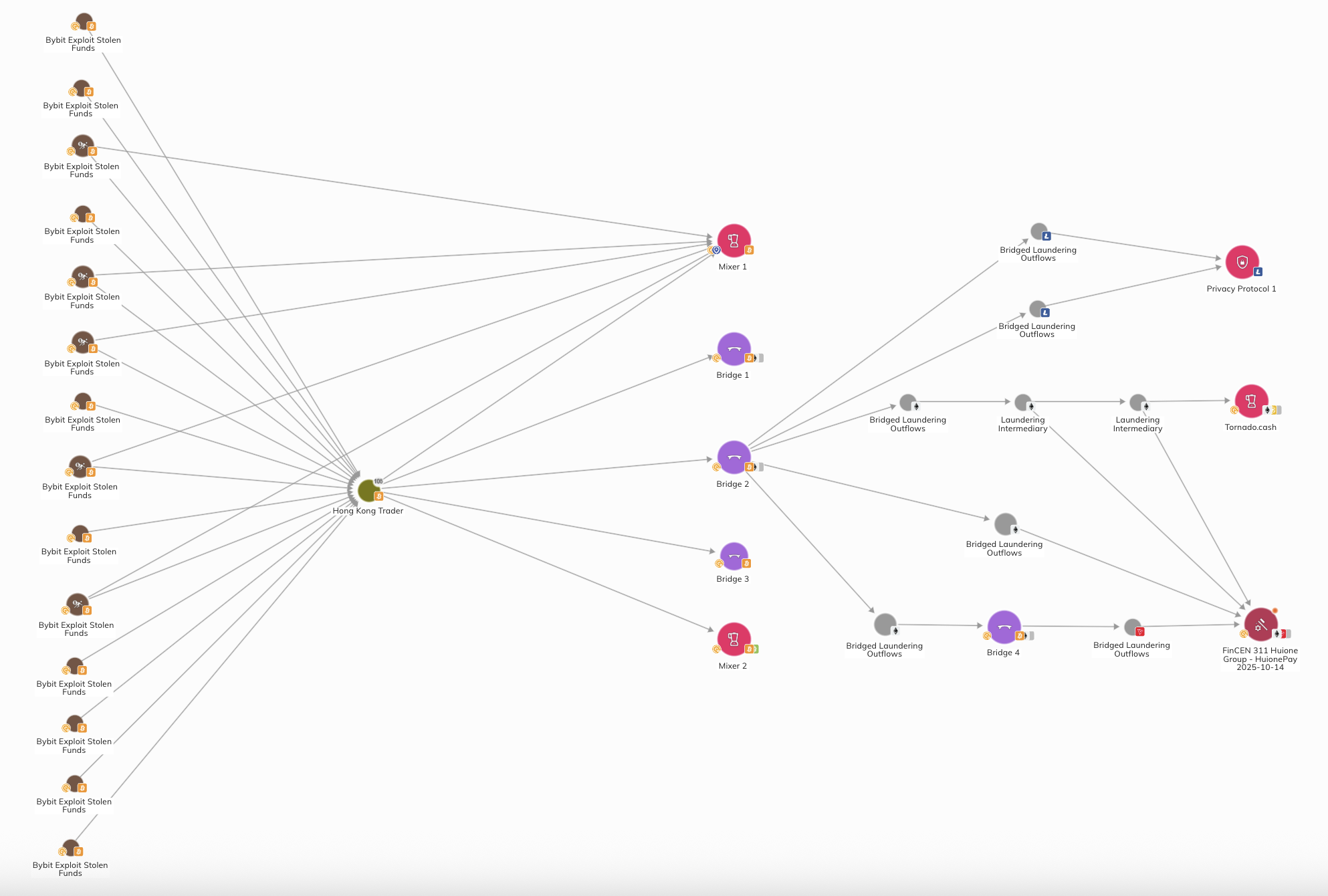
Cryptocurrency laundering scheme used by North Korean hackers
3. Attack methods are becoming more sophisticated
Phishing emails are still being used, but they are no longer the main focus. Hackers are increasingly attacking software providers and companies that store other people’s crypto assets. In other words, there is a shift from random thefts to targeted attacks on key infrastructure, which makes their strategy much more dangerous.
How to launder $1,5 billion worth of crypto in 5 easy steps. Lazarus Group case
Crypto exchange Bybit managed to block only $42,8 million. This is less than 3% of the total value of stolen assets
4. Working “under a false name” — a new source of income
Previously, this seemed like a minor scheme, but now it has turned into a global business. North Korean IT specialists get jobs at foreign companies under fictitious names and earn between $3500 and $10 000 per month, with the best earning up to $100 000. They work mainly from China and Russia, creating dozens of fake identities and targeting companies in important industries: artificial intelligence, blockchain, and defense technologies. Increasing attention is being paid to firms in Germany, Portugal, and the UK.

North Korean hackers hacked the creator of the Pepe meme. How it happened
The attackers released an unlimited number of Replicandy, Peplicator, Hedz, and Zogz NFT game projects
5. North Korea’s goal is not just money
The worst thing is that the stolen funds are being used to develop weapons. This money is used to purchase equipment and components for missile systems. At the same time, hackers are hunting for data on chip production, uranium processing, and missile technology. This creates a dangerous link between money theft, espionage, and military projects.
What does this mean?
North Korean cyber operations are no longer just crime for profit, but a multi-level strategy combining:
- financial theft
- technological espionage
- development of military capabilities
Countering this requires a comprehensive approach. Companies are advised to:
- strengthen the screening of IT specialists before hiring
- implement modern security systems
- monitor large transactions and suspicious operations
- conduct regular data protection audits
It is especially important to monitor cryptocurrency transactions, as North Korea is now actively targeting specific industries and regions.

Useful material?
 Telegram
  Twitter
 Research
One and the same cryptocurrency address received two completely opposite assessments from different analytics systems: from an ordinary gambling service to an extremely severe criminal offense. This story has become the starting point for a broader conversation about what the scientific standards of blockchain analysis should look like — and why errors in systems like these can shape the fates of real people.
Jul 1, 2026
Research
The blockchain has helped uncover the ties between cryptocurrency fundraising campaigns, exchangers in Syria, and intermediaries in several countries around the world. A telltale pattern has emerged in which the same addresses were used across multiple donation drives at once
Jun 24, 2026
Research
Four Iranian cryptocurrency exchanges accounted for roughly 78% of all digital asset volume tied to the country in 2025. They have now become the focal point of the largest U.S. sanctions campaign against Iran's cryptocurrency infrastructure.
Jun 5, 2026
Research
A financial system is already up and running on public blockchains, with loans, analogues of U.S. Treasuries, and automated capital markets. More than $551 billion has flowed through DeFi protocols — but most of that activity has nothing to do with the real economy and everything to do with the speculative build-up of risk.
May 29, 2026
Research
Around 97% of Chinese suppliers of chemicals used to make fentanyl accept payment in cryptocurrency. The volume of such transactions continues to grow alongside the global market for synthetic drugs
May 22, 2026
Research
For the first time, the new law makes blockchain analytics an officially mandatory tool of financial oversight in the United States. Authorities will also gain the power to restrict transactions with foreign crypto services tied to money-laundering risks.
May 20, 2026
Cryptocurrency rates
-

Bitcoin
$81 385
BTC
-1.68%
-

Ethereum
$2 379.56
ETH
-2.22%
-

BNB Smart Chain
$726.83
BSC
+0.13%
-

Ripple
$1.42
XRP
+1.04%
-

TRON
$0.331882
TRX
+0.29%
-

Zcash
$1 126.24
ZEC
-3.4%
-

Dogecoin
$0.078807
DOGE
-1.15%
-

Cardano
$0.218269
ADA
+2.11%
-

Stellar XLM
$0.184461
XLM
+2.83%
-

Bitcoin Cash
$273.57
BCH
-1.69%