

Tommy Robinson's $TOMMY memecoin on Pump.fun: how the politician and his son pulled off a 125.6 SOL rug pull
We trace the journey of the $TOMMY tokens and compare it with the earlier $UTK project, uncovering similar patterns of asset distribution and profit-taking. We explain why launches like these raise serious questions among participants in the cryptocurrency market
10.07.2026
911
15 min
0
Early in the morning of June 29, British political activist Stephen Yaxley-Lennon, better known as Tommy Robinson, posted a message on social media urging his followers to check out a new meme coin created on the Pump.fun platform. According to him, the fees generated from trading this cryptocurrency would go toward "making Britain better." GetBlock AML Research has uncovered some interesting details about Robinson's crypto ventures.
An analysis of blockchain data shows that ten cryptocurrency wallets, connected to one another by their funding sources, the timing of their operations, and their transaction patterns, acted as a single group tied to the token's launch. It was these addresses that received a significant share of the initial coin supply, took ten of the thirteen most profitable positions among all market participants, and sold their holdings virtually at the peak — at the very moment when Robinson's supporters were aggressively buying the token.
Today, the price of this cryptocurrency is down roughly 98% from its all-time high.
Key points:
- Tommy Robinson promoted the $TOMMY meme coin, created on the Pump.fun platform, claiming that fees from trading the token would be used "to make Britain better."
- A blockchain analysis links ten cryptocurrency wallets to a single operator involved in the launch of the project. It is these addresses that took ten of the thirteen most profitable positions among all market participants.
- The owners of these wallets sold their tokens practically at the peak, taking home a combined 125.6 SOL. After that, the coin's price dropped by roughly 98% from its peak, when the market cap had reached $144,000.
- The token was released by Tommy Robinson's son, and 65% of the total coin supply was subsequently transferred to Robinson's own public cryptocurrency wallet.
- A nearly identical scheme had already been used just a few weeks earlier for the launch of the $UTK token, tied to Robinson's political movement Unite the Kingdom.
How Tommy Robinson launched the $TOMMY meme coin on Pump.fun
On June 29, Tommy Robinson published a post announcing the launch of the Patriotic Bull ($TOMMY) meme coin, alongside an image of a bull in the colors of the British flag and the token's smart contract address. In the early hours of June 29, Robinson invited his followers to buy the new cryptocurrency.
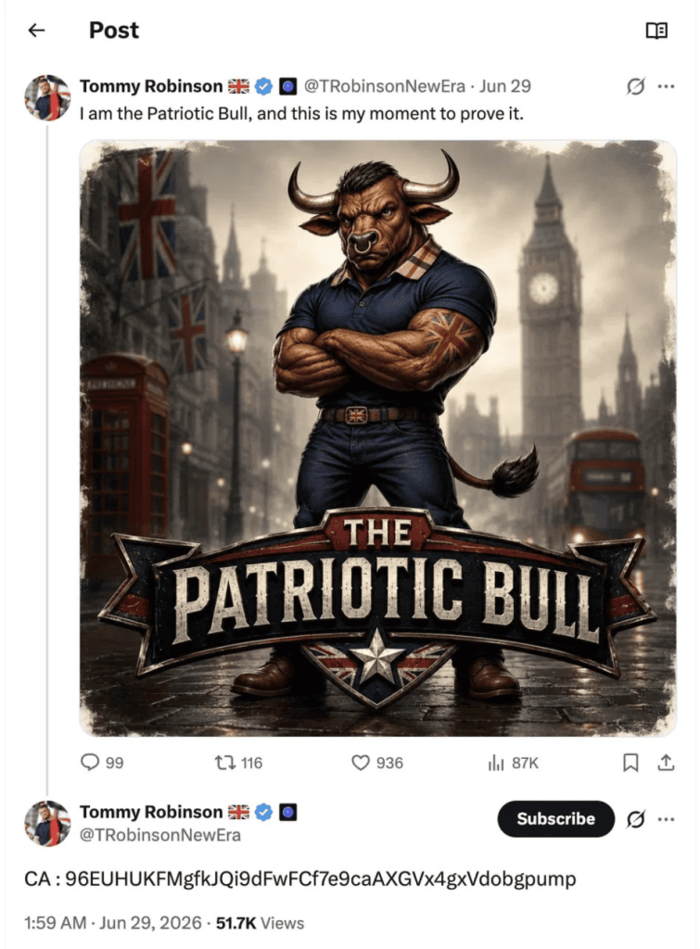
Announcement of the TOMMY token on X on Tommy Robinson's page
The post used an AI-generated image: a humanoid minotaur wearing a belt in the colors of the British flag, standing in front of the UK Parliament building.
"I am the Patriotic Bull, and now is my moment to prove it," Robinson wrote, at the same time posting a link to the token of the same name and stating that the proceeds from the fees would go "toward making Britain better."
About an hour after the post went up, part of his audience started to wonder whether Robinson was really launching his own cryptocurrency himself.
He responded:
"I haven't been hacked. I'm just letting my son promote his crypto. Honestly, I feel awkward posting messages like this myself."
Key terms
- Meme coin — a cryptocurrency with no real product, company, or technology behind it. The value of such tokens is driven purely by audience attention, online popularity, and speculative demand.
- Launchpad (Pump.fun, Bags.fm) — a dedicated platform that lets anyone create their own cryptocurrency on the Solana network in literally a matter of minutes and immediately open it up for free trading. There is virtually no upfront vetting of projects.
- Market cap — the estimated value of all outstanding tokens of a project, calculated based on their current market price. It is the metric typically used to gauge the size of a crypto project.
- Creator fees — a share of the fee taken from each trade that is automatically routed to the person who issued the token. These are the payments Tommy Robinson promised to use "to make Britain better."
- Bundling — a scheme in which one owner distributes a large volume of tokens across many different wallets. From the outside, it looks as though the asset is held by a large number of independent market participants, when in reality it is controlled by a single person or group.
- Rug pull — a common form of fraud in the crypto market, in which the creators or insiders first drum up attention around a new token, then sell off the large holdings they own to buyers. The price plummets, and ordinary investors are left with tokens worth next to nothing.
The Patriotic Bull ($TOMMY) meme coin
Blockchain / platform: Solana
Pump.fun (Pump AMM)
Smart contract address: 96EUHUKFMgfkJQi9dFwFCf7e9caAXGVx4gxVdobgpump
Peak market cap: $144,000
Current market cap: around $3,250
Liquidity: around $4,300
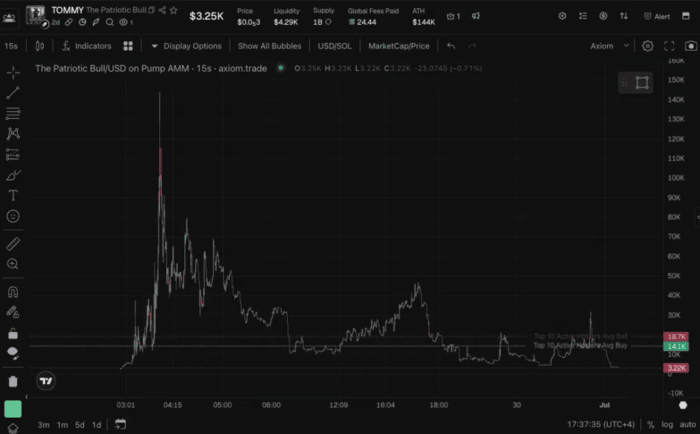
TOMMY token trading chart
The trading chart shows a picture that is typical for projects of this kind: after launch, the price surged, driving the market cap up to around $144,000, only to almost completely collapse afterwards, falling back to just a few thousand dollars.
How celebrities cash in on meme coins: insiders versus the audience
Any well-known figure trying to make money off a meme coin runs into the same problem. They have to strike a balance between turning a profit and being accused of effectively extracting money from their own audience. The fastest way to earn looks fairly straightforward.
First, quietly buy up a large share of the new token while almost no one knows about it. Then, once public interest picks up, start actively promoting it. After the price rises, sell those coins to the people drawn in by the promotion. A scheme like this really does turn a profit.
But it always produces obvious winners and losers. The insiders who bought the tokens early book their gains. The rest of the market, buying in later, ends up holding losses once the price collapses.
That is why practically every meme coin launch involving popular bloggers, politicians, or celebrities is dogged by accusations of fraud, market manipulation, or the use of insider information.
The result is that the damage extends beyond the token's price alone — it also erodes the trust of the audience in the person doing the promoting.
The $TOMMY scheme: Robinson's son released the token, and 65% of the supply landed in his father's wallet
An analysis of trading activity around the $TOMMY token has turned up a whole series of unusual transactions.
Tommy Robinson publicly claimed to have no connection whatsoever to the person who created the token, and said the only source of his income was the fees paid to him through the Creator Reward program. Robinson's post on X linked to the project's Pump.fun page and promised that the fees would be used "to make Britain better."
The promise in his own words: the money received in the form of fees would be used "to make Britain better." But the blockchain analysis paints a completely different picture.
The token was not created by an independent developer at all. It was released by Tommy Robinson's son. Blockchain records show that after the token was created, the developer transferred 65% of the entire supply to Robinson's public cryptocurrency address.
On top of that, before the promotional post on the social network X even went up, an additional batch of tokens was purchased and then distributed across several cryptocurrency wallets in such a way as to create the impression of a large number of independent market participants.
The analysis suggests that this arrangement made it possible to disguise the true scale of insider holdings in the token as early as the project's launch phase. Thanks to the Creator Reward program, Tommy Robinson's address has already received $5,090 in fees — the money he described as "funds for the good of Britain."
At the time of writing, that money was still sitting at the same cryptocurrency address and had not been transferred anywhere. The token creator's profile page on Pump.fun shows Creator Reward fees totaling $5,090. This is the very profile Robinson shared with his followers. The $5,090 in question is the official source of income he publicly talked about.
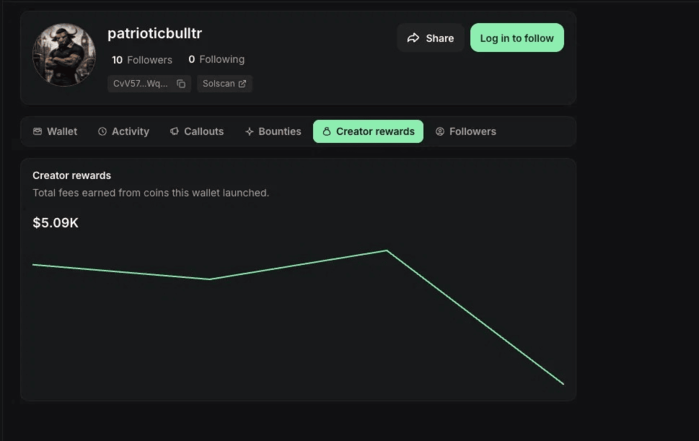
Pump.fun creator profile with accrued fees totaling $5.09K
But the story does not end there. After the launch, a significant portion of the token supply was traded through wallets that had been deliberately set up so that no connection between them would be visible. Before Robinson began aggressively promoting the coin, the entire initial supply had been quietly split up across several addresses in advance. As a result, one large, coordinated position looked like a swarm of independent traders.
The blockchain analysis links ten such wallets to a single operator. Between them, they took ten of the thirteen most profitable positions among all token holders, missing only spots #2, #8, and #10. Almost all of these wallets sold their holdings close to the peak, taking home a combined profit of 125.6 SOL. That income came on top of the fees credited to the project's creator.
Ten wallets — one operator: the insiders pocketed 125.6 SOL
| Address | Место в топе по прибыли | Источник пополнения | Реализованная прибыль |
| 5ymWG78VPbPN8AQeHJ5vkDDKjJumuGd3bcso9bpcdwv2 | №1 | MEXC | +20,17 SOL |
| 7rp1nMSQzijxshjW24m9Wit6qRNEsdGJ5auj8pNBo1hW | №3 | Address | +15,98 SOL |
| iWnCFTTzny4TUqBJ1WJoMgFeZnoaBsLDCRh48vB78yj | №4 | Bybit | +14,11 SOL |
| EfBwGRapRaKukJrACiy9R9Tor6LQe7yjJrjX3zzkwXtw | №5 | Address | +13,75 SOL |
| DDkspof8y97jJpSyDGNNC59KGzdxtpBA9NS2Camgjsjg | №6 | Mayan Bridge | +12,53 SOL |
| BrX1y2q5dGifjAaHC8W42qBpvd4GdCjgbSo3NX7KvP8d | №7 | Mayan Bridge | +11,07 SOL |
| 6dJQdDpPCvTru6Hr41FV23D1z2gADwNHGKnzZiJsfL7g | №9 | Address | +10,28 SOL |
| G3fte5Q64Xwbfd5CGGwP33w1uD5S1RR7dZyJ9dc7oQFZ | №11 | Address | +9,59 SOL |
| 59oQvfxv78JcWhqrv5rC1qJfuAc8WBzwVeKCLYuQy7aq | №12 | Address | +9,29 SOL |
| 6vyFxMqdUJkCbRVvCtFPjBt6D3gchvc5cjogtZFvgsF2 | №13 | Changelly | +8,79 SOL |
Total: around 125.6 SOL.
According to the blockchain transaction analysis, all of these addresses are connected to one another and lead back to a single operator tied to the launch of the token. That conclusion is based on the overlap of funding sources, the timing of the transactions, and the characteristic patterns of the transfers themselves.
Rug pull or gray area: the legal classification of the $TOMMY launch
Of the thirteen most profitable addresses, ten belong to a single group. They hold positions #1, #3–7, #9, and #11–13, and the funding of these wallets can be traced back through MEXC, Bybit, Changelly, and Mayan Bridge.
Formally speaking, token launches of this kind still sit in a legal gray zone: in many countries, they are effectively unregulated. But the scheme visible here is known in the cryptocurrency community as a rug pull — a situation in which the organizers sell a stockpile of tokens they had accumulated in advance to the very people they themselves brought into the project. For many market participants, further confirmation of intent comes from Robinson's own words about how he was "just helping my son promote his crypto."
Profile: who is Tommy Robinson, and how is he tied to crypto activism
Stephen Yaxley-Lennon, better known as Tommy Robinson, is one of Britain's best-known far-right activists and opponents of Islamization. In 2009, he was one of the co-founders of the English Defence League (EDL) and led the group until 2013. After leaving the EDL, Robinson began styling himself as an independent journalist, focusing his work on the subject of migration and criticism of immigration policy.
Over the years, he has been in trouble with the law on numerous occasions. Episodes from his biography include charges of assault, the use of a fake passport, and involvement in a mortgage fraud scheme. In 2014, a British court found that he had orchestrated a mortgage fraud scheme worth around £160,000, as reported at the time by ITV.
Today, Robinson organizes large-scale nationalist rallies, the biggest of which goes by the name Unite the Kingdom. It is with this movement that his own cryptocurrency token, $UTK, is associated.
The project has been partly funded through cryptocurrencies for several years. At the same time, Robinson's activities regularly draw media attention thanks to the backing of prominent entrepreneurs. It has been reported in the press, for example, that Elon Musk restored his X account after a ban and helped cover part of his legal costs, and that American businessman Robert Shillman has funded his activities in the past.
The $UTK token and the Unite the Kingdom movement: the same scheme a month before $TOMMY
Just weeks before Patriotic Bull appeared, a similar scheme had already been used around Robinson's own political movement. The $UTK token, tied to the Unite the Kingdom rally that took place on September 13 in London and drew well over 100,000 attendees, was launched on August 29, 2025, on the Bags.fm platform, which runs on the Solana network.
The project was built around the by-now-familiar idea of "voluntary donations." A 1% fee was taken from every transaction, of which 0.85%, it was claimed, went to Robinson. Buyers were told that by purchasing the token, they were funding the movement, and that Robinson took his cut of the fees whether the coin's price went up or down.
A livestream of the Unite the Kingdom rally with the $UTK logo displayed alongside those of crypto sponsors. During the broadcast of the event, the $UTK logo was shown on screen next to the logos of cryptocurrency companies, including JustFomo and Athena Bitcoin.
Robinson promoted the token aggressively. In the run-up to the rally, he took part in eleven lengthy X Spaces audio broadcasts devoted to promoting the project.
What is particularly striking is how his own statements in those broadcasts contradicted each other. While claiming to know virtually nothing about cryptocurrencies, he said in one breath: "Seven thousand pounds have already been made on this."
And immediately followed up with: "I'd love to know how to actually get that seven thousand pounds out to pay the bills." During one of the streams, the project's organizer said that in just four days he would be able to "write Tommy a check for $20,000."
At one point, Robinson asked outright: "Have I just done a rug pull?" The way the story unfolded was typical of projects like this.
The price of $UTK rose by roughly 58,000% by the time of the rally and hit its peak almost immediately after it wrapped up. The token's market cap approached $2.6 million.
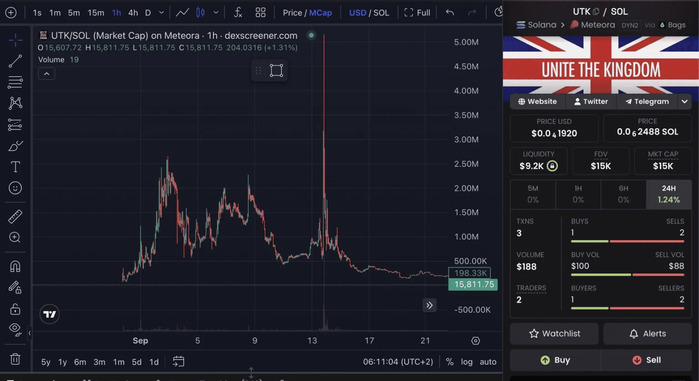
UTK token chart
But a week later, the coin was worth only about a tenth of the peak it had reached.
Tommy Robinson's fundraising history: from bitcoin donations in 2018 to Urban Scoop
The story of Patriotic Bull is far from the first time that public fundraising campaigns connected to Tommy Robinson have diverged from what the money was actually used for.
In 2018, when Robinson was in prison for contempt of court, his supporters sent him nearly £20,000 in bitcoin. Among these transfers was a single payment of more than £5,500, which passed through his cryptocurrency wallet on the same day he was taken into custody. That was reported at the time by ITV News.
In 2022, testifying at the UK High Court after losing a libel case brought by Syrian schoolboy Jamal Hijazi, and having already declared bankruptcy, Robinson said that he had spent around £100,000 on gambling — both in casinos and online. He also acknowledged that he had spent money on alcohol, parties, and entertainment, all while continuing to receive donations from his supporters. According to him, in 2020 those donations averaged around £1,000 a month, at times reaching £3,000 to £4,000 per month.
The scale of the financial infrastructure behind these fundraisers has also drawn the attention of researchers. In 2022, HOPE not hate published an investigation according to which Robinson effectively controls the company Urban Scoop and continues to run it behind the scenes. The authors of the study estimated that this operation brought in tens of thousands of pounds a month, which led them to describe Robinson as the wealthiest far-right activist in British history. Urban Scoop, meanwhile, continues to collect donations — including in cryptocurrency.
One mechanism for $TOMMY and $UTK: Robinson's audience cast in the role of buyers
The same pattern runs through all of the cases examined. Robinson lends the project his audience and takes a cut of the fees. Other people create the token, quietly seize a significant share of its supply in advance, and then sell those coins on to the very supporters Robinson brought into the project.
In the case of Patriotic Bull, the analysis suggests the key role was played by his son. In the case of $UTK, the launch was handled by an outside group of crypto operators. But the end result was the same.
In the first case, the insiders were closely tied to Robinson himself. In the second, they were third parties in the crypto market to whom he had, in effect, opened the doors to his audience.
According to Robinson himself, the $UTK project was run entirely by an outside team, while he simply received the trading fees. But that did nothing to change the outcome: the audience that trusted him bought the token, while other market participants were already in a favorable position to sell it.
In the case of Patriotic Bull, the insiders turned out to be people from Robinson's inner circle. In the case of $UTK — outside organizers. But in both cases, it was Robinson's supporters who ultimately ended up holding the rapidly collapsing tokens.

Useful material?
 Telegram
  Twitter
 Research
One and the same cryptocurrency address received two completely opposite assessments from different analytics systems: from an ordinary gambling service to an extremely severe criminal offense. This story has become the starting point for a broader conversation about what the scientific standards of blockchain analysis should look like — and why errors in systems like these can shape the fates of real people.
Jul 1, 2026
Research
The blockchain has helped uncover the ties between cryptocurrency fundraising campaigns, exchangers in Syria, and intermediaries in several countries around the world. A telltale pattern has emerged in which the same addresses were used across multiple donation drives at once
Jun 24, 2026
Research
Four Iranian cryptocurrency exchanges accounted for roughly 78% of all digital asset volume tied to the country in 2025. They have now become the focal point of the largest U.S. sanctions campaign against Iran's cryptocurrency infrastructure.
Jun 5, 2026
Research
A financial system is already up and running on public blockchains, with loans, analogues of U.S. Treasuries, and automated capital markets. More than $551 billion has flowed through DeFi protocols — but most of that activity has nothing to do with the real economy and everything to do with the speculative build-up of risk.
May 29, 2026
Research
Around 97% of Chinese suppliers of chemicals used to make fentanyl accept payment in cryptocurrency. The volume of such transactions continues to grow alongside the global market for synthetic drugs
May 22, 2026
Research
For the first time, the new law makes blockchain analytics an officially mandatory tool of financial oversight in the United States. Authorities will also gain the power to restrict transactions with foreign crypto services tied to money-laundering risks.
May 20, 2026
Cryptocurrency rates
-

Bitcoin
$80 038
BTC
-0.94%
-

Ethereum
$2 320.68
ETH
-1.83%
-

BNB Smart Chain
$741.65
BSC
-0.72%
-

Ripple
$1.42
XRP
+1.04%
-

TRON
$0.330065
TRX
+0.47%
-

Zcash
$1 204.29
ZEC
-0.84%
-

Dogecoin
$0.077088
DOGE
-0.69%
-

Cardano
$0.218269
ADA
+2.11%
-

Stellar XLM
$0.184461
XLM
+2.83%
-

Bitcoin Cash
$282.4
BCH
+2.1%