

Trump’s meme coin turns one: how the leader of the Western World left Investors holding the bag
We break down how the current U.S. president and World Liberty Financial allegedly manipulated the crypto market to generate more than $1 billion in profit.

23.01.2026
483
5 min
0
January 19 marked one year since the launch of U.S. President Donald Trump’s meme coin. The event became one of the most high-profile moments at the start of 2025 and significantly shaped subsequent developments in the crypto market. GetBlock AML Research reviews the first year of the TRUMP meme coin.
The value of the coin
The TRUMP meme coin was issued on the Solana network by World Liberty Financial, a company owned by Donald Trump’s family. The same company also launched other cryptocurrencies, including MELANIA and WLFI. The total supply of TRUMP was set at 1 billion tokens.
Trading in TRUMP began at $1, but by the next day, January 20, the price had surged past $45. Another day later, the token reached an all-time high of over $75. After that, the altcoin began to decline. At the time of publication, TRUMP is trading around $4.80, down nearly 94% from its peak.
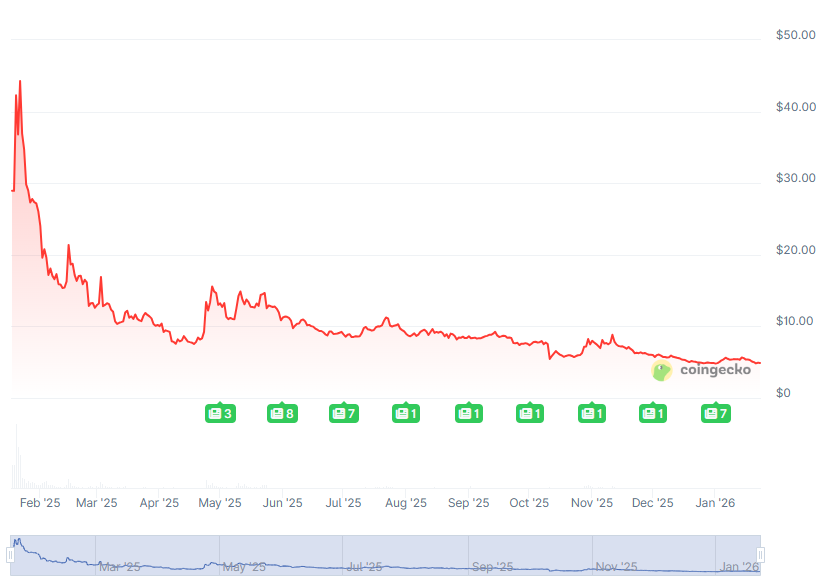
TRUMP price chart. Source: CoinGecko
According to Chainalysis, out of roughly two million wallets that bought TRUMP, the bulk of the profits went to just 58 addresses. These wallets are believed to belong to a single individual or entity, as they held identical amounts of TRUMP. Each of them earned more than $10 million. Meanwhile, over 764,000 TRUMP holders suffered losses, while the remaining addresses made only minimal gains.
The presidency as a marketing tool
The launch of TRUMP and its public sale began just one day before Donald Trump’s inauguration as U.S. president. This timing was likely no coincidence. It is also notable that Trump released his meme coin before officially taking office, as he may have faced legal restrictions after the inauguration.
Promoting personal crypto assets through political momentum delivered tangible results. In less than a year, the Trump family increased its wealth by approximately $1.4 billion through cryptocurrency. Most of this income came from the sale of TRUMP and WLFI tokens.
Gala dinner and ambassadors
Several months after TRUMP launched, as hype around the token faded and its price dropped sharply, Donald Trump made another high-profile move. Already serving as president, he hosted an exclusive gala dinner attended only by the largest holders of the TRUMP meme coin.
Among the guests were prominent crypto influencers who continued to promote Trump’s token and encouraged investors to keep accumulating it. One of the most notable ambassadors was Justin Sun, founder of the Tron blockchain. He invested $20 million in TRUMP and became the coin’s largest holder.
Later, Sun invested another $75 million in the WLFI token and nearly lost the entire amount. World Liberty Financial blacklisted Sun’s wallets, freezing his assets. To this day, he has been unable to sell or transfer his WLFI tokens, which have already lost around $60 million in value.
Liquidity extraction
The Trump family reportedly boosted profits from its crypto projects by extracting liquidity and conducting large-scale token sales. Developer-linked addresses associated with the TRUMP meme coin regularly removed liquidity from trading pools—funds that allow tokens to be exchanged or sold at market prices.
| One address used for liquidity withdrawals |
| 7qtDv72fGzuuGmyg1FkTxBybYH2sXkUd6u8WXwnkRnpE |
Democratic criticism
The financial maneuvers carried out by World Liberty Financial may be considered criminal only from a moral standpoint. As of now, U.S. law does not specifically regulate new forms of financial misconduct that exist exclusively within the crypto market.
Members of the Democratic Party have repeatedly urged the public and regulators to scrutinize the activities of the Trump family and its affiliated companies.
In November 2025, Democratic Senators Elizabeth Warren of Massachusetts and Jack Reed of Rhode Island sent a letter to U.S. Attorney General Pamela Bondi, calling for an investigation into World Liberty Financial over potential national security risks posed by the company and its connections. Warren and Reed expressed concern that no KYC procedures were applied during the initial sale of WLFI tokens. According to the senators, WLFI token holders included questionable actors such as North Korean hackers, money launderers, and sanctioned Russian and Iranian businessmen and companies.
Why did Trump pardon the former head of Binance? There is a simple explanation
The American leader may have pardoned Changpeng Zhao after receiving financial benefits from deals with the former Binance CEO’s entities
In October of the previous year, the attorney general received another request urging an investigation into Donald Trump’s decision to pardon former Binance CEO Changpeng Zhao. The letter was signed by seven Democratic senators. They believe the Trump family and World Liberty Financial have financial ties to Zhao, which could indicate a corrupt motive behind the pardon.

Useful material?
 Telegram
  Twitter
 Research
One and the same cryptocurrency address received two completely opposite assessments from different analytics systems: from an ordinary gambling service to an extremely severe criminal offense. This story has become the starting point for a broader conversation about what the scientific standards of blockchain analysis should look like — and why errors in systems like these can shape the fates of real people.
Jul 1, 2026
Research
The blockchain has helped uncover the ties between cryptocurrency fundraising campaigns, exchangers in Syria, and intermediaries in several countries around the world. A telltale pattern has emerged in which the same addresses were used across multiple donation drives at once
Jun 24, 2026
Research
Four Iranian cryptocurrency exchanges accounted for roughly 78% of all digital asset volume tied to the country in 2025. They have now become the focal point of the largest U.S. sanctions campaign against Iran's cryptocurrency infrastructure.
Jun 5, 2026
Research
A financial system is already up and running on public blockchains, with loans, analogues of U.S. Treasuries, and automated capital markets. More than $551 billion has flowed through DeFi protocols — but most of that activity has nothing to do with the real economy and everything to do with the speculative build-up of risk.
May 29, 2026
Research
Around 97% of Chinese suppliers of chemicals used to make fentanyl accept payment in cryptocurrency. The volume of such transactions continues to grow alongside the global market for synthetic drugs
May 22, 2026
Research
For the first time, the new law makes blockchain analytics an officially mandatory tool of financial oversight in the United States. Authorities will also gain the power to restrict transactions with foreign crypto services tied to money-laundering risks.
May 20, 2026
Cryptocurrency rates
-

Bitcoin
$83 299
BTC
+0.67%
-

Ethereum
$2 448.08
ETH
+0.03%
-

BNB Smart Chain
$744.13
BSC
+0.47%
-

Ripple
$1.42
XRP
+1.04%
-

TRON
$0.330188
TRX
-0.14%
-

Zcash
$1 305.31
ZEC
+3.2%
-

Dogecoin
$0.081004
DOGE
-0.86%
-

Cardano
$0.218269
ADA
+2.11%
-

Stellar XLM
$0.184461
XLM
+2.83%
-

Bitcoin Cash
$282.99
BCH
-1.11%