

US authorities have seized another $5,5 million from a drug cartel. Why is this important?
US law enforcement agencies continue to track schemes for laundering cryptocurrency obtained from drug trafficking

18.08.2025
775
4 min
0
Last year, federal prosecutors in the Eastern District of Wisconsin filed a lawsuit to confiscate more than $5,5 million in USDT. According to authorities, this money was earned through large-scale international drug trafficking. GetBlock AML Research reveals a complex scheme for laundering cryptocurrency obtained from the sale of narcotic substances.
These crypto assets were stored in different wallets. They were traced thanks to an investigation by the Drug Enforcement Administration (DEA), which used undercover agents, informants, and special tools to analyze the blockchain.
The complaint, filed on November 20, 2024, describes in detail how a professional money laundering network for cartels is organized. It showed that such networks combine:
- cash transportation,
- traditional bank transfers,
- fast cryptocurrency transactions.
All this is done to disguise the origin of criminal money.
How the scheme worked
The scheme replicated a proven cartel money laundering method. Cryptocurrency was a key element:
- Cash from cocaine sales in the US was collected by special intermediaries.
- The money was then quickly converted into various cryptocurrencies.
- The assets were transferred to an international account in a cryptocurrency service (account No. 7382) managed by a member of the cartel network.
- More than $15 million in cryptocurrency passed through this account, indicating that it was used as a “channel” to mask the origin of the money.
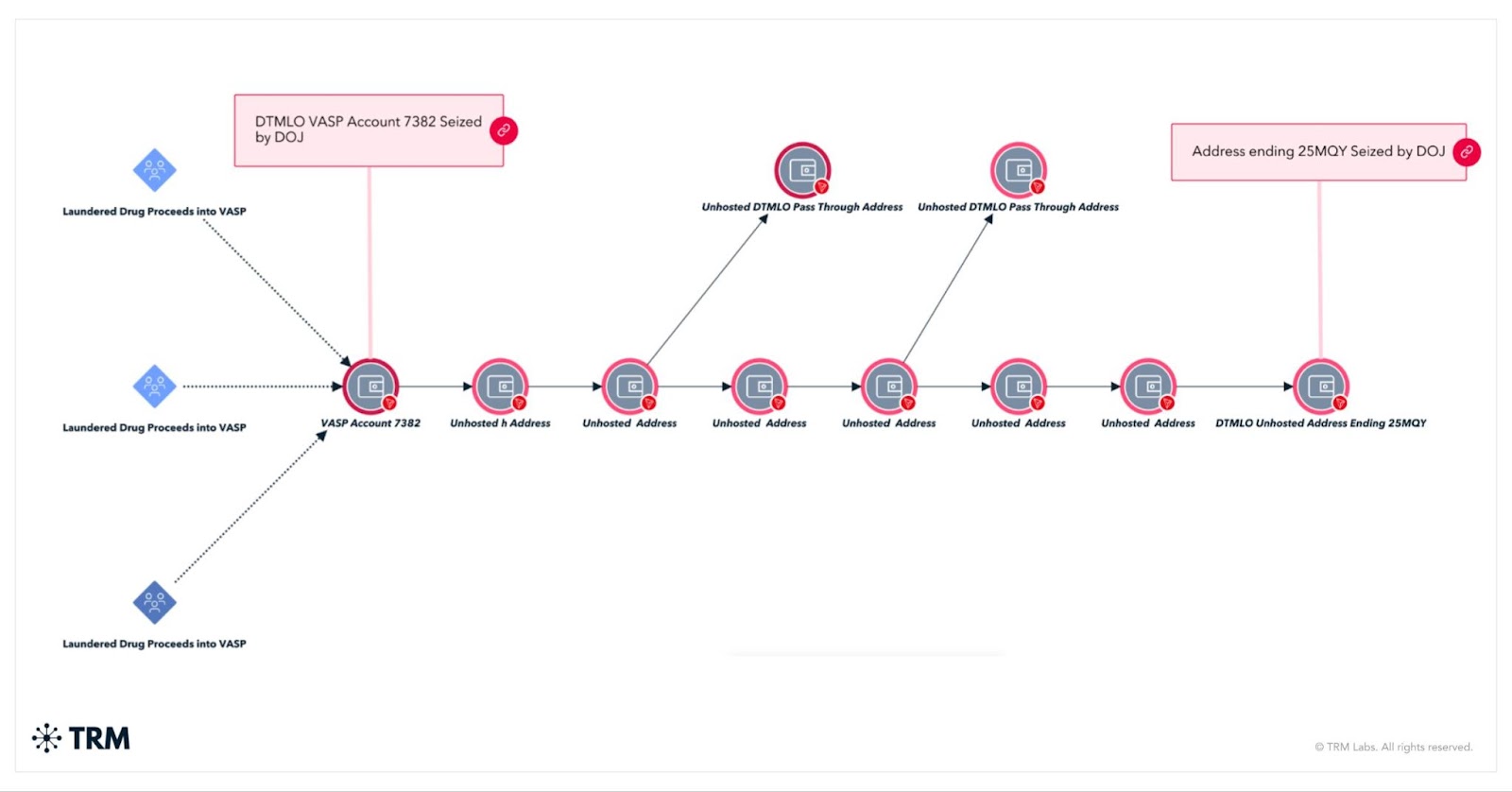
Scheme for laundering cryptocurrency obtained from drug trafficking
To make tracking more difficult, the funds were moved between different blockchain networks (TRON, Ethereum) and then through a chain of anonymous wallets. Ultimately, the money was collected at two TRON addresses, which the US Department of Justice recognized as proceeds from drug trafficking and confiscated.
On-chain tracking
DEA agents traced the money’s path:
- from street dealers,
- through an international exchange,
- then through a chain of wallets,
- and finally to addresses where the money was “stored” before being laundered.
Recently, the US Treasury Department (OFAC) imposed sanctions against the Mexican cartel Cartel del Noreste (CDN), which may be linked to synthetic drug manufacturers and accepts cryptocurrency as payment.
How the investigation was conducted
The Drug Enforcement Administration used different approaches to study criminals:
- traditional (undercover agents, sting operations, investigation of shell companies, analysis of banking operations),
- and modern (tracking blockchain transactions).
For example, one front company associated with this network carried out more than $22 million in suspicious transactions in less than a year. As a result, authorities were able to confiscate more than $5,5 million USDT.
Why it matters
The investigation revealed that stablecoins(USDT) can play a huge role in money laundering. Cartels use cash, cross-chain transfers, anonymous wallets, and dubious exchanges. All of this is combined into a single system where money is quickly “chased” to cover its tracks.
For law enforcement, this is an example of how combining traditional methods with blockchain analysis can help dismantle complex money laundering schemes. Although authorities did not specify whether any foreign participants in the scheme were arrested, the case dealt a serious blow to the cartel network.
Red flags for compliance
This investigation raised “red flags” for crypto companies:
- very fast transfers,
- no long-term balances in accounts,
- large amounts in anonymous wallets.
Thanks to blockchain analytics, companies can identify such signs and block risky customers.

Useful material?
 Telegram
  Twitter
 Research
One and the same cryptocurrency address received two completely opposite assessments from different analytics systems: from an ordinary gambling service to an extremely severe criminal offense. This story has become the starting point for a broader conversation about what the scientific standards of blockchain analysis should look like — and why errors in systems like these can shape the fates of real people.
Jul 1, 2026
Research
The blockchain has helped uncover the ties between cryptocurrency fundraising campaigns, exchangers in Syria, and intermediaries in several countries around the world. A telltale pattern has emerged in which the same addresses were used across multiple donation drives at once
Jun 24, 2026
Research
Four Iranian cryptocurrency exchanges accounted for roughly 78% of all digital asset volume tied to the country in 2025. They have now become the focal point of the largest U.S. sanctions campaign against Iran's cryptocurrency infrastructure.
Jun 5, 2026
Research
A financial system is already up and running on public blockchains, with loans, analogues of U.S. Treasuries, and automated capital markets. More than $551 billion has flowed through DeFi protocols — but most of that activity has nothing to do with the real economy and everything to do with the speculative build-up of risk.
May 29, 2026
Research
Around 97% of Chinese suppliers of chemicals used to make fentanyl accept payment in cryptocurrency. The volume of such transactions continues to grow alongside the global market for synthetic drugs
May 22, 2026
Research
For the first time, the new law makes blockchain analytics an officially mandatory tool of financial oversight in the United States. Authorities will also gain the power to restrict transactions with foreign crypto services tied to money-laundering risks.
May 20, 2026
Cryptocurrency rates
-

Bitcoin
$81 427
BTC
-0.4%
-

Ethereum
$2 424.08
ETH
-1.25%
-

BNB Smart Chain
$719.05
BSC
-0.93%
-

Ripple
$1.42
XRP
+1.04%
-

TRON
$0.336685
TRX
+0.46%
-

Zcash
$1 161.82
ZEC
-4.61%
-

Dogecoin
$0.079637
DOGE
-2%
-

Cardano
$0.218269
ADA
+2.11%
-

Stellar XLM
$0.184461
XLM
+2.83%
-

Bitcoin Cash
$272.48
BCH
-3.2%