

US Secret Service has seized a record $225 million in USDT. How it happened
Law enforcers uncovered a large-scale scheme to launder funds obtained by defrauding investors

23.06.2025
773
2 min
0
The US Secret Service, in conjunction with the Federal Bureau of Investigation, conducted an operation to disrupt an international group of fraudsters who were building advanced infrastructure to defraud users. GetBlock AML Research explains how US law enforcers managed to seize a record amount of cryptocurrency.
Essence of the scheme
At least 430 victims were identified worldwide (about 60 are in the United States). They were offered profitable ways to invest using fake trading platforms. Victims deposited funds on such platforms, and the attackers imitated high profit growth on user trading accounts. Victims were blocked or required to pay tax deductions when attempting to withdraw funds.
In the English-speaking world, this type of fraud is called pig butchering. Scammers use social engineering techniques to gain the trust of a potential victim and then offer to earn money through investments.
How funds were laundered
A complex scheme involving hundreds of disposable addresses was used to legalize cryptocurrency stolen from gullible users. Funds were passed through various cross-chain bridges to interrupt the chain of movement of coins. All this was done to eventually send the cryptocurrency to the centralized OKX exchange. A total of 144 addresses were discovered on the trading platform, which stored $225 million worth of stolen cryptocurrency.
The accounts on OKX that were used to launder the funds were verified using Vietnamese government-issued documents. The individuals who maintained these accounts often used Philippine IP addresses.
Tracing
Law enforcement officials were able to track down a scheme to launder stolen funds using on-chain data. One of the victims turned out to be the former CEO (full name withheld as part of the investigation) of Heartland Tri-State Bank in Elkhart, Kansas. He misappropriated more than $47 million of the bank’s assets, which he decided to invest in cryptocurrency, and transferred the funds to a fraudulent platform. One of the transactions for $3 million was passed through 16 intermediate addresses before reaching the OKX wallet.
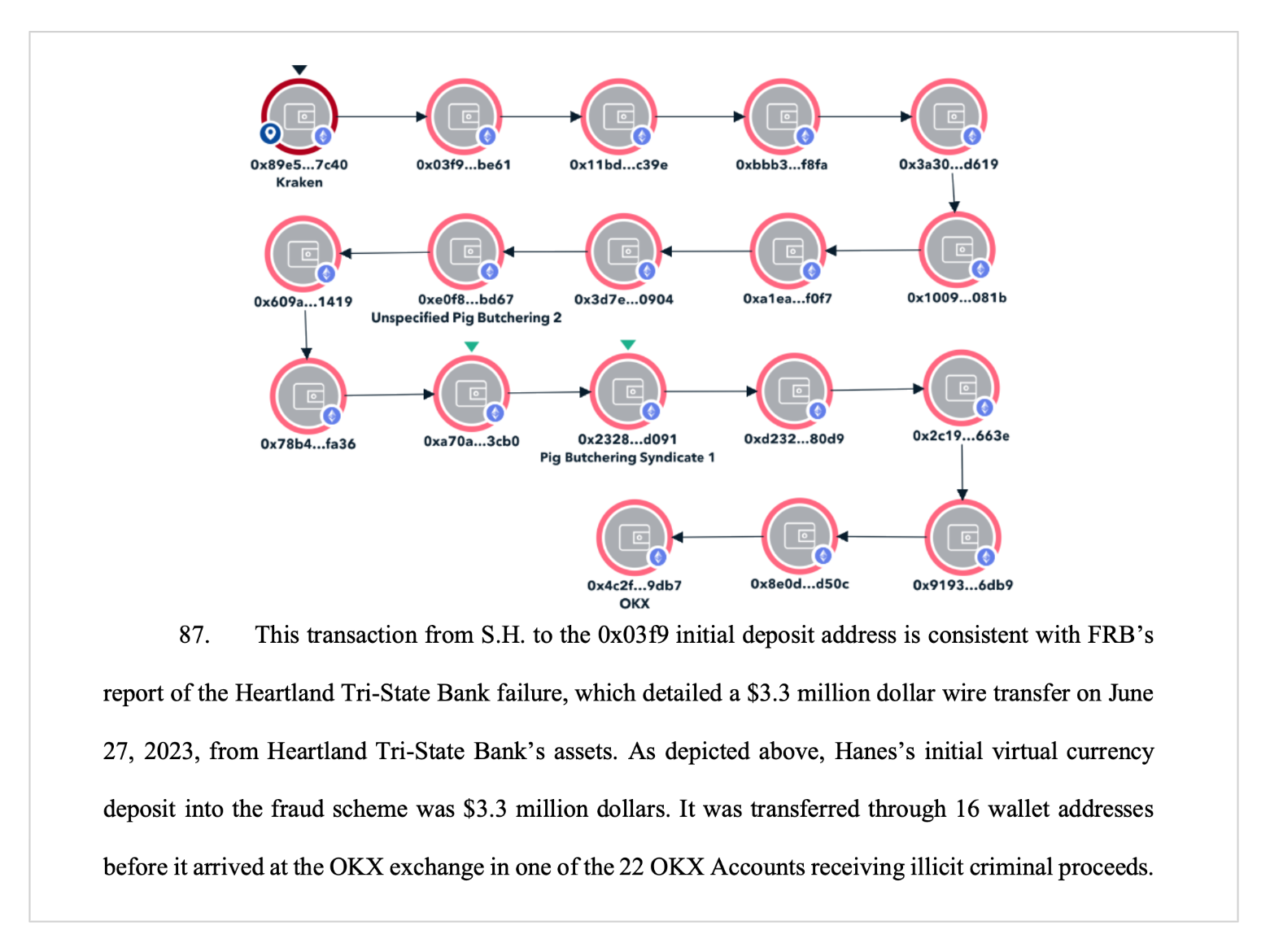
Money laundering transaction chain leading to OKX
After uncovering the money laundering scheme, law enforcers, with the help of OKX exchange and Tether, conducted an operation to block the accounts and seize the criminal proceeds, which were represented in USDT stablecoins.
Further fate of assets
The United States will seek forfeiture of the seized $225 million to the government based on two federal statutes: 18 U.S.C. § 981(a)(1)(A) and 18 U.S.C. § 981(a)(1)(C).

Useful material?
 Telegram
  Twitter
 Research
One and the same cryptocurrency address received two completely opposite assessments from different analytics systems: from an ordinary gambling service to an extremely severe criminal offense. This story has become the starting point for a broader conversation about what the scientific standards of blockchain analysis should look like — and why errors in systems like these can shape the fates of real people.
Jul 1, 2026
Research
The blockchain has helped uncover the ties between cryptocurrency fundraising campaigns, exchangers in Syria, and intermediaries in several countries around the world. A telltale pattern has emerged in which the same addresses were used across multiple donation drives at once
Jun 24, 2026
Research
Four Iranian cryptocurrency exchanges accounted for roughly 78% of all digital asset volume tied to the country in 2025. They have now become the focal point of the largest U.S. sanctions campaign against Iran's cryptocurrency infrastructure.
Jun 5, 2026
Research
A financial system is already up and running on public blockchains, with loans, analogues of U.S. Treasuries, and automated capital markets. More than $551 billion has flowed through DeFi protocols — but most of that activity has nothing to do with the real economy and everything to do with the speculative build-up of risk.
May 29, 2026
Research
Around 97% of Chinese suppliers of chemicals used to make fentanyl accept payment in cryptocurrency. The volume of such transactions continues to grow alongside the global market for synthetic drugs
May 22, 2026
Research
For the first time, the new law makes blockchain analytics an officially mandatory tool of financial oversight in the United States. Authorities will also gain the power to restrict transactions with foreign crypto services tied to money-laundering risks.
May 20, 2026
Cryptocurrency rates
-

Bitcoin
$84 589
BTC
-2.12%
-

Ethereum
$2 677.05
ETH
-1.9%
-

BNB Smart Chain
$767.18
BSC
-1.56%
-

Ripple
$1.42
XRP
+1.04%
-

TRON
$0.33469
TRX
-0.08%
-

Zcash
$1 320.03
ZEC
-5.23%
-

Dogecoin
$0.093072
DOGE
-3.22%
-

Cardano
$0.218269
ADA
+2.11%
-

Stellar XLM
$0.184461
XLM
+2.83%
-

Bitcoin Cash
$309.28
BCH
-1.32%