

Why the USR token collapsed: a breakdown of the Revolv hack
The attack on Revolv showed how critical a compromise of cloud infrastructure can be. The attacker managed to mint tens of millions of tokens with minimal cost

27.03.2026
246
5 min
0
On March 22, 2026, the Revolv protocol was attacked, resulting in losses of approximately $26.8 million. The root cause was a compromise of the project’s cloud infrastructure, which gave the attacker access to AWS Key Management Service (KMS). GetBlock AML Research provides a detailed breakdown of the Revolv attack.
Revolv uses a hybrid model: users deposit collateral (e.g., USDC), after which an off-chain system verifies the deposit and authorizes the minting of the internal token USR. The attacker first made several small legitimate deposits (approximately $100,000–$200,000 in USDC).
Then, using compromised privileged access (a so-called “service role”), they called the completeSwap() function and manually inflated the amount of USR tokens received. As a result, in just two transactions, the attacker obtained 80 million USR. The excessive token issuance caused a sharp price drop — from $1 to $0.03 — after which other platforms began suspending operations with the asset.
How the Revolv hack happened and access to AWS KMS
To secure its keys, Revolv used AWS KMS — a cloud-based key management system.
Why AWS KMS is used and how key management works
First, it provides security at scale: if a platform serves thousands of users, storing keys on separate physical devices is impractical — cloud solutions allow centralized management.
Second, access control: only specific services or employees can use the keys, with actions restricted and auditable. Auditability and compliance are also critical — every key usage is logged, which is essential for regulated companies.
Additionally, the system provides backup and recovery of keys and enables automatic transaction signing without manual intervention. Within this system was the key that allowed the attacker to access the “service role.” This enabled them to:
- sign operations to mint any amount of tokens (the contract enforced a minimum, but not a maximum),
- generate signatures that the system treated as legitimate,
- mint tens of millions of tokens with minimal real deposits using the completeSwap() function.
How the attack unfolded and USR tokens were minted
| Affected addresses |
| 0xa27a69Ae180e202fDe5D38189a3F24Fe24E55861 (контракт USR) |
| 0x15CAd41e6BdCaDc7121ce65080489C92CF6de398 (сервисный кошелек) |
Timeline of the Revolv attack
- March 22, 2026, 01:50:59: The attacker created a swap request, depositing approximately 100,000 USDC. Transaction: 0x590b5c66df27b7f34cde721ca1b5f973ae047ffda370610491f694dade732c89
- March 22, 2026, 02:21:35: The attacker created a swap request, depositing approximately 100,000 USDC. Transaction: 0xfe37f25efd67d0a4da4afe48509b258df48757b97810b28ce4c649658dc33743
Approximately two hours later, the attacker repeated the same scheme — creating another request and confirming it to receive an additional 30 million USR. Transaction: 0x41b6b9376d174165cbd54ba576c8f6675ff966f17609a7b80d27d8652db1f18f.
Vulnerability in the key management system
The primary cause of the incident was the compromise of AWS KMS, where the attacker gained access to the private key of a service wallet. This wallet (0x15CAd41e6BdCaDc7121ce65080489C92CF6de398) had previously been granted elevated privileges (“service role”), enabling the execution of critical operations.
Where the funds went after the attack
One of the attacker’s wallets (0x04A288a7789DD6Ade935361a4fB1Ec5db513caEd) received 80 million USR.
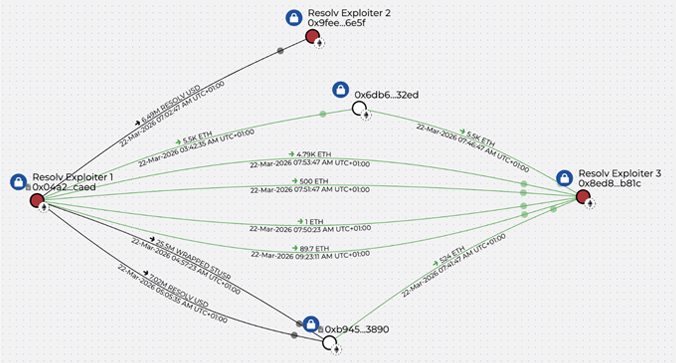
Flow of stolen funds. Visualization: Certik
As of March 27:
- one address (0x04A288a7789DD6Ade935361a4fB1Ec5db513caEd) holds 20.4 million wstUSR ($1.26 million)
- another (0x8ed8cf0c1c531c1b20848e78f1cb32fa5b99b81c) holds 11,408 ETH (~$24.78 million)
- a third address (0x9FeeEAEc113E6d2DCD5ac997d5358eee41836e5f) holds 12 million wstUSR ($742,000) and 25.93 ETH ($56,000)

Useful material?
 Telegram
  Twitter
 Research
One and the same cryptocurrency address received two completely opposite assessments from different analytics systems: from an ordinary gambling service to an extremely severe criminal offense. This story has become the starting point for a broader conversation about what the scientific standards of blockchain analysis should look like — and why errors in systems like these can shape the fates of real people.
Jul 1, 2026
Research
The blockchain has helped uncover the ties between cryptocurrency fundraising campaigns, exchangers in Syria, and intermediaries in several countries around the world. A telltale pattern has emerged in which the same addresses were used across multiple donation drives at once
Jun 24, 2026
Research
Four Iranian cryptocurrency exchanges accounted for roughly 78% of all digital asset volume tied to the country in 2025. They have now become the focal point of the largest U.S. sanctions campaign against Iran's cryptocurrency infrastructure.
Jun 5, 2026
Research
A financial system is already up and running on public blockchains, with loans, analogues of U.S. Treasuries, and automated capital markets. More than $551 billion has flowed through DeFi protocols — but most of that activity has nothing to do with the real economy and everything to do with the speculative build-up of risk.
May 29, 2026
Research
Around 97% of Chinese suppliers of chemicals used to make fentanyl accept payment in cryptocurrency. The volume of such transactions continues to grow alongside the global market for synthetic drugs
May 22, 2026
Research
For the first time, the new law makes blockchain analytics an officially mandatory tool of financial oversight in the United States. Authorities will also gain the power to restrict transactions with foreign crypto services tied to money-laundering risks.
May 20, 2026
Cryptocurrency rates
-

Bitcoin
$81 385
BTC
-1.68%
-

Ethereum
$2 379.56
ETH
-2.22%
-

BNB Smart Chain
$726.83
BSC
+0.13%
-

Ripple
$1.42
XRP
+1.04%
-

TRON
$0.331882
TRX
+0.29%
-

Zcash
$1 126.24
ZEC
-3.4%
-

Dogecoin
$0.078807
DOGE
-1.15%
-

Cardano
$0.218269
ADA
+2.11%
-

Stellar XLM
$0.184461
XLM
+2.83%
-

Bitcoin Cash
$273.57
BCH
-1.69%