

You can no longer roll back transactions in Ethereum — here’s why
In 2016, the Ethereum network was already rolled back to take the cryptocurrency away from hackers. Why didn’t this happen after the $1,5 billion ByBit hack?

14.04.2025
764
6 min
0
Despite its efficiency, blockchain is not a perfect technology. Because it is possible to roll back a chain of transactions, i.e., undo certain operations. As recently as two months ago, such a precedent could have happened on the Ethereum network. GetBlock AML Research explains how such a need arose and why it didn’t happen.
The first rollback
Rolling back a transaction chain is not a theoretical assumption. Such an incident already took place back in 2010. Back then, there was a software failure in the bitcoin network on block 74638, the blockchain mistakenly issued 184 billion BTC, although the maximum issue of cryptocurrency is limited to 21 million. At that time, the value of BTC was about $0,07. The bug fix was released by bitcoin’s mythical creator, Satoshi Nakamoto. The blockchain rollback to the software bug was supported by miners. As a result, a new transaction chain replaced the old one.
Ethereum was also rolled back
In 2016 (a year after the launch of the network), a similar unpleasant incident occurred in the Ethereum blockchain. A hacker gained access to one of the wallets of The DAO platform. The hacked wallet stored about 15% of the ETH issue.
The developers decided to unilaterally intervene in the network and blocked the funds so that the hacker could not use them. Not everyone supported the unilateral intervention, as the Ethereum creators demonstrated that they have the ability to centrally manage the network. So the Ethereum blockchain split into two transaction chains. The network with locked ETH became the Ethereum we use to this day. The transaction chain where miners rejected the developers’ changes was named Ethereum Classic.
Since 2019, Ethereum co-founder Vitalik Buterin has, from time to time, tried again to convince the crypto community that the blockchain needs a feature that can roll back the transaction chain in emergencies, such as major hacks. However, users regularly speak out against the idea. In one of his X publications, Buterin conducted a poll. More than 63% of poll participants were against rolling back the blockchain.
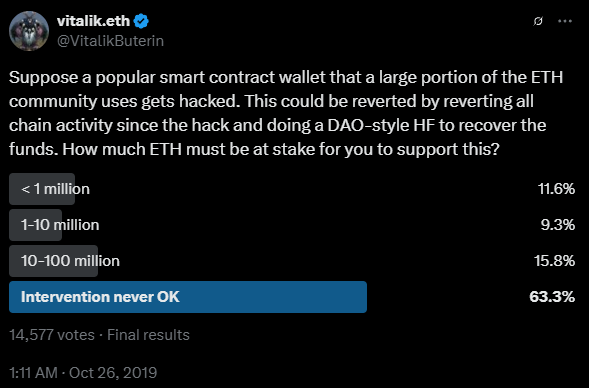
Voting on Vitalik Buterin’s X page
Back on the same rake
Even though the community rejects the idea of rollbacks every time, the topic continues to come up regularly. In February 2025, after the $1,5 billion ByBit exchange hack, which was the largest in history, many public figures once again called for a rollback of the network before the hack to prevent hackers from taking over the cryptocurrency.
One of the first to speak in favor of the idea was Jan3 CEO Samson Mow. On his X page, he wrote the following: “I fully support rolling back Ethereum’s chain (again).” The infamous BitMEX exchange co-founder Arthur Hayes didn’t hold back either. He appealed to Vitalik Buterin to approve the blockchain rollback. The reasoning behind the call was as follows: “I would support it because we already voted no on immutability in 2016 y not do it again?”
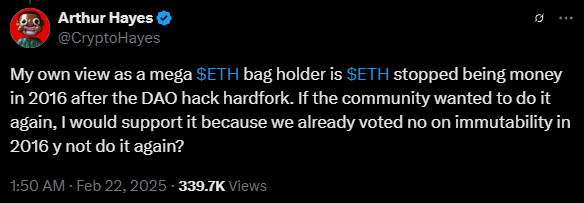
Arthur Hayes’ call in X
ByBit CEO Ben Zhou, who lost $1,5 billion, was more restrained. In his opinion, the decision to roll back the Ethereum blockchain should not be made centrally, as was done in 2016. Zhou suggested that the community should hold a vote, but it was never held.
Why the Ethereum network can no longer be rolled back
Technically, rolling back the transaction chain in Ethereum is possible. The network developers can do it centrally or engage the community in a dialogue. But there are a number of reasons that significantly complicate this process and actually make it impossible:
- Minus trust. If the network is rolled back, the question of Ethereum’s true decentralization will come up again;
- Threat of separation. As in 2016, some validators may oppose the rollback and continue the original transaction chain. In this case, the Ethereum network will split into two chains again;
- Technical nuances. An entire ecosystem of decentralized applications and Layer 2 (L2) solutions, such as Polygon and Arbitrum, is built on Ethereum. The blockchain’s rollback could paralyze the ecosystem and cause numerous disruptions.
One of the main open questions remains the fate of ordinary Ethereum users in the event of a network rollback. Even if the transaction chain was rolled back the day after the hack, tens of thousands of users who made transactions during that period would be stranded.
Technical experts are still unable to assess the implications of a possible Ethereum network rollback for cross-chain bridges and other complex technological decentralized solutions. When a cross-chain bridge is used to transfer cryptocurrency from one network to another, the coins are blocked in the original blockchain and used as collateral for the issuance of assets in the other network. In the event of a rollback, assets issued during this period are stripped of their collateral. The hackers who hacked ByBit used such complex decentralized solutions to launder stolen cryptocurrency, as it helped them hide the chain of funds movement for a while.

How to launder $1,5 billion worth of crypto in 5 easy steps. Lazarus Group case
Crypto exchange Bybit managed to block only $42,8 million. This is less than 3% of the total value of stolen assets
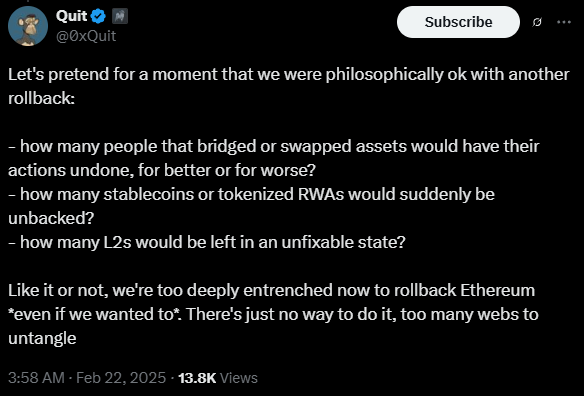
Blockchain developer’s opinion on the impossibility of an Ethereum rollback
Moral aspect
Part of the crypto community negatively perceived the idea of the Ethereum rollback to compensate ByBit losses. It is argued that the hacking of the exchange cannot be a sufficient reason to ignore the principle of decentralization. This is the opinion of one of the L2 developers.
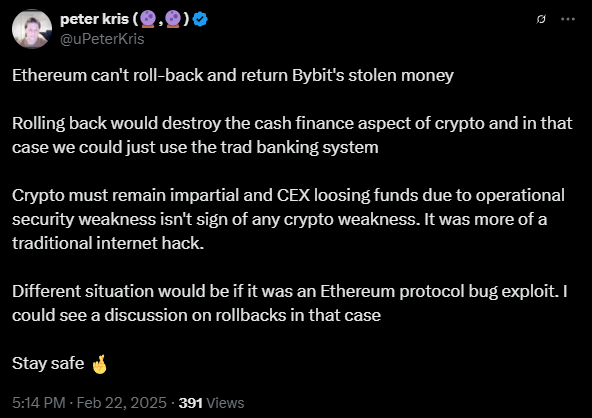
Opinion of L2 developer Peter Kris on X
The neural network was asked
Following the popular trends, we decided to ask ChatGPT-4o whether the Ethereum network rollback is possible and what it can threaten. Neural network considers transaction chain rollback technically possible, but destructive for the network, because:
- Lost blocks and deleted transactions could cause smart contracts to fail;
- Decentralized applications using these smart contracts would cease to function;
- A network rollback could be exploited by hackers and arbitrage MEV bots.

Results of the Ethereum rollback modeling by neural network

Useful material?
 Telegram
  Twitter
 Research
One and the same cryptocurrency address received two completely opposite assessments from different analytics systems: from an ordinary gambling service to an extremely severe criminal offense. This story has become the starting point for a broader conversation about what the scientific standards of blockchain analysis should look like — and why errors in systems like these can shape the fates of real people.
Jul 1, 2026
Research
The blockchain has helped uncover the ties between cryptocurrency fundraising campaigns, exchangers in Syria, and intermediaries in several countries around the world. A telltale pattern has emerged in which the same addresses were used across multiple donation drives at once
Jun 24, 2026
Research
Four Iranian cryptocurrency exchanges accounted for roughly 78% of all digital asset volume tied to the country in 2025. They have now become the focal point of the largest U.S. sanctions campaign against Iran's cryptocurrency infrastructure.
Jun 5, 2026
Research
A financial system is already up and running on public blockchains, with loans, analogues of U.S. Treasuries, and automated capital markets. More than $551 billion has flowed through DeFi protocols — but most of that activity has nothing to do with the real economy and everything to do with the speculative build-up of risk.
May 29, 2026
Research
Around 97% of Chinese suppliers of chemicals used to make fentanyl accept payment in cryptocurrency. The volume of such transactions continues to grow alongside the global market for synthetic drugs
May 22, 2026
Research
For the first time, the new law makes blockchain analytics an officially mandatory tool of financial oversight in the United States. Authorities will also gain the power to restrict transactions with foreign crypto services tied to money-laundering risks.
May 20, 2026
Cryptocurrency rates
-

Bitcoin
$82 736
BTC
+0.05%
-

Ethereum
$2 440.3
ETH
-0.03%
-

BNB Smart Chain
$739.33
BSC
-0.21%
-

Ripple
$1.42
XRP
+1.04%
-

TRON
$0.330365
TRX
-0.17%
-

Zcash
$1 287.54
ZEC
+2.36%
-

Dogecoin
$0.080015
DOGE
-1.73%
-

Cardano
$0.218269
ADA
+2.11%
-

Stellar XLM
$0.184461
XLM
+2.83%
-

Bitcoin Cash
$278.72
BCH
-1.95%