

$22 billion has already been laundered through cross-chain bridges. How did this happen
Moving assets between different blockchains is massively used by hackers and scammers to hide the chain of cryptocurrency movement

21.07.2025
576
3 min
0
The transfer of cryptocurrency between blockchains greatly simplifies the use of digital assets and also creates an opportunity to conceal financial flows. This opportunity is often exploited by hackers and fraudsters to launder illegally obtained funds. GetBlock AML Research explains why cross-chain bridges have become so popular with attackers.
How cross-chain exchanges work
Each blockchain has its own unique architecture and is not compatible with other blockchains, so a direct transfer of assets from one blockchain to another is impossible. To transfer cryptocurrencies between networks, intermediaries (cross-chain bridges) are used.
How cross-chain bridges work:
- Transfer assets to the bridge;
- The bridge locks the received assets in blockchain A;
- The bridge issues similarly equivalent assets in blockchain B, using assets from blockchain A as collateral;
- To return the original assets in blockchain A, the issued assets in blockchain B must be returned to the bridge, after which they will be burned.
Why cross-chain bridges are being used to launder cryptocurrency
Cross-chain bridges act as exchange points without KYC (Know-your-customer). An attacker can leave dirty cryptocurrency (derived from criminal activity) on a cross-chain bridge and, in return, receive clean assets on another network.
How cross-chain bridges help hide the origin of funds:
- When cross-chain bridges are used, a gap is created in the chain of asset movement; the trail of cryptocurrency is as if “lost”;
- In recent years, a large number of different cross-chain bridges with support for almost all popular blockchains (Bitcoin, Ethereum, Solana, Cardano, Polygon, Tron, BNB Chain, and others) have appeared;
- Most cross-chain bridges operate in a decentralized manner and do not require identity verification (KYC);
- Attackers can break assets into small pieces and send them to different cross-chain bridges to make it harder to track the movement of cryptocurrency.
Illicit transaction volumes
According to Elliptic, nearly $22 billion has already been laundered using cross-chain bridges between 2022 and 2025. Criminals have learned to make it much harder to track assets on the blockchain thanks to cross-chain bridges. More than a third of illicit transactions involved more than three blockchains. In 27% of cases, criminals used more than five blockchains. 20% of cryptocurrency laundering schemes used more than ten blockchains to hide the chain of funds movement.
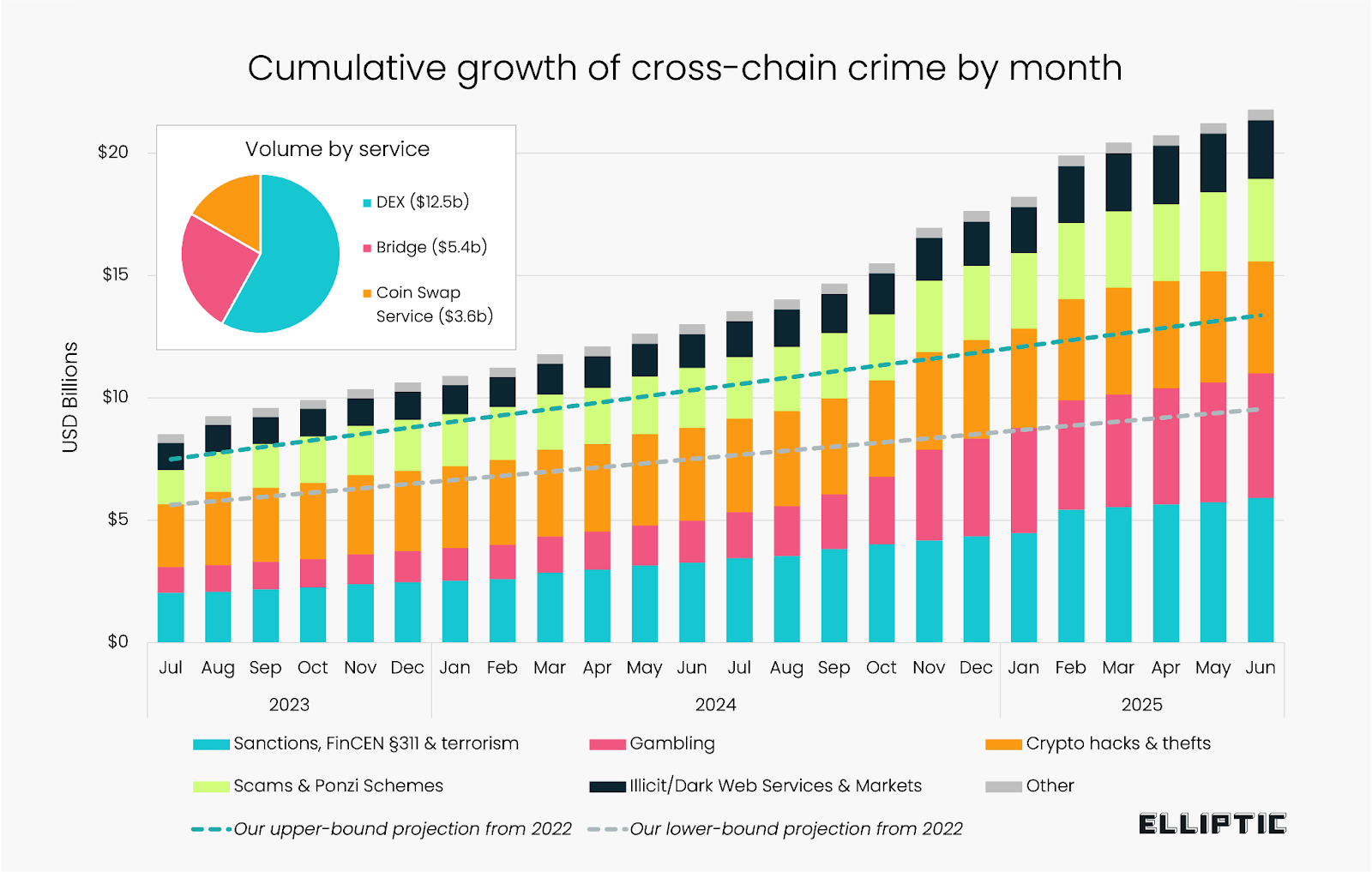
Volume of digital asset laundering via cross-chain bridges
Cross-chain bridges were one of the main tools for laundering the cryptocurrency stolen from the Bybit exchange in February 2025. The hack was the largest in history as hackers managed to steal $1,5 billion in assets. North Korean hackers from the Lazarus Group are suspected of being involved in the Bybit hack.

How to launder $1,5 billion worth of crypto in 5 easy steps. Lazarus Group case
Crypto exchange Bybit managed to block only $42,8 million. This is less than 3% of the total value of stolen assets

Useful material?
 Telegram
  Twitter
 Research
One and the same cryptocurrency address received two completely opposite assessments from different analytics systems: from an ordinary gambling service to an extremely severe criminal offense. This story has become the starting point for a broader conversation about what the scientific standards of blockchain analysis should look like — and why errors in systems like these can shape the fates of real people.
Jul 1, 2026
Research
The blockchain has helped uncover the ties between cryptocurrency fundraising campaigns, exchangers in Syria, and intermediaries in several countries around the world. A telltale pattern has emerged in which the same addresses were used across multiple donation drives at once
Jun 24, 2026
Research
Four Iranian cryptocurrency exchanges accounted for roughly 78% of all digital asset volume tied to the country in 2025. They have now become the focal point of the largest U.S. sanctions campaign against Iran's cryptocurrency infrastructure.
Jun 5, 2026
Research
A financial system is already up and running on public blockchains, with loans, analogues of U.S. Treasuries, and automated capital markets. More than $551 billion has flowed through DeFi protocols — but most of that activity has nothing to do with the real economy and everything to do with the speculative build-up of risk.
May 29, 2026
Research
Around 97% of Chinese suppliers of chemicals used to make fentanyl accept payment in cryptocurrency. The volume of such transactions continues to grow alongside the global market for synthetic drugs
May 22, 2026
Research
For the first time, the new law makes blockchain analytics an officially mandatory tool of financial oversight in the United States. Authorities will also gain the power to restrict transactions with foreign crypto services tied to money-laundering risks.
May 20, 2026
Cryptocurrency rates
-

Bitcoin
$83 083
BTC
+0.3%
-

Ethereum
$2 504.64
ETH
+0.36%
-

BNB Smart Chain
$748.66
BSC
+0.03%
-

Ripple
$1.42
XRP
+1.04%
-

TRON
$0.330354
TRX
-0.23%
-

Zcash
$1 235.99
ZEC
+0.74%
-

Dogecoin
$0.085332
DOGE
-0.58%
-

Cardano
$0.218269
ADA
+2.11%
-

Stellar XLM
$0.184461
XLM
+2.83%
-

Bitcoin Cash
$278.01
BCH
-0.37%