

Are there “dirty” USDT? We take a detailed look at the issue
What is the status of USDT stablecoins involved in criminal activity? And how does Tether combat the illegal circulation of its coins? We explain in this article

22.12.2025
663
6 min
0
In 2025, no one will be surprised that bitcoins or Ethereum can be “dirty.” AML practices have become tightly integrated into the crypto industry and are now followed by most digital asset users. But can USDT be “dirty”? We at GetBlock AML Research also asked ourselves this question and tried to figure it out.
The essence of the issue
Of course, at first glance, USDT may be “dirty.” That is, stablecoins can be used in illegal activities, and AML providers will place such coins and associated addresses in a special risk group.
HOWEVER, the issuer of USDT, Tether, has anticipated such situations. Therefore, the USDT smart contract provides for centralized management, i.e., the blocking of stablecoins at a specific address. If Tether receives confirmation that a specific address with stablecoins has been used in illegal transactions, the company can blacklist that address.
What happens if Tether blacklists an address with USDT:
- This will not affect the address itself in the blockchain, as the technology is decentralized;
- The owner of the address will be able to perform any transactions on the network (sending/receiving) funds in any other coins except USDT;
- USDT stored at the address will be completely blocked and cannot be sent/spent/exchanged.
Why is this necessary?
In this way, Tether has provided not only a blocking mechanism but also a burning mechanism. Blocked USDT that are on the blacklist are recognized as withdrawn from circulation (invalid). Therefore, Tether issues new coins to replace them.
According to Dune Analytics, as of December 22, 2025, more than $1,65 billion USDT had been blocked across 2654 addresses.
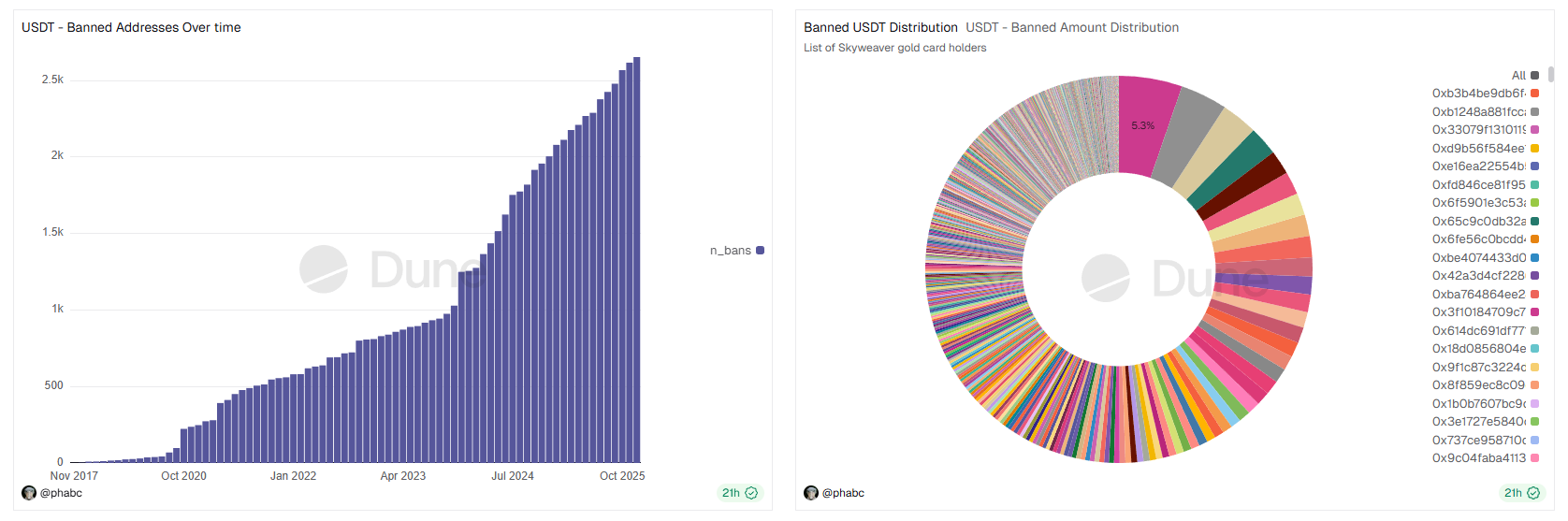
USDT blocking statistics.
How the blocking mechanism works
Adding illegal addresses to the blacklist is not a quick process. First, AML providers need to confirm the address’s connection to criminal activity. Then they need to transfer the data to Tether. Only after that will Tether make a decision about blocking. Several employees are needed to execute such a decision, as adding an address to the blacklist requires a multisig.
Due to all the organizational and bureaucratic costs, this process takes several days at best. Sometimes such decisions are delayed for weeks or months.

Criminal loophole: how to bypass the blocking of Tether’s USDT
Suddenly it turned out that transactions on the blockchain do not happen instantly. Tether had to make excuses for this
Priority on volumes
As a rule, there is a positive correlation between the speed of blocking “dirty” USDT and the volume of stolen funds. In other words, the more money that has been stolen, the faster AML providers and Tether will try to prevent the laundering of these funds. For example, in the summer of 2025, Tether froze $1,6 million USDT that was used by terrorists in the Gaza Strip.
But there are exceptions. One of them was the most high-profile hack of 2025 — the compromise of the Bybit wallet for $1,5 billion. At that time, only 3% of the stolen funds were frozen; the rest were laundered within 10 days, and Tether was unable to prevent this. Professional hackers prefer to transfer funds from USDT and other similar stablecoins to ETH as quickly as possible to avoid having their assets blocked.

How to launder $1,5 billion worth of crypto in 5 easy steps. Lazarus Group case
Crypto exchange Bybit managed to block only $42,8 million. This is less than 3% of the total value of stolen assets
Open question
After hackers quickly “dump” the stolen USDT, they remain “dirty,” but the question of blocking them no longer arises, as such coins end up with unsuspecting users or service providers. As a result, Tether finds itself in a difficult position: it is no longer possible to block such funds, but it is also impossible to cancel transactions on the blockchain. AML providers still do not have a single algorithm for action in such situations, so in each individual case, a decision is made on a case-by-case basis, based on various conditions.
Bridges for criminals
In 2025, cross-chain bridges began to be used on a massive scale to launder illegally obtained cryptocurrency.
A cross-chain bridge is used to transfer assets from one blockchain to another. The technology works as follows: in one blockchain (from which the assets are to be transferred), the funds are locked in a special smart contract and then used as collateral. In another blockchain (to which the assets are to be transferred), new coins are issued
When laundering funds stolen from Bybit, tens of millions of USDT were moved to cross-chain bridges and locked as collateral. In exchange for these coins, the hackers received completely clean assets on another network. But then, the “dirty” USDT that was used as collateral wasn’t locked and marked as “dangerous” by AML providers. There are a few reasons for this:
- The assets were locked in a smart contract and weren’t available for any transactions.
- The funds went to a service provider who was unaware of their illegal origin.
The main trend in cryptocurrency laundering in 2025: cross-chain transfers
Cybercriminals have significantly complicated the process of legalizing illegally obtained cryptocurrency in 2025
Case study
Will my 100/1000 USDT be considered “dirty” if they were stolen by hackers or fraudsters?
Answer: Probably not. Even if you contact law enforcement, who will open a case and contact Tether, the process will take weeks or possibly months. During this time, the attackers will exchange the stolen USDT for other cryptocurrencies. And your USDT will end up with another user who is unaware of its origin.
This opens up opportunities for criminals to launder funds obtained illegally. Especially when it comes to relatively small amounts and ordinary individuals.

Useful material?
 Telegram
  Twitter
 Research
One and the same cryptocurrency address received two completely opposite assessments from different analytics systems: from an ordinary gambling service to an extremely severe criminal offense. This story has become the starting point for a broader conversation about what the scientific standards of blockchain analysis should look like — and why errors in systems like these can shape the fates of real people.
Jul 1, 2026
Research
The blockchain has helped uncover the ties between cryptocurrency fundraising campaigns, exchangers in Syria, and intermediaries in several countries around the world. A telltale pattern has emerged in which the same addresses were used across multiple donation drives at once
Jun 24, 2026
Research
Four Iranian cryptocurrency exchanges accounted for roughly 78% of all digital asset volume tied to the country in 2025. They have now become the focal point of the largest U.S. sanctions campaign against Iran's cryptocurrency infrastructure.
Jun 5, 2026
Research
A financial system is already up and running on public blockchains, with loans, analogues of U.S. Treasuries, and automated capital markets. More than $551 billion has flowed through DeFi protocols — but most of that activity has nothing to do with the real economy and everything to do with the speculative build-up of risk.
May 29, 2026
Research
Around 97% of Chinese suppliers of chemicals used to make fentanyl accept payment in cryptocurrency. The volume of such transactions continues to grow alongside the global market for synthetic drugs
May 22, 2026
Research
For the first time, the new law makes blockchain analytics an officially mandatory tool of financial oversight in the United States. Authorities will also gain the power to restrict transactions with foreign crypto services tied to money-laundering risks.
May 20, 2026
Cryptocurrency rates
-

Bitcoin
$82 756
BTC
+0.34%
-

Ethereum
$2 483.69
ETH
-1.89%
-

BNB Smart Chain
$738.36
BSC
-2.58%
-

Ripple
$1.42
XRP
+1.04%
-

TRON
$0.332226
TRX
-0.7%
-

Zcash
$1 210.99
ZEC
-0.12%
-

Dogecoin
$0.084437
DOGE
-3.34%
-

Cardano
$0.218269
ADA
+2.11%
-

Stellar XLM
$0.184461
XLM
+2.83%
-

Bitcoin Cash
$272.69
BCH
-8.06%