

How crypto ransomware operate: the tactics of the Embargo and BlackCat groups
Criminals also learn and develop themselves to increase their income and maintain a high degree of anonymity. We explain how the BlackCat ransomware group has evolved

11.08.2025
494
5 min
0
In 2024, the world first learned about the Embargo crypto ransomware gang. As it became known, the group was previously called BlackCat, but decided to undergo a “rebranding.” In addition to changing their name, the extortionists modified their methods and learned new techniques. GetBlock AML Research reveals the tactics of the most successful crypto ransomware group.
The connection between Embargo and BlackCat
TRM Labs has identified several factors that indicate that Embargo and BlackCat are one and the same group:
- they write viruses in the same Rust programming language;
- they have similar websites with data leaks;
- they use some of the same crypto wallets
Embargo launders the cryptocurrency it receives through a chain of intermediate wallets, risky exchanges, and prohibited services such as Cryptex.net. Approximately $18,8 million lies dormant in anonymous wallets — this is one way to cover their tracks and distract law enforcement from financial flows.
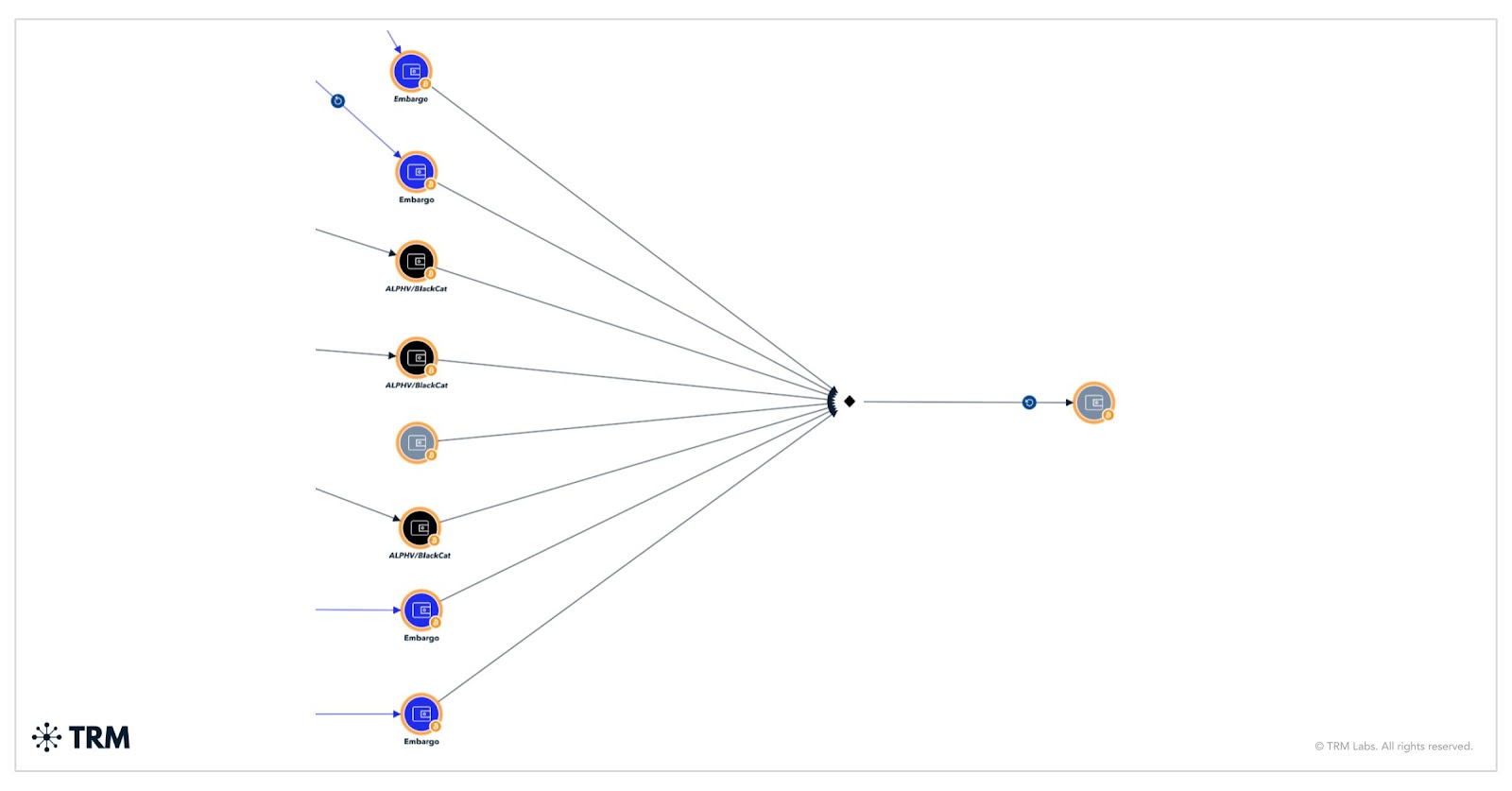
Connection between Embargo and BlackCat wallets
Judging by their technical level, Embargo may use artificial intelligence and machine learning to scale attacks, create more plausible phishing emails, modify virus code, and speed up operations.
What does cryptocurrency have to do with it
Cryptocurrency is a key tool for extortion groups: it allows them to receive money anonymously and transfer it across borders. They most often use Bitcoin, but some prefer Monero (XLM) because it better hides transactions. Despite the fact that the police are increasingly tracking crypto payments, such groups are constantly coming up with new ways to avoid surveillance.
Embargo’s operating model
Embargo is known for its sophisticated and targeted attacks using the RaaS (Ransomware-as-a-Service) model. This means that they provide their “partners” with tools for attacks, and they give them a share of the ransom. At the same time, Embargo maintains complete control over the main infrastructure and negotiations with victims. This scheme allows them to quickly expand their activities and attack different industries and countries.
“Quiet” style
Unlike high-profile groups such as LockBit or Cl0p, Embargo operates more quietly. They use powerful and aggressive software, but avoid excessive publicity and open threats to victims. This makes them harder to track and less likely to be covered in the media.

Hack the ransomware: how the Lockbit group was hacked and 60 000 addresses were leaked
Anonymous from Prague published information about 75 partners of extortionists in the public domain
Who is being attacked
Embargo most often targets:
- medical organizations,
- service companies,
- manufacturing enterprises.
The choice is explained by the fact that such organizations cannot afford downtime and are willing to pay faster. Attacks on medical organizations are particularly dangerous, as they can directly affect patients’ lives.
Geographically, the main target is the United States, but attacks have also been recorded in Europe and Asia.
Pressure on victims
Embargo has a website where it publishes the details of those who have refused to pay. Sometimes they even post names and personal information to increase the pressure.
In addition, they use double extortion:
- they encrypt files,
- steal data, and then threaten to leak or sell it.
This creates not only financial losses, but also reputational and legal problems.
Cryptocurrency laundering
On-chain analysis of Embargo wallets reveals their methods of laundering cryptocurrency obtained from victims. The group uses:
- CEX and DEX exchanges;
- services for anonymous transfers;
- mixers and P2P platforms;
- Cryptex.net.
The total amount that Embargo laundered through exchanges is about $13,5 million, and more than $1 million passed through Cryptex.net.
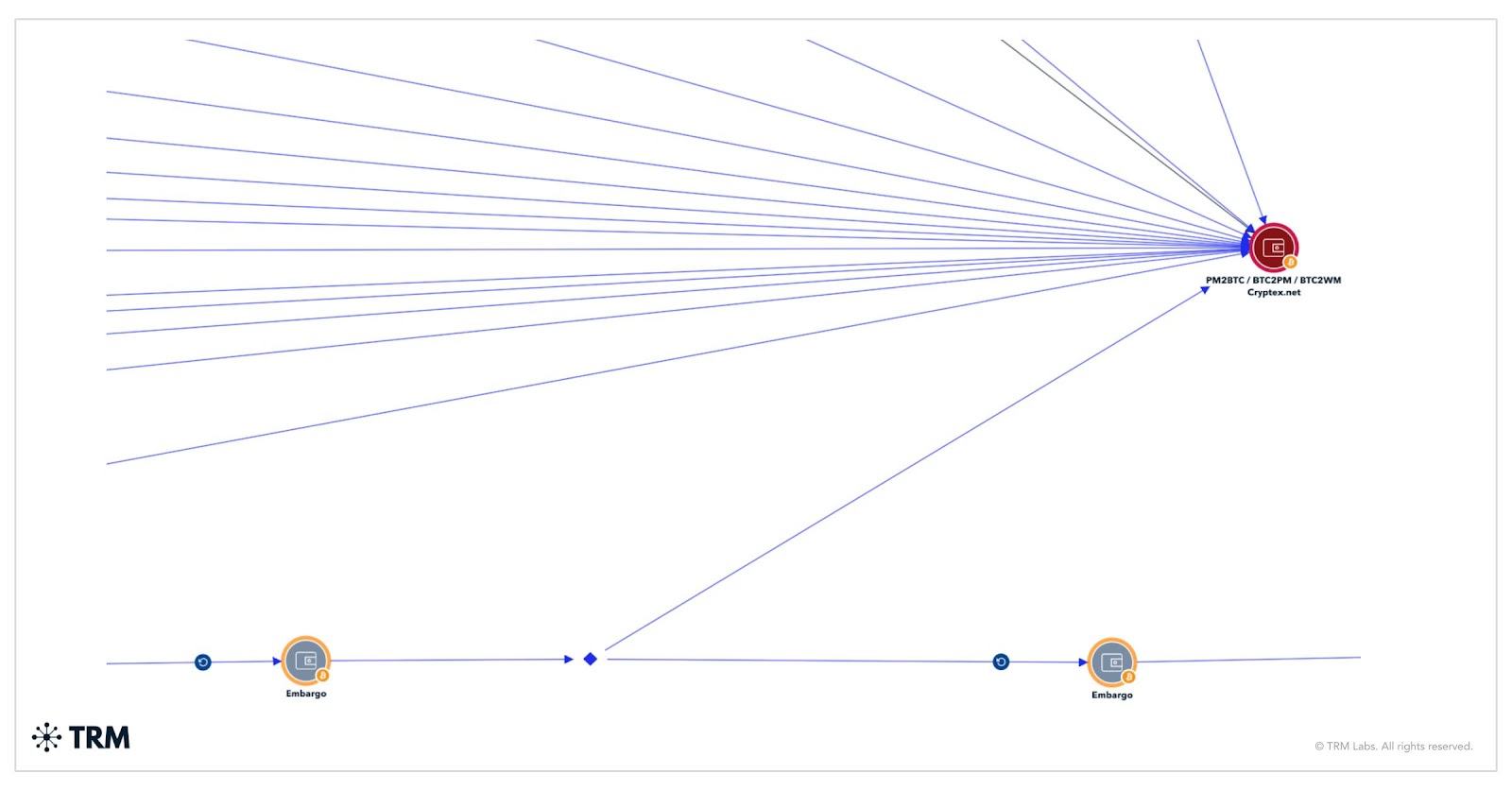
On-chain connection between Embargo wallets and Cryptex
Embargo rarely uses mixers like Wasabi. More often, they simply move cryptocurrency through a chain of intermediate wallets and then deposit it on exchanges.
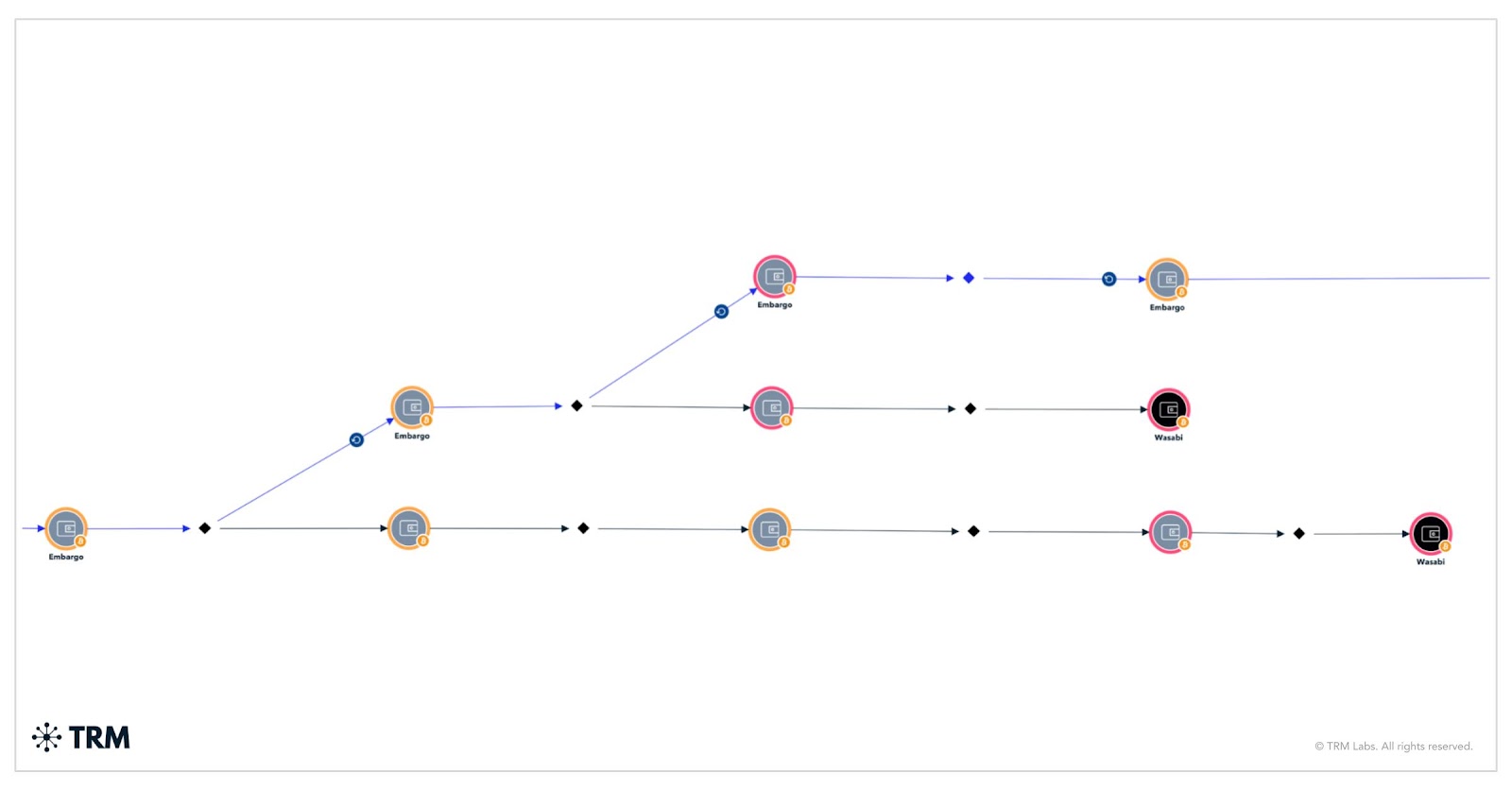
On-chain connection between Embargo wallets and Wasabi
Embargo uses AI
Embargo can use AI and machine learning to:
- automatically search for victims and vulnerabilities;
- create more convincing emails with viruses;
- generate fake videos and audio (deepfakes);
- write and modify malicious code that antivirus programs cannot detect.

Useful material?
 Telegram
  Twitter
 Research
One and the same cryptocurrency address received two completely opposite assessments from different analytics systems: from an ordinary gambling service to an extremely severe criminal offense. This story has become the starting point for a broader conversation about what the scientific standards of blockchain analysis should look like — and why errors in systems like these can shape the fates of real people.
Jul 1, 2026
Research
The blockchain has helped uncover the ties between cryptocurrency fundraising campaigns, exchangers in Syria, and intermediaries in several countries around the world. A telltale pattern has emerged in which the same addresses were used across multiple donation drives at once
Jun 24, 2026
Research
Four Iranian cryptocurrency exchanges accounted for roughly 78% of all digital asset volume tied to the country in 2025. They have now become the focal point of the largest U.S. sanctions campaign against Iran's cryptocurrency infrastructure.
Jun 5, 2026
Research
A financial system is already up and running on public blockchains, with loans, analogues of U.S. Treasuries, and automated capital markets. More than $551 billion has flowed through DeFi protocols — but most of that activity has nothing to do with the real economy and everything to do with the speculative build-up of risk.
May 29, 2026
Research
Around 97% of Chinese suppliers of chemicals used to make fentanyl accept payment in cryptocurrency. The volume of such transactions continues to grow alongside the global market for synthetic drugs
May 22, 2026
Research
For the first time, the new law makes blockchain analytics an officially mandatory tool of financial oversight in the United States. Authorities will also gain the power to restrict transactions with foreign crypto services tied to money-laundering risks.
May 20, 2026
Cryptocurrency rates
-

Bitcoin
$81 285
BTC
-1.97%
-

Ethereum
$2 377.82
ETH
-2.59%
-

BNB Smart Chain
$726.39
BSC
-0.02%
-

Ripple
$1.42
XRP
+1.04%
-

TRON
$0.332031
TRX
+0.3%
-

Zcash
$1 126
ZEC
-3.49%
-

Dogecoin
$0.078743
DOGE
-1.36%
-

Cardano
$0.218269
ADA
+2.11%
-

Stellar XLM
$0.184461
XLM
+2.83%
-

Bitcoin Cash
$272.5
BCH
-2.49%