

Overview of the largest NPM attack in history: what it is and how it relates to crypto
Malicious code was embedded in specialized packages for developers that are used to create global Internet infrastructure

10.09.2025
508
5 min
0
On September 8, the largest attack in history on the NPM infrastructure targeting cryptocurrency users took place. It could have affected billions of users around the world, but the developer community detected the threat in time. GetBlock AML Research explains in simple terms what NPM is and why attackers choose this tool for hacking.
What is NPM
NPM is the world’s largest catalog (library) of ready-made software “parts” for developers. Imagine a store with millions of small parts that programmers use to assemble their applications. Instead of writing everything from scratch each time, they take these ready-made “building blocks” and quickly build programs and services.
These “parts” are called packages. Any developer can create them and make them publicly available. Other programmers use these packages in their projects — for example, in websites, mobile applications, or even in programs related to cryptocurrencies.
And this is where the connection with cryptocurrencies comes in. Most modern crypto wallets, exchanges, and other services are written in programming languages that actively use NPM packages. If an attacker injects malicious code into one of these packages, all programs that use this “part” will also be infected.
In the case of the recent attack, hackers embedded code that replaced cryptocurrency addresses. That is, when a person tried to send money, instead of their real address, someone else’s address was secretly substituted — the attacker’s wallet.
How a simple build error helped detect an attack
It all started with a strange error during automatic build in the CI/CD pipeline, which was noticed by one of the developers:
ReferenceError: fetch is not defined
This seemingly minor error turned out to be the first sign of a complex attack. The error was traced to its source in a small dependency called error-ex. Further investigation revealed that malicious code had been injected into the package. It contained a reference to a suspicious function called checkethereumw, which immediately raised concerns among the developers.
The attacker embedded malware designed to detect and steal cryptocurrency. The fetch error occurred because the Node.js environment was quite old and did not have this function. In newer systems, the attack could have gone completely unnoticed.
Scale of impact on the ecosystem
After gaining control of the qix developer account, the attacker published malicious updates for a number of fundamental JavaScript utilities, including:
- chalk: ~300 million downloads per week
- strip-ansi: ~261 million downloads per week
- color-convert: ~193 million downloads per week
- color-name: ~191 million downloads per week
- error-ex: ~47 million downloads per week
- simple-swizzle: ~26 million downloads per week
- has-ansi: ~12 million downloads per week
These are not niche libraries, but essential “building blocks” deeply embedded in the dependencies of many projects.
Malicious code analysis: a two-stage attack
Inside the infected packages was a sophisticated crypto clipper that used a two-stage scheme to steal funds.
Attack vector 1: Passive address spoofing
The code first checked for the presence of the window.ethereum object, which is added by browser wallets such as MetaMask. If the wallet was not detected, “passive” mode was activated.
The malicious code replaced the browser’s built-in functions for network requests in order to intercept all incoming and outgoing data. Inside were lists of the hacker’s wallets for Bitcoin (BTC), Ethereum (ETH), Solana (SOL), Tron (TRX), Litecoin (LTC), and Bitcoin Cash (BCH).
What made it particularly sophisticated was that the program did not simply substitute a random address from the list, but chose one that was as similar as possible to the real one. To do this, it used the Levenshtein algorithm, which measures the “similarity of strings.” Thanks to this, the substitution looked so plausible that the victim might not notice it.
Attack vector 2: Active interference in transactions
If the wallet was detected, the second, more dangerous part of the code was launched. It intercepted the wallet’s functions (for example, sendTransaction).
When the user attempted to perform an operation, the code silently replaced the recipient’s address with a predetermined address belonging to the attackers. The transaction was then sent for confirmation. If the user did not check the address manually, they themselves signed off on the transfer of funds to the scammers.
Tracking stolen funds
Despite the scale of the attack and billions of downloads of malicious files, the attacker received only 0,1 ETH (about $430 at the time of publication), which is stored at the address:
0xFc4a4858bafef54D1b1d7697bfb5c52F4c166976
Interesting fact: 0,1 ETH was received from a single user with the domain name leonard.eth (0xFD89d3831C6973fB5BA0b82022142b54AD9e8d46).
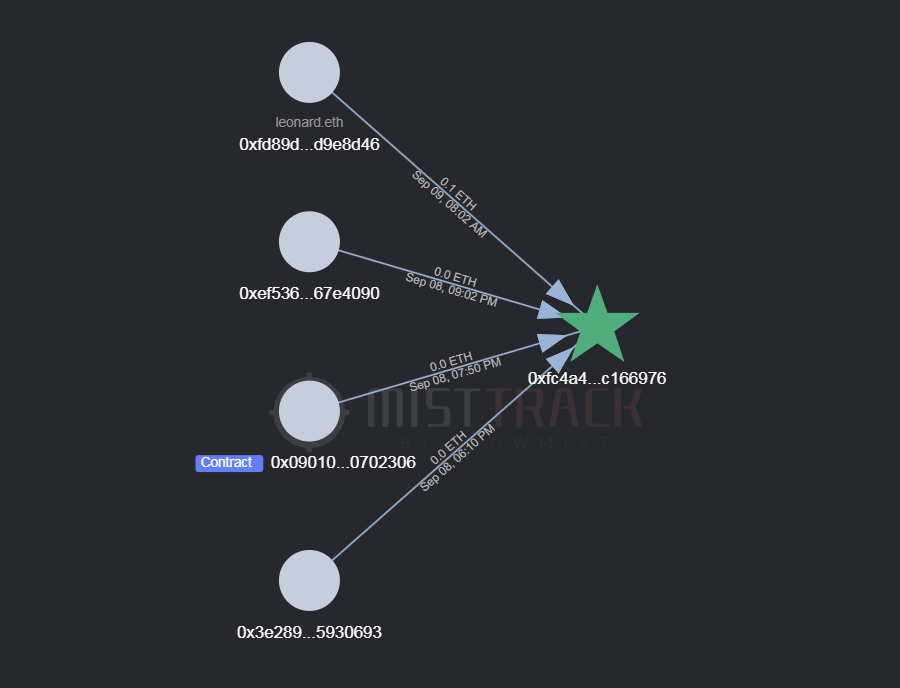
The full list of the attacker’s wallets is published on GitHub
How to protect your projects: urgent measures for developers
Although some of the infected versions have already been removed from NPM, some may still be available. Therefore:
- use the overrides function in package.json;
- this will force secure versions of packages to be fixed throughout the project.
After making changes, you must delete the node_modules folder and the package-lock.json file, then re-run the dependencies’ installation (npm install) to generate a clean lock file.

Useful material?
 Telegram
  Twitter
 Research
One and the same cryptocurrency address received two completely opposite assessments from different analytics systems: from an ordinary gambling service to an extremely severe criminal offense. This story has become the starting point for a broader conversation about what the scientific standards of blockchain analysis should look like — and why errors in systems like these can shape the fates of real people.
Jul 1, 2026
Research
The blockchain has helped uncover the ties between cryptocurrency fundraising campaigns, exchangers in Syria, and intermediaries in several countries around the world. A telltale pattern has emerged in which the same addresses were used across multiple donation drives at once
Jun 24, 2026
Research
Four Iranian cryptocurrency exchanges accounted for roughly 78% of all digital asset volume tied to the country in 2025. They have now become the focal point of the largest U.S. sanctions campaign against Iran's cryptocurrency infrastructure.
Jun 5, 2026
Research
A financial system is already up and running on public blockchains, with loans, analogues of U.S. Treasuries, and automated capital markets. More than $551 billion has flowed through DeFi protocols — but most of that activity has nothing to do with the real economy and everything to do with the speculative build-up of risk.
May 29, 2026
Research
Around 97% of Chinese suppliers of chemicals used to make fentanyl accept payment in cryptocurrency. The volume of such transactions continues to grow alongside the global market for synthetic drugs
May 22, 2026
Research
For the first time, the new law makes blockchain analytics an officially mandatory tool of financial oversight in the United States. Authorities will also gain the power to restrict transactions with foreign crypto services tied to money-laundering risks.
May 20, 2026
Cryptocurrency rates
-

Bitcoin
$81 285
BTC
-1.97%
-

Ethereum
$2 377.82
ETH
-2.59%
-

BNB Smart Chain
$726.39
BSC
-0.02%
-

Ripple
$1.42
XRP
+1.04%
-

TRON
$0.332031
TRX
+0.3%
-

Zcash
$1 126
ZEC
-3.49%
-

Dogecoin
$0.078743
DOGE
-1.36%
-

Cardano
$0.218269
ADA
+2.11%
-

Stellar XLM
$0.184461
XLM
+2.83%
-

Bitcoin Cash
$272.5
BCH
-2.49%