

Trust Wallet review: how to safely store, buy and stake cryptocurrency
We explain how the application combines simplicity, security, and multi-blockchain support
22.07.2025
1607
8 min
0
The world of cryptocurrencies is rapidly evolving, offering an increasing array of tools for the safe and convenient management of digital assets. Among them stands out Trust Wallet, a mobile wallet that gives the user full control over cryptocurrencies without intermediaries and unnecessary complications.
Having initially appeared as a simple solution for storing tokens, Trust Wallet has today evolved into a full-fledged tool, offering multi-currency support, a built-in browser for decentralized applications, staking, and the ability to buy cryptocurrencies using a bank card. Wallet’s philosophy is privacy, decentralization, and simplicity.
Why do millions of users around the world choose Trust Wallet? What makes it especially convenient and safe? In this article, we will take a detailed look at how Trust Wallet is organized, its key features, advantages, and give advice to beginners and experienced investors.
Content:
- What Trust Wallet is and how it came to be
- Supported blockchains and tokens in Trust Wallet
- Basic functions of Trust Wallet: storage, exchange, dApps, and staking
- Trust Wallet security: how the wallet protects your assets
- Pros and cons of Trust Wallet
- Trust Wallet or MetaMask: what to choose
- Who Trust Wallet is suitable for
- Conclusion: should you use a Trust Wallet?
What Trust Wallet is and how it came to be
Trust Wallet is a decentralized crypto wallet for secure storage, management, and exchange of cryptocurrencies.
One of the main advantages of Trust Wallet is its versatility – it supports a large number of blockchains and tokens, providing the ability to work with a wide range of digital assets.
Trust Wallet was created in 2017 by Victor Radchenko to work with Ethereum tokens and ERC-20 standard tokens. In 2018, Trust Wallet was bought by Binance exchange. This gave the project a new impetus and accelerated the development of new features.
Supported blockchains and tokens in Trust Wallet
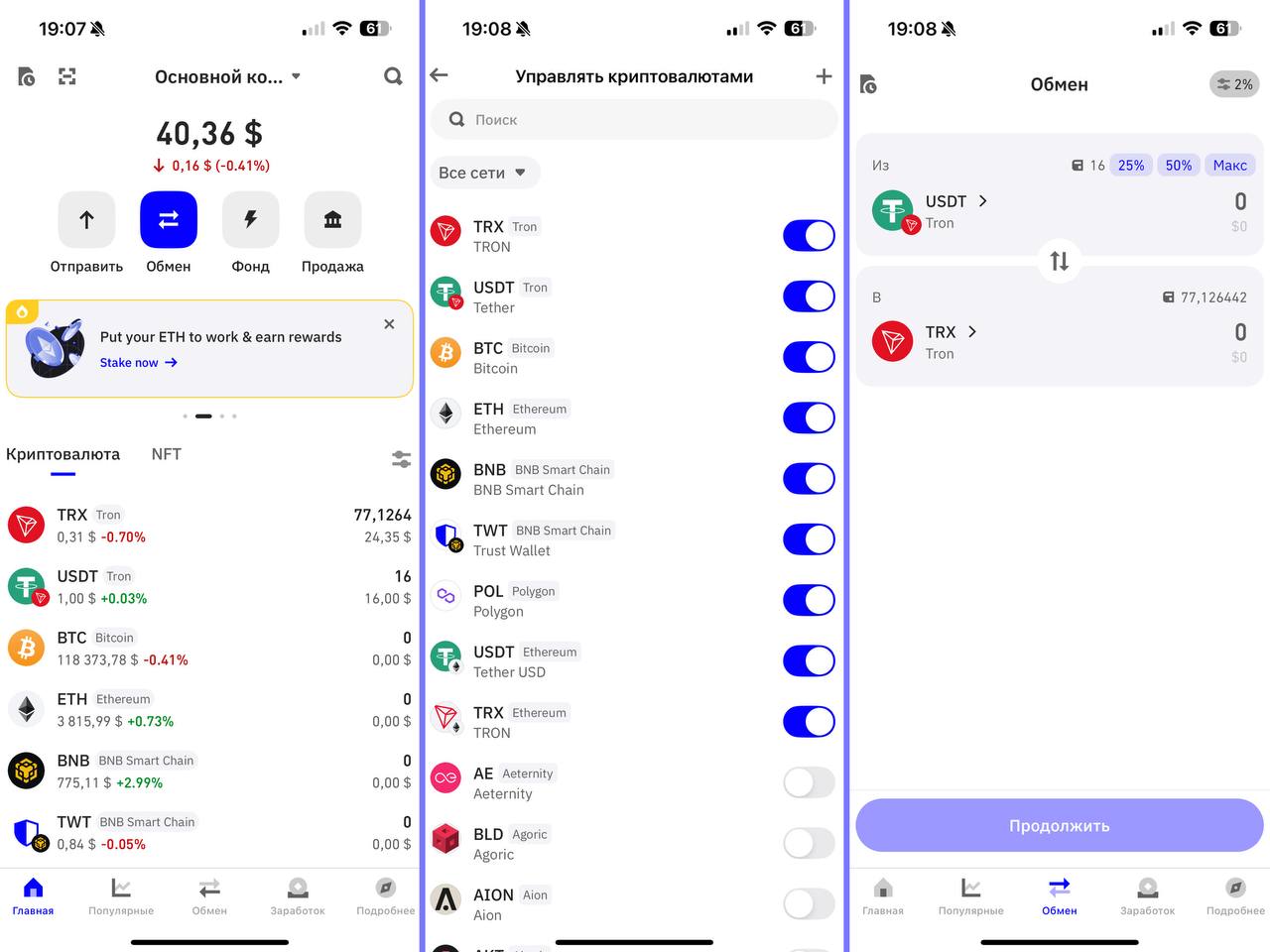
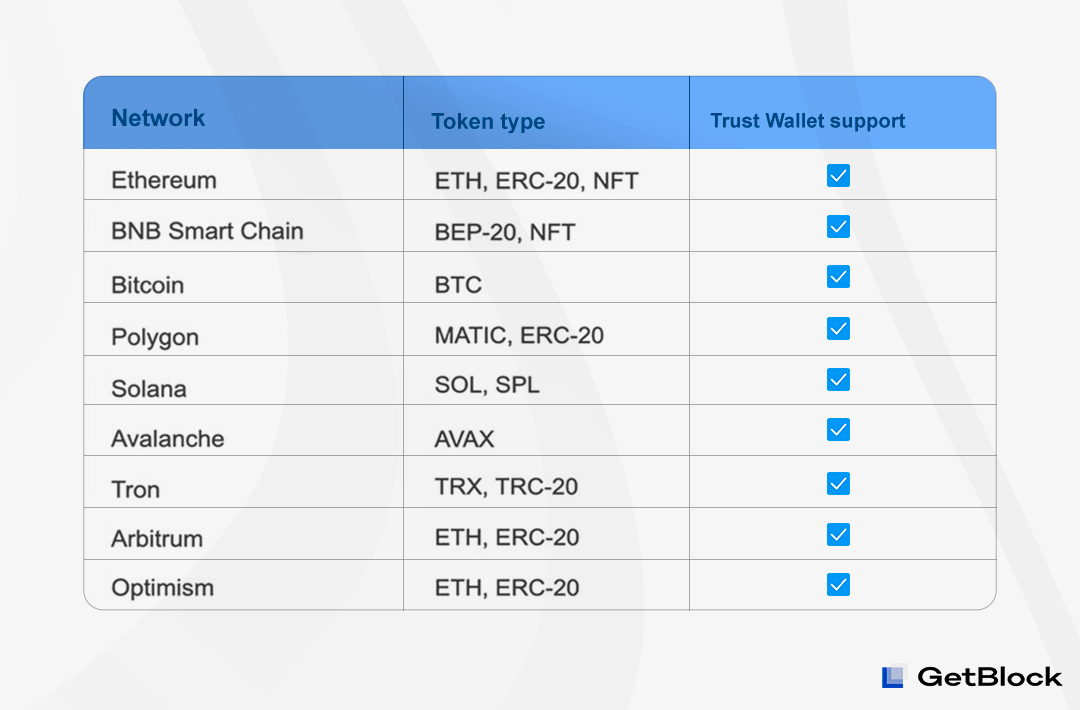
One of the strengths of Trust Wallet is its support for multiple blockchains and tokens. The wallet can integrate work with more than 70 blockchains such as Ethereum, BNB Chain, Solana, Bitcoin, Polygon, Avalanche, Arbitrum, Optimism, and others. This allows you to store and manage different cryptocurrencies on one platform.
On each of the supported blockchains, it is possible to work with native tokens (e.g., Ethereum — ETH, Solana — SOL), as well as tokens that are created according to the specific standards of these blockchains (e.g., ERC-20 on Ethereum, BEP-20 on BNB Chain). Users can easily track and manage assets without having to use different wallets for each type of coin.
Trust Wallet is constantly adding new networks and tokens, so the app stays current and in line with the dynamics of the crypto market.
Basic functions of Trust Wallet: storage, exchange, dApps, and staking
Trust Wallet offers convenient and secure tools for managing crypto assets. Among the key features of the wallet are the following:
✅ Management and tracking of crypto assets
The wallet allows you to track coin and token balances in real time and view transaction history.
✅ Buying and exchanging cryptocurrencies in Trust Wallet
Trust Wallet has built-in decentralized exchanges — you can exchange cryptocurrencies directly in the application. Buying for fiat via bank cards is also available.
✅ Access to dApps and DeFi through the built-in browser
Through the built-in browser, you can use decentralized applications — DeFi services: loans, exchanges, farming, and others. All of this without leaving your wallet.
✅ Staking capabilities in Trust Wallet
Trust Wallet supports staking for various blockchains such as Tezos and Cosmos. Staking allows users to earn rewards by locking their cryptocurrencies for a certain period of time.
Trust Wallet security: how the wallet protects your assets
Security is the top priority for most cryptocurrency users. Trust Wallet offers a high level of security by giving full control over the seed phrase and following the concept of local data storage.
✅ Control over seed-phrase
When creating a new wallet, users are given a seed-phrase — a sequence of 12 words that serves as a key to regain access to funds. Only the device owner knows the phrase, so he/she retains control over the funds.
✅ Local data storage
Data is stored locally on the user’s device and is not transferred to servers. Even if Trust Wallet is hacked, attackers will not have access to user data and assets.
✅ Mobile App
Trust Wallet is available on iOS and Android. The mobile format provides convenient access to funds and dApps anytime and anywhere.
|
Security component |
Availability |
Explanation |
|
Private key control |
✅ |
User only (seed phrase) |
|
Local data storage |
✅ |
Nothing is stored on Trust Wallet servers |
|
Face ID / PIN protection |
✅ |
Available in app settings |
|
Email recovery |
❌ |
Only via seed phrase — must be saved offline |
|
2FA support |
❌ |
Not provided (as with most non-custodial wallets) |
Pros and cons of Trust Wallet
One of the main advantages of Trust Wallet is its wide range of supported blockchains and tokens, allowing you to store and manage a variety of cryptocurrencies in one place. Its exchange, cryptocurrency buying, and staking features make it a versatile tool for dealing with digital assets.
Trust Wallet’s security is also top-notch thanks to its full seed-phrase control and local data storage. Ease of use and an intuitive interface make the wallet accessible to users of all experience levels.
Drawbacks include the lack of a PC version, which may limit the wallet’s usability for some users. In addition, despite the high level of security, the use of mobile wallets may pose additional risks if the user’s device is compromised.
|
Pros |
Cons |
|
Supports a large number of networks |
Mobile app only |
|
User-friendly Web3 browser |
Sometimes unstable work with dApp |
|
Simple and intuitive interface |
Fees from third-party providers are high |
|
Built-in exchange and purchase of crypto |
No hardware integration with Ledger / Trezor |
|
Security: only you own the seed phrase |
Trust Wallet or MetaMask: what to choose
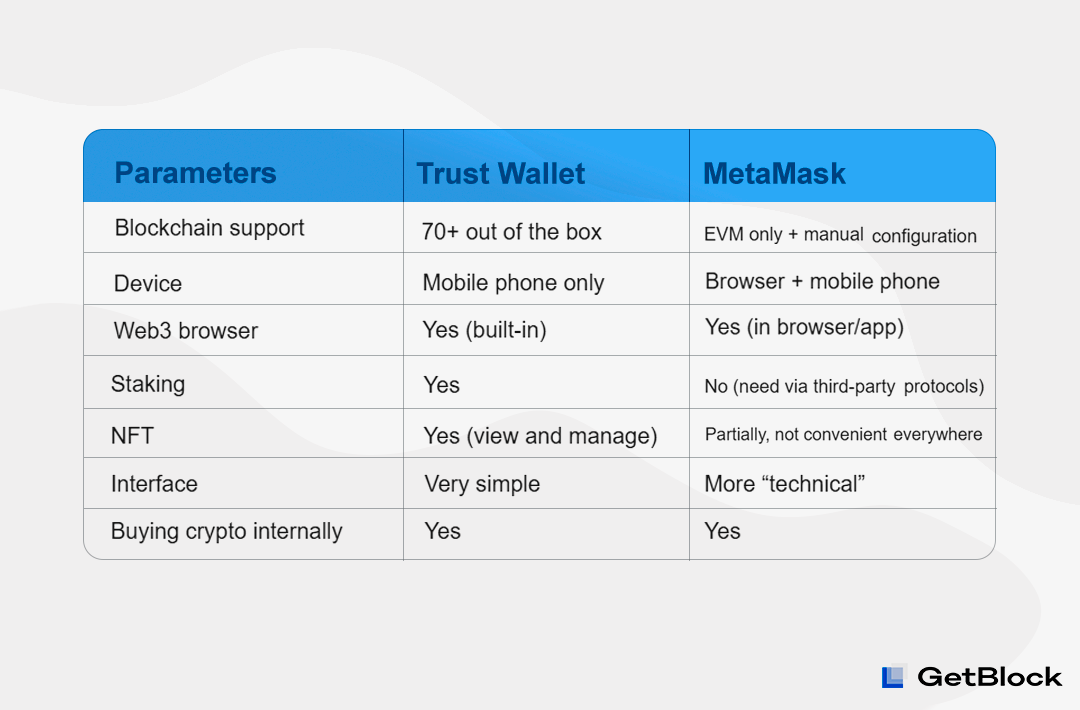
Trust Wallet and MetaMask are popular crypto wallets, but they have key differences.
Trust Wallet is designed for mobile devices and supports multiple blockchains, including Bitcoin. It is versatile, easy to use, and has built-in features: buying crypto with a card, decentralized exchange, and a browser for dApps.
MetaMask is primarily a browser extension. It is customized for Ethereum and EVM networks, so it is better suited for deep work with dApps. Buying cryptocurrency in MetaMask is possible through third-party services, and for exchange, you need external DEX interfaces.
✅ If simplicity and support for different coins is important to you, choose Trust Wallet.
✅ If you need advanced access to dApps and DeFi in the Ethereum ecosystem, pick MetaMask.
Who Trust Wallet is suitable for
Choosing the right crypto wallet depends on your individual needs and preferences. Trust Wallet can be a great choice if you care about support for a large number of cryptocurrencies and blockchains, high security, and ease of use.
If using various decentralized applications and DeFi services is a priority for you, Trust Wallet will also suit you thanks to its built-in dApps browser. However, if you need a desktop version of the wallet, it may be worth considering other alternatives such as MetaMask.
Conclusion: should you use a Trust Wallet?
Trust Wallet is a versatile tool for storing, managing, and exchanging cryptocurrencies. It supports over 70 blockchains and multiple tokens, giving users the ability to store their digital assets in one place. The high level of security, ease of use, and the ability to work with decentralized applications make Trust Wallet one of the best crypto wallets on the market.
If you need a reliable and simple wallet, Trust Wallet is a great solution for beginners and advanced users alike.

Useful material?
 Telegram
  Twitter
 Basics
Why Satoshi Nakamoto’s technical manifesto for a decentralized money system matters
Oct 31, 2022
Basics
Experts evaluated the development prospects of the new ecosystem and the investment attractiveness of its token
Oct 20, 2022
Basics
How to track fluctuations correctly and create an effective income strategy
Sep 13, 2022
Basics
Review of the most profitable offers from proven trading platforms
Aug 29, 2022
Basics
The Ethereum Foundation team has published a breakdown of major misconceptions about the upcoming network upgrade
Aug 18, 2022
Basics
What benefits the exchange offers, and what else is in the near future
Aug 4, 2022
Cryptocurrency rates
-

Bitcoin
$84 158
BTC
+1.24%
-

Ethereum
$2 474.84
ETH
+0.85%
-

BNB Smart Chain
$747.94
BSC
+0.77%
-

Ripple
$1.42
XRP
+1.04%
-

TRON
$0.330533
TRX
-0.16%
-

Zcash
$1 323.36
ZEC
+4%
-

Dogecoin
$0.082043
DOGE
+0.05%
-

Cardano
$0.218269
ADA
+2.11%
-

Stellar XLM
$0.184461
XLM
+2.83%
-

Bitcoin Cash
$287.34
BCH
+0.85%