

Hacken: Crypto Industry Losses Reach $3.1 Billion in the First Half of 2025
We discuss key incidents, the consequences for the industry, and ways to improve the security of decentralized projects

19.08.2025
860
8 min
0
According to Hacken’s Web3 security report for 2025, the crypto industry lost more than $3.1 billion in just six months due to hacks and fraud. This exceeds the total annual loss for 2024, with most of the losses, amounting to approximately $1,83 billion, attributable to access control system failures.
We have studied the report and will analyze in detail the hacks, schemes, and vulnerabilities that shaped the Web3 landscape in the first half of 2025.
Content:
- The main cause of losses — access control vulnerabilities
- How AI exploits and social engineering have caused hundreds of millions in losses to the crypto industry
- DeFi protocols lost $263 million due to smart contracts: major attacks
- Why Web3 projects need continuous auditing and monitoring
- The future of blockchains: security as the foundation of trust and growth
The main cause of losses — access control vulnerabilities
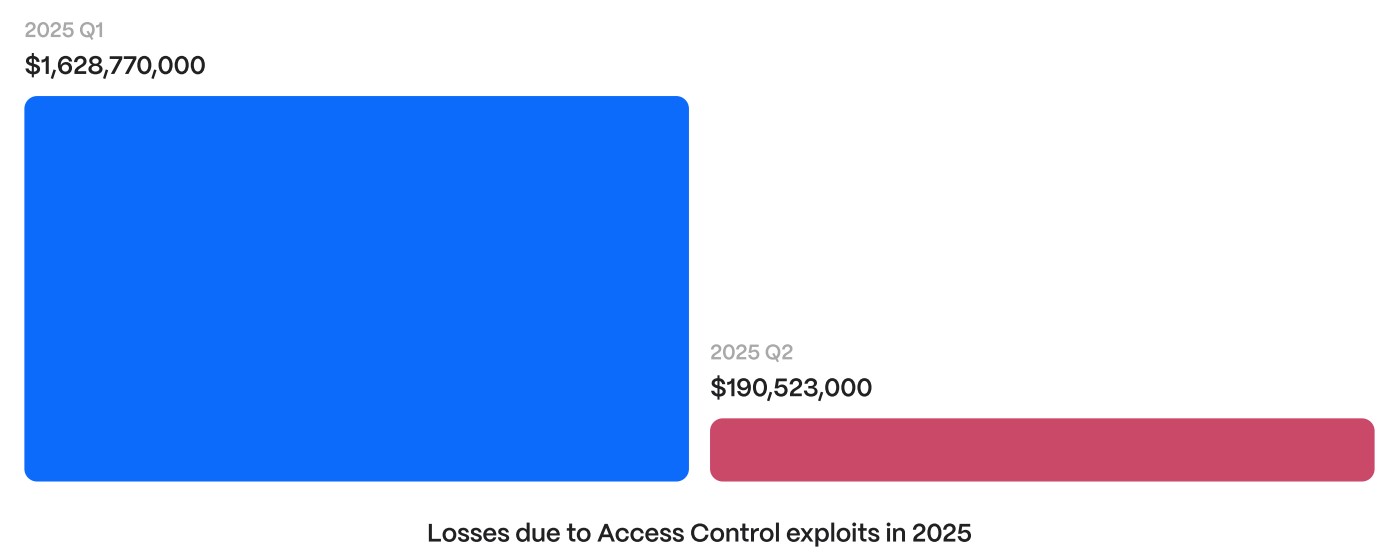
In the first half of 2025, operational security vulnerabilities led to the theft of approximately $1.83 billion on decentralized finance (DeFi) and centralized finance (CeFi) platforms. Almost all of this amount (about $1,63 billion) occurred in the first quarter, accounting for 83% of total losses for the first quarter.
The largest loss in the first quarter of 2025 was the Bybit hack, which amounted to $1,46 billion. The cause was a compromised interface through which attackers were able to send and distribute a malicious transaction.

Hack the ransomware: how the Lockbit group was hacked and 60 000 addresses were leaked
Anonymous from Prague published information about 75 partners of extortionists in the public domain
The Hacken report also highlights other incidents:
- On UPCX, attackers hacked the ProxyAdmin owner’s account, implemented a malicious update, and called the built-in tookByAdmin function to drain 18,4 million UPC tokens (about $70 million).
- On KiloEx, the lack of permission checks in the MinimalForwarder contract allowed an attacker to lower the oracle price to zero, open and quickly close positions at a profit. This led to the first major hack of the opBNB network, resulting in losses of $7,5 million.
- On June 18, 2025, Iran’s largest crypto exchange, Nobitex, was hacked. According to analysts, the attack was politically motivated. The attackers stole more than $90 million in BTC, ETH, DOGE, TRX, and other assets, sending everything to “burning” addresses.
Experts advise using cold wallets to store keys and applying multi-signature and time lock mechanisms when performing critical operations to avoid attacks by malicious actors. It is recommended to ensure access to the private key exclusively through a specialized device not intended for other tasks, as well as to implement a system for monitoring suspicious activity and protocol anomalies in real time.

Lazarus Group suspected of the largest hack worth $22,8 million
The first theories appeared in the OFSI report, but the regulator did not disclose the sources of the information
How AI exploits and social engineering have caused hundreds of millions in losses to the crypto industry
Hacken recorded a surge in the number of AI-related exploits, with the number of incidents increasing by 1025% compared to the second half of 2024. The exploits were related to vulnerabilities in API architecture, a lack of proper access restrictions to AI models, and weak filtering of user input during the response generation phase.

SlowMist: Phishing attacks were the leading cause of cryptocurrency loss to fraud in Q2
According to analysts, attackers are improving their social engineering techniques
Phishing and social engineering attacks brought attackers more than $600 million in the first half of 2025. This figure has increased sharply compared to the previous year. Social engineering is a set of methods by which attackers exploit users’ trust to obtain confidential information. The most common forms of such attacks are phishing, fraudulent phone calls, and the use of fake interfaces.
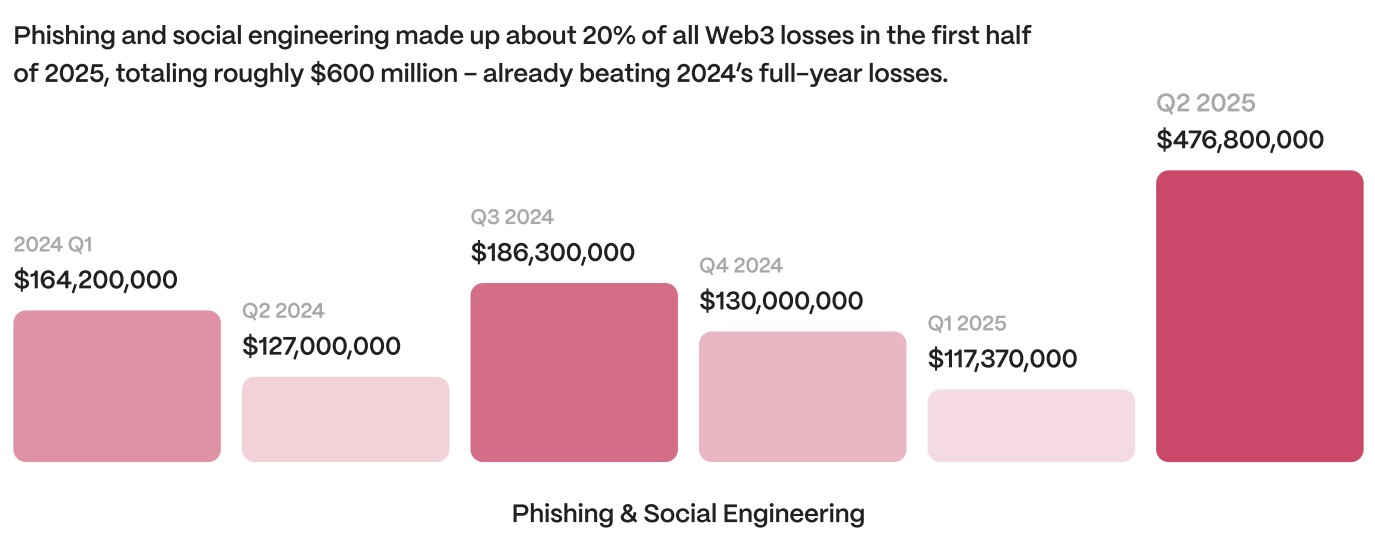
The Hacken report cites an example of the largest theft of bitcoins, amounting to $330 million, from an elderly American investor. A complex social engineering tactic convinced him to grant access to his wallet. The attacker transferred the BTC through hundreds of wallets, partially converting it to Monero (which caused the price of XMR to rise by 50%), and then transferred part of the funds to Ethereum. Only a small portion of the coins was frozen.
At the same time, Coinbase users fell victim to social engineering phishing after a data leak on the platform. The scammers called on behalf of “Coinbase support,” recited real user balances to gain trust, and tricked victims into revealing their private keys and passwords. As a result, more than $100 million was stolen, which was then laundered through crypto mixers, over-the-counter exchanges, and DeFi protocols.

Why you shouldn’t follow the links on X: real phishing cases
Phishing links on X have become a frequent and widespread phenomenon because many users of the social network can’t identify malicious content
The report recommends using continuous monitoring and automated protection systems to counter growing threats. Experts also warn that standard audits are no longer sufficient, especially given the increased complexity of integrated systems and AI models in Web3 environments.
DeFi protocols lost $263 million due to smart contracts: major attacks
Almost 69% of all incidents recorded in the first half of 2025 involved DeFi protocols. There were fewer CeFi incidents, but they often resulted in larger individual losses. The report also notes a growing convergence between financial and infrastructure attacks.
$263 million was lost due to smart contract vulnerabilities, making this period the most costly for the sector since the beginning of 2023.
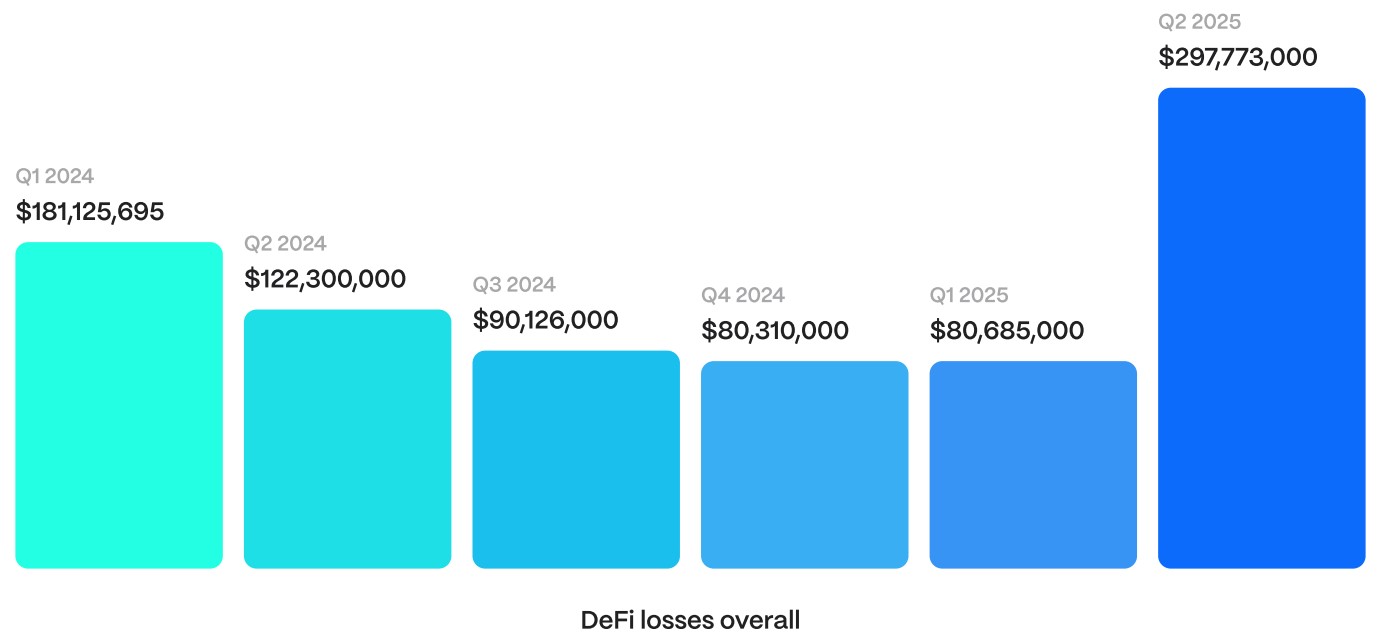
The most notable incident was the Cetus hack in the second quarter, when $223 million was stolen in just 15 minutes. Another major case was the Cork protocol exploit. Attackers took advantage of the lack of access rights checks indicating who could call the Uniswap V4 beforeSwap hook, and stole $12 million.
Hacken co-founder Yevheniia Broshevan emphasized the importance of rethinking cybersecurity:
“As blockchain reaches enterprise scale and regulations advance, cybersecurity becomes a core business function.”
Why Web3 projects need continuous auditing and monitoring
With growing interest in regulating the crypto industry, including thanks to initiatives such as MiCA and the EU Artificial Intelligence Act, Web3 projects are increasingly being advised to move away from one-off audits in favor of continuous monitoring.
In Hacken’s report, analysts emphasize that real risk reduction is only possible with the use of online monitoring systems, automatic threat detection, and centralized security management.
The future of blockchains: security as the foundation of trust and growth
In the first half of 2025, the crypto industry faced unprecedented losses totaling $3,1 billion. This alarming figure, recorded by Hacken experts, highlights how vulnerable the market remains in the face of growing cybercrime threats, smart contract flaws, and a general lack of cybersecurity in the Web3 environment.
These losses not only cause financial damage to investors and projects but also undermine confidence in the blockchain ecosystem as a whole. With the ongoing development of technology and growing interest in decentralized finance, it is becoming clear that the industry needs a systematic approach to security, transparency, and regulation. Only comprehensive measures, including smart contract audits, user awareness campaigns, and cooperation with cybersecurity platforms, can significantly reduce risks and prevent further losses.
The future of the crypto industry will depend not only on technological innovation, but also on the ability of all participants — developers, users, and regulators — to build a sustainable digital infrastructure capable of withstanding new challenges and maintaining trust.

Useful material?
 Telegram
  Twitter
 Research
One and the same cryptocurrency address received two completely opposite assessments from different analytics systems: from an ordinary gambling service to an extremely severe criminal offense. This story has become the starting point for a broader conversation about what the scientific standards of blockchain analysis should look like — and why errors in systems like these can shape the fates of real people.
Jul 1, 2026
Research
The blockchain has helped uncover the ties between cryptocurrency fundraising campaigns, exchangers in Syria, and intermediaries in several countries around the world. A telltale pattern has emerged in which the same addresses were used across multiple donation drives at once
Jun 24, 2026
Research
Four Iranian cryptocurrency exchanges accounted for roughly 78% of all digital asset volume tied to the country in 2025. They have now become the focal point of the largest U.S. sanctions campaign against Iran's cryptocurrency infrastructure.
Jun 5, 2026
Research
A financial system is already up and running on public blockchains, with loans, analogues of U.S. Treasuries, and automated capital markets. More than $551 billion has flowed through DeFi protocols — but most of that activity has nothing to do with the real economy and everything to do with the speculative build-up of risk.
May 29, 2026
Research
Around 97% of Chinese suppliers of chemicals used to make fentanyl accept payment in cryptocurrency. The volume of such transactions continues to grow alongside the global market for synthetic drugs
May 22, 2026
Research
For the first time, the new law makes blockchain analytics an officially mandatory tool of financial oversight in the United States. Authorities will also gain the power to restrict transactions with foreign crypto services tied to money-laundering risks.
May 20, 2026
Cryptocurrency rates
-

Bitcoin
$82 520
BTC
+0.85%
-

Ethereum
$2 487.82
ETH
+0.37%
-

BNB Smart Chain
$742.53
BSC
+0.93%
-

Ripple
$1.42
XRP
+1.04%
-

TRON
$0.33086
TRX
-0.45%
-

Zcash
$1 211.72
ZEC
+2.06%
-

Dogecoin
$0.085741
DOGE
+1.66%
-

Cardano
$0.218269
ADA
+2.11%
-

Stellar XLM
$0.184461
XLM
+2.83%
-

Bitcoin Cash
$277.29
BCH
+0.61%