

The Trump crypto empire: how one clan gained influence over the crypto industry
In 2024, the crypto industry directed more than $119 million to support Trump’s campaign, betting on deregulation and market growth. By 2026, investors were facing a 90% collapse in meme coins and $19 billion in losses in a single day

02.03.2026
267
7 min
0
The world of cryptocurrency has long defined itself through confrontation. For years, the industry waged a grueling battle with the U.S. financial regulator — the Securities and Exchange Commission (SEC). After a series of aggressive lawsuits and efforts by parts of the banking sector to restrict crypto companies’ access to the traditional financial system, investors felt cornered and awaited a politician who would “stop the bleeding.”
Desperation during the Biden presidency turned into virtually unlimited support. In 2024, representatives of the crypto industry directed more than $119 million to support Donald Trump’s presidential campaign through dedicated political action committees (super PACs).
Market leaders and prominent influencers convinced their audiences that Trump was the only chance to avoid “financial ruin,” despite the fact that he had previously called Bitcoin a scam. Retail investors believed that under his presidency, Bitcoin’s price would surge. But by early 2026, the picture looked far bleaker. The industry wasn’t rescued — it was brought under control. GetBlock AML Research explains where the crypto industry “took a wrong turn.”
The 2022 NFT projects as the first stage of audience monetization
The plan began to take shape not through legislation, but through digital trading cards — NFTs. The launch of Trump-themed collections became a kind of test: how much money could be extracted from a loyal audience through a trendy digital product? The presidency began to resemble a souvenir shop. The Trump family saw that the crypto market was a largely unregulated environment where “access” and privileges could be sold in exchange for digital tokens. This became the blueprint for larger-scale schemes.
$119 million from the crypto industry: the political investments of 2024
In the summer of 2024, major market players made a big bet. Companies such as Coinbase and Ripple, along with prominent venture investors Marc Andreessen and Ben Horowitz, invested tens of millions of dollars into the pro-Trump political fund Fairshake. Publicly, this was framed as a fight for innovation freedom.
The culmination came at the Bitcoin conference in Nashville in July 2024. From the stage, Trump promised to fire “hostile” regulators, create a national Bitcoin reserve, and make the United States the global capital of cryptocurrency. The atmosphere was euphoric. In hindsight, however, it appeared to be a calculated move: a new class of major donors with limited oversight, and millions of retail investors inspired by promises of growth. After securing support, the rhetoric gradually shifted from public interest to private gain.
Official Trump and Melania meme coins: token distribution structure and price collapse
Ahead of the 2025 inauguration, so-called meme coins — Official Trump and Melania — were launched. These were not mere speculative tokens but projects structured with unequal conditions from the outset. Blockchain analysis (the public ledger of all transactions) showed that a large portion of the tokens was controlled by a limited number of wallets linked to campaign insiders.

Trump’s meme coin turns one: how the leader of the Western World left Investors holding the bag
We break down how the current U.S. president and World Liberty Financial allegedly manipulated the crypto market to generate more than $1 billion in profit.
The tokens were heavily promoted on social media. Retail investors, hoping to profit from the “new administration,” bought in en masse. When prices peaked, large holders sold their positions. Within weeks, the tokens had lost more than 90% of their value, and investors lost billions of dollars. This was the first clear signal: the industry was being treated as a source of personal profit.
World Liberty Financial: profit-sharing model and control over USD1
By mid-2025, the process became more structured. World Liberty Financial was launched — effectively a family-backed project in which an entity linked to the Trump family received up to 75% of net profits. At the same time, the rhetoric centered on “deregulation,” meaning relaxed rules for business.
The company issued its own digital currency, USD1, positioned as the foundation of a new financial system. In practice, it functioned as a closed ecosystem through which investor funds flowed back to the project’s creators.
Investment from the UAE: $500 million and expanding international ties
Financial operations quickly took on an international dimension. Sheikh Tahnoon bin Zayed Al Nahyan, a member of the UAE’s ruling family, invested $500 million in World Liberty Financial shortly before the inauguration. Soon afterward, the administration approved the delivery of a large shipment of advanced Nvidia microchips to the UAE, despite national security concerns. In this context, cryptocurrency served as a convenient channel for financial arrangements.
Pardon of the Binance founder and the exchange’s role in USD1
On October 23, 2025, President Trump signed a pardon for Binance founder Changpeng Zhao. Officially, this was presented as a move against excessive regulation. However, by February 2026, it became known that Binance held about 90% of all issued USD1 tokens. The exchange had effectively become the primary operator of the family’s digital currency, gaining a privileged position.
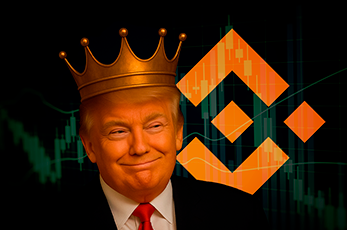
Why did Trump pardon the former head of Binance? There is a simple explanation
The American leader may have pardoned Changpeng Zhao after receiving financial benefits from deals with the former Binance CEO’s entities
“Trump winter”: market crash and $19 billion in losses
When Bitcoin reached an all-time high of $126,000, the administration unexpectedly announced 100% tariffs on Chinese goods. The market reacted sharply. In a single day, retail investors lost approximately $19.1 billion.
The promised “national Bitcoin reserve” was not used to stabilize the situation. Later transaction analysis showed that large players began selling assets shortly before the official announcement, while more than 1.6 million smaller accounts faced forced liquidations and losses.
Crypto.com banking license and political donations in 2026
In early 2026, Crypto.com transferred $35 million to the MAGA Inc. political fund. Shortly thereafter, on February 23, 2026, the Office of the Comptroller of the Currency granted the company a federal banking license. This allowed it to operate nationwide alongside traditional banks and service major funds and insurance companies.
Critics described this as an example of a “pay-to-play” system, where financial support results in favorable regulatory outcomes.
Polymarket and bets on military events: conflict of interest concerns
In 2026, attention turned to activity on Polymarket, a platform where users place bets on political and global events. Ahead of major military actions against Iran, new accounts appeared on the platform placing bets on the escalation of the conflict and earning significant profits.
Similar cases had been recorded before, including in connection with events in Venezuela and investment funds tied to tensions around Iran. Given that Donald Trump Jr. had served in advisory roles on some of these platforms, questions arose about potential conflicts of interest and the possible use of insider information.
Concentration of influence in the crypto industry: 2024–2026
According to this perspective, Trump did not so much “save” the crypto market from regulatory pressure as replace external pressure with internal concentration of influence. Promises of growth and financial freedom gave way to accusations of monopolization and infrastructure being used in the interests of a narrow circle.
Investors were promised rapid growth and a protective national reserve. Instead, the market evolved into a system where the rules are shaped by those in power.
For industry supporters, the most painful conclusion is that the ideal of an independent and free financial system has come under threat. Cryptocurrency has ceased to symbolize a technological revolution and has instead become an instrument in the struggle for power and influence.

Useful material?
 Telegram
  Twitter
 Research
One and the same cryptocurrency address received two completely opposite assessments from different analytics systems: from an ordinary gambling service to an extremely severe criminal offense. This story has become the starting point for a broader conversation about what the scientific standards of blockchain analysis should look like — and why errors in systems like these can shape the fates of real people.
Jul 1, 2026
Research
The blockchain has helped uncover the ties between cryptocurrency fundraising campaigns, exchangers in Syria, and intermediaries in several countries around the world. A telltale pattern has emerged in which the same addresses were used across multiple donation drives at once
Jun 24, 2026
Research
Four Iranian cryptocurrency exchanges accounted for roughly 78% of all digital asset volume tied to the country in 2025. They have now become the focal point of the largest U.S. sanctions campaign against Iran's cryptocurrency infrastructure.
Jun 5, 2026
Research
A financial system is already up and running on public blockchains, with loans, analogues of U.S. Treasuries, and automated capital markets. More than $551 billion has flowed through DeFi protocols — but most of that activity has nothing to do with the real economy and everything to do with the speculative build-up of risk.
May 29, 2026
Research
Around 97% of Chinese suppliers of chemicals used to make fentanyl accept payment in cryptocurrency. The volume of such transactions continues to grow alongside the global market for synthetic drugs
May 22, 2026
Research
For the first time, the new law makes blockchain analytics an officially mandatory tool of financial oversight in the United States. Authorities will also gain the power to restrict transactions with foreign crypto services tied to money-laundering risks.
May 20, 2026
Cryptocurrency rates
-

Bitcoin
$84 171
BTC
+1.54%
-

Ethereum
$2 473.28
ETH
+0.94%
-

BNB Smart Chain
$748.04
BSC
+0.91%
-

Ripple
$1.42
XRP
+1.04%
-

TRON
$0.330357
TRX
-0.22%
-

Zcash
$1 322.65
ZEC
+4.22%
-

Dogecoin
$0.081876
DOGE
+0.02%
-

Cardano
$0.218269
ADA
+2.11%
-

Stellar XLM
$0.184461
XLM
+2.83%
-

Bitcoin Cash
$286.35
BCH
+0.25%